
Historical cohorts — MCQs

A case-control study with a focus on risk factors that may influence the development of depression was conducted among the elderly population in one tertiary hospital in Malaysia. The study involved 150 elderly patients diagnosed with depressive illness from the psychiatry ward, as well as another group of 150 elderly patients without any history of depressive illness (but hospitalized for other reasons) at the same ward. The data were collected through questionnaires, and 2 principal investigators (who were also the patients’ attending physicians) acted as interviewers after proper training for the purposes of this study. Multivariate analyses of logistic regression with independent variables were employed to determine the adjusted odds ratio for the risk of developing depression. The study results showed that a lower level of social support, lack of education, and the presence of chronic illnesses highly correlated with depression. In order to maximally avoid bias that may stem from this kind of study design, what should the researchers have done differently to increase the validity of their results?
A recent study attempted to analyze whether increased "patient satisfaction" driven healthcare resulted in increased hospitalization. Using this patient population, the sociodemographics, health status, and hospital use were assessed. Next year, patient satisfaction with health care providers was assessed using 5 items from the Consumer Assessment of Health Plans Survey. Which of the following best describes this study design?
A 15-year-old female presents to her family physician for an annual school physical exam and check-up. She is accompanied by her mother to the visit and is present in the exam room. The patient has no complaints, and she does not have any past medical problems. She takes no medications. The patient reports that she remains active, exercising 5 times a week, and eats a healthy and varied diet. Which of the following would be the best way for the physician to obtain a more in-depth social history, including sexual history and use of alcohol, tobacco, or recreational drugs?
A resident in the department of obstetrics and gynecology is reading about a randomized clinical trial from the late 1990s that was conducted to compare breast cancer mortality risk, disease localization, and tumor size in women who were randomized to groups receiving either annual mammograms starting at age 40 or annual mammograms starting at age 50. One of the tables in the study compares the two experimental groups with regard to socioeconomic demographics (e.g., age, income), medical conditions at the time of recruitment, and family history of breast cancer. The purpose of this table is most likely to evaluate which of the following?
You are currently employed as a clinical researcher working on clinical trials of a new drug to be used for the treatment of Parkinson's disease. Currently, you have already determined the safe clinical dose of the drug in a healthy patient. You are in the phase of drug development where the drug is studied in patients with the target disease to determine its efficacy. Which of the following phases is this new drug currently in?
You are interested in studying the etiology of heart failure reduced ejection fraction (HFrEF) and attempt to construct an appropriate design study. Specifically, you wish to look for potential causality between dietary glucose consumption and HFrEF. Which of the following study designs would allow you to assess for and determine this causality?
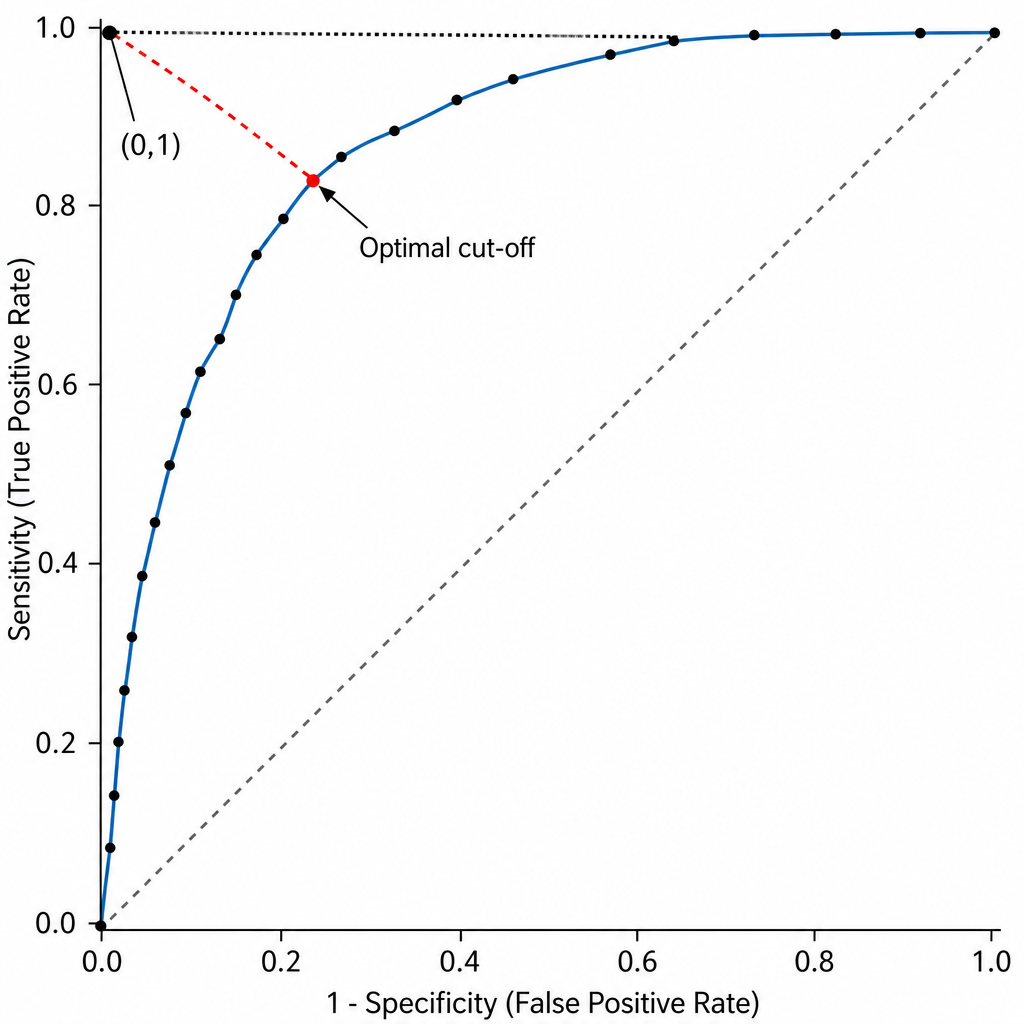
A clinician wants to select the single cut-off point on a diagnostic biomarker's ROC curve that minimizes the Euclidean distance to the upper-left corner (0,1), thereby simultaneously minimizing the false-negative rate and the false-positive rate. Which of the following best describes this optimal cut-off point selection criterion on the ROC curve?
A researcher wants to determine whether there is an association between CRP values and the risk of MI or cancer. Four relative risk (RR) values were plotted $(0.5,1.5,1.7,1.8)$ with respect to CRP levels. What conclusion can be drawn?
A researcher wants to study the carcinogenic effects of a food additive. From the literature, he finds that 7 different types of cancers have been linked to the consumption of this food additive. He wants to study all 7 possible outcomes. He conducts interviews with people who consume food containing these additives and people who do not. He then follows both groups for several years to see if they develop any of these 7 cancers or any other health outcomes. Which of the following study models best represents this study?
A 52-year-old man comes to the physician for a follow-up examination 1 year after an uncomplicated liver transplantation. He feels well but wants to know how long he can expect his donor graft to function. The physician informs him that the odds of graft survival are 90% at 1 year, 78% at 5 years, and 64% at 10 years. At this time, given that the graft has already survived 1 year, the probability of the patient's graft surviving to 10 years after transplantation is closest to which of the following?
Want unlimited practice?
Get full access to all questions, explanations, and performance tracking.
Scan to download app