
Follow-up methods — MCQs

A researcher is studying whether a new knee implant is better than existing alternatives in terms of pain after knee replacement. She designs the study so that it includes all the surgeries performed at a certain hospital. Interestingly, she notices that patients who underwent surgeries on Mondays and Thursdays reported much better pain outcomes on a survey compared with those who underwent the same surgeries from the same surgeons on Tuesdays and Fridays. Upon performing further analysis, she discovers that one of the staff members who works on Mondays and Thursdays is aware of the study and tells all the patients about how wonderful the new implant is. Which of the following forms of bias does this most likely represent?
A researcher is conducting a study to compare fracture risk in male patients above the age of 65 who received annual DEXA screening to peers who did not receive screening. He conducts a randomized controlled trial in 900 patients, with half of participants assigned to each experimental group. The researcher ultimately finds similar rates of fractures in the two groups. He then notices that he had forgotten to include 400 patients in his analysis. Including the additional participants in his analysis would most likely affect the study's results in which of the following ways?
An investigator is measuring the blood calcium level in a sample of female cross country runners and a control group of sedentary females. If she would like to compare the means of the two groups, which statistical test should she use?
An experimental new drug (SD27C) is being studied. This novel drug delivers insulin via the intranasal route. Consent is obtained from participants who are diabetic and are taking insulin as their current treatment regimen to participate in a clinical trial. 500 patients consent and are divided into 2 groups, and a double-blind clinical trial was conducted. One group received the new formulation (SD27C), while the second group received regular insulin via subcutaneous injection. The results showed that the treatment outcomes in both groups are the same. SD27C is currently under investigation in which phase of the clinical trial?
In the study, all participants who were enrolled and randomly assigned to treatment with pulmharkimab were analyzed in the pulmharkimab group regardless of medication nonadherence or refusal of allocated treatment. A medical student reading the abstract is confused about why some participants assigned to pulmharkimab who did not adhere to the regimen were still analyzed as part of the pulmharkimab group. Which of the following best reflects the purpose of such an analysis strategy?
A research group wants to assess the safety and toxicity profile of a new drug. A clinical trial is conducted with 20 volunteers to estimate the maximum tolerated dose and monitor the apparent toxicity of the drug. The study design is best described as which of the following phases of a clinical trial?
Study X examined the relationship between coffee consumption and lung cancer. The authors of Study X retrospectively reviewed patients' reported coffee consumption and found that drinking greater than 6 cups of coffee per day was associated with an increased risk of developing lung cancer. However, Study X was criticized by the authors of Study Y. Study Y showed that increased coffee consumption was associated with smoking. What type of bias affected Study X, and what study design is geared to reduce the chance of that bias?
A pharmaceutical corporation is developing a research study to evaluate a novel blood test to screen for breast cancer. They enrolled 800 patients in the study, half of which have breast cancer. The remaining enrolled patients are age-matched controls who do not have the disease. Of those in the diseased arm, 330 are found positive for the test. Of the patients in the control arm, only 30 are found positive. What is this test’s sensitivity?
A pharmaceutical company conducts a randomized clinical trial in an attempt to show that their new anticoagulant drug prevents more thrombotic events following total knee arthroplasty than the current standard of care. However, a significant number of patients are lost to follow-up or fail to complete treatment according to the study arm to which they were assigned. Several patients in the novel drug arm are also switched at a later time to a novel anticoagulant or warfarin per their primary care physician. All patients enrolled in the study are subsequently analyzed based on the initial group they were assigned to and there is a significant improvement in outcome of the new drug. What analysis most appropriately describes this trial?
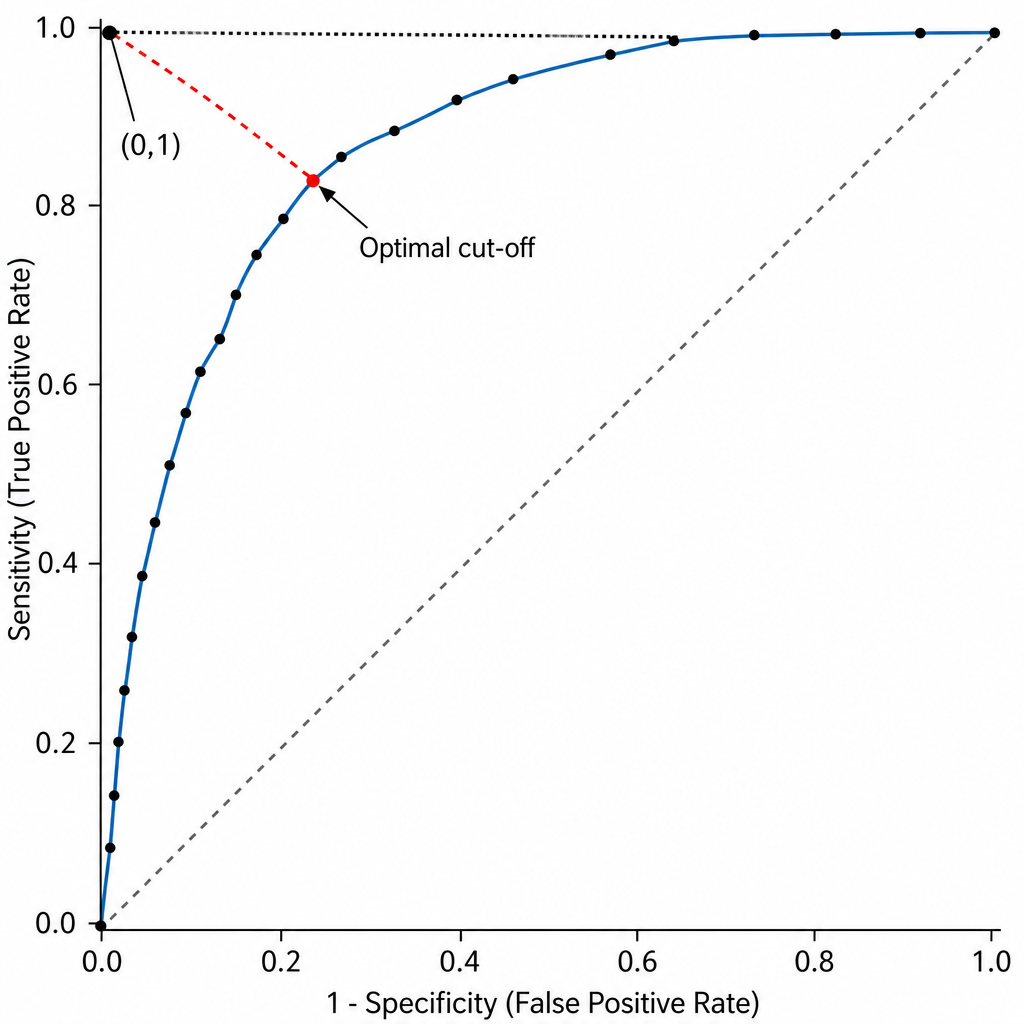
A clinician wants to select the single cut-off point on a diagnostic biomarker's ROC curve that minimizes the Euclidean distance to the upper-left corner (0,1), thereby simultaneously minimizing the false-negative rate and the false-positive rate. Which of the following best describes this optimal cut-off point selection criterion on the ROC curve?
Want unlimited practice?
Get full access to all questions, explanations, and performance tracking.
Scan to download app