
Competing risks — MCQs

Two separate investigators have conducted cohort studies to calculate the risk of lymphoma in rheumatoid arthritis patients taking anti-TNF alpha medications. They each followed patients with rheumatoid arthritis for a number of years and tracked the number of patients who were diagnosed with lymphoma. The results of the two studies are summarized in the table. Number of patients Follow-up period Number of new cases of lymphoma Study 1 3000 10 years 30 Study 2 300 30 years 9 Based on these results, which of the following statements about the risk of lymphoma is most accurate?
A 25-year-old man with a genetic disorder presents for genetic counseling because he is concerned about the risk that any children he has will have the same disease as himself. Specifically, since childhood he has had difficulty breathing requiring bronchodilators, inhaled corticosteroids, and chest physiotherapy. He has also had diarrhea and malabsorption requiring enzyme replacement therapy. If his wife comes from a population where 1 in 10,000 people are affected by this same disorder, which of the following best represents the likelihood a child would be affected as well?
A researcher is designing an experiment to examine the toxicity of a new chemotherapeutic agent in mice. She splits the mice into 2 groups, one of which she exposes to daily injections of the drug for 1 week. The other group is not exposed to any intervention. Both groups are otherwise raised in the same conditions with the same diet. One month later, she sacrifices the mice to check for dilated cardiomyopathy. In total, 52 mice were exposed to the drug, and 50 were not exposed. Out of the exposed group, 13 were found to have dilated cardiomyopathy on necropsy. In the unexposed group, 1 mouse was found to have dilated cardiomyopathy. Which of the following is the relative risk of developing cardiomyopathy with this drug?
A biostatistician is processing data for a large clinical trial she is working on. The study is analyzing the use of a novel pharmaceutical compound for the treatment of anorexia after chemotherapy with the outcome of interest being the change in weight while taking the drug. While most participants remained about the same weight or continued to lose weight while on chemotherapy, there were smaller groups of individuals who responded very positively to the orexic agent. As a result, the data had a strong positive skew. The biostatistician wishes to report the measures of central tendency for this project. Just by understanding the skew in the data, which of the following can be expected for this data set?
An epidemiologist is evaluating the efficacy of Noxbinle in preventing HCC deaths at the population level. A clinical trial shows that over 5 years, the mortality rate from HCC was 25% in the control group and 15% in patients treated with Noxbinle 100 mg daily. Based on this data, how many patients need to be treated with Noxbinle 100 mg to prevent, on average, one death from HCC?
You are currently employed as a clinical researcher working on clinical trials of a new drug to be used for the treatment of Parkinson's disease. Currently, you have already determined the safe clinical dose of the drug in a healthy patient. You are in the phase of drug development where the drug is studied in patients with the target disease to determine its efficacy. Which of the following phases is this new drug currently in?
A population is studied for risk factors associated with testicular cancer. Alcohol exposure, smoking, dietary factors, social support, and environmental exposure are all assessed. The researchers are interested in the incidence and prevalence of the disease in addition to other outcomes. Which pair of studies would best assess the 1. incidence and 2. prevalence?
Many large clinics have noticed that the prevalence of primary biliary cholangitis (PBC) has increased significantly over the past 20 years. An epidemiologist is working to identify possible reasons for this. After analyzing a series of nationwide health surveillance databases, the epidemiologist finds that the incidence of PBC has remained stable over the past 20 years. Which of the following is the most plausible explanation for the increased prevalence of PBC?
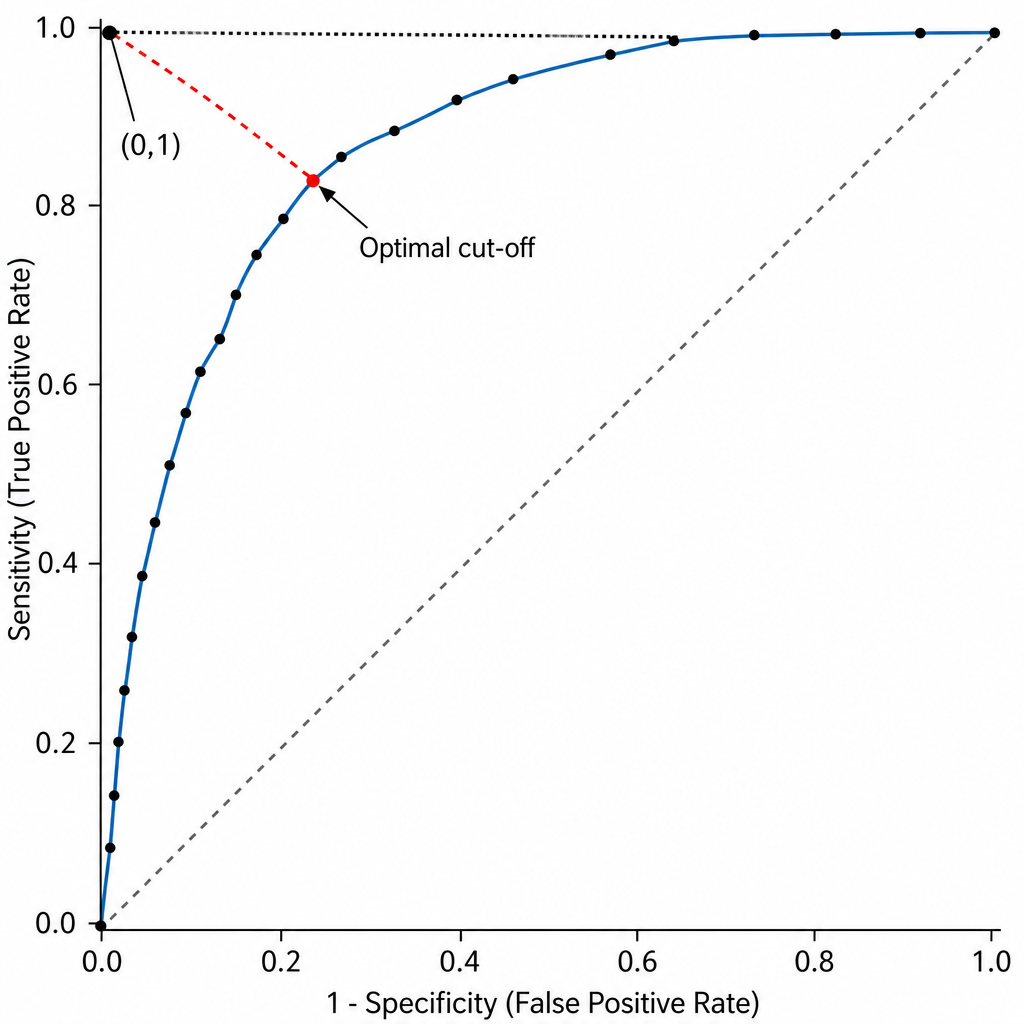
A clinician wants to select the single cut-off point on a diagnostic biomarker's ROC curve that minimizes the Euclidean distance to the upper-left corner (0,1), thereby simultaneously minimizing the false-negative rate and the false-positive rate. Which of the following best describes this optimal cut-off point selection criterion on the ROC curve?
A researcher wants to determine whether there is an association between CRP values and the risk of MI or cancer. Four relative risk (RR) values were plotted $(0.5,1.5,1.7,1.8)$ with respect to CRP levels. What conclusion can be drawn?
Want unlimited practice?
Get full access to all questions, explanations, and performance tracking.
Scan to download app