
Vitamin C (ascorbic acid) — MCQs

A 45-year-old man undergoes an esophagogastroduodenoscopy for his recurrent episodes of epigastric pain. He also lost a significant amount of weight in the last 6 months. He says that he has been taking a number of dietary supplements "to cope". His past medical history is insignificant, and a physical examination is within normal limits. The endoscopy shows a bleeding ulcer in the proximal duodenum. Lab tests reveal a serum iron level of 130 μg/dL. However, his stool guaiac test is negative for occult blood. Over-ingestion of which of the following substances is the most likely cause for this patient’s lab findings?
A 35-year-old woman presents to the clinic with a 2-week history of headaches. She was in her usual state of health until 2 weeks ago, when she started having headaches. The headaches are throughout her whole head and rated as a 7/10. They are worse in the mornings and when she bends over. She has some mild nausea, but no vomiting. The headaches are not throbbing and are not associated with photophobia or phonophobia. On further questioning, she has noticed more hair than usual on her pillow in the morning and coming out in her hands when she washes her hair. The past medical history is unremarkable; she takes no prescription medications, but for the past year she has been taking an oral 'health supplement' recommended by her sister, which she orders over the internet. She cannot recall the supplement's name and does not know its contents. The physical exam is notable for some mild hepatomegaly but is otherwise unremarkable. This patient's presentation is most likely related to which of the following micronutrients?
A 13-year-old girl is brought to the physician by her parents for the evaluation of progressive hair loss over the past 2 months. The parents report that they have noticed increased number of hairless patches on their daughter's head. The patient denies any itching. There is no personal or family history of serious illness. The patient states that she has been feeling tense since her boyfriend broke up with her. She does not smoke or drink alcohol. She does not use illicit drugs. Her vital signs are within normal limits. Physical examination shows ill-defined patchy hair loss and hair of different lengths with no scaling or reddening of the scalp. Further examination shows poor hair growth of the eyebrows and eyelashes. The remainder of the examination shows no abnormalities. Which of the following is the most likely diagnosis?
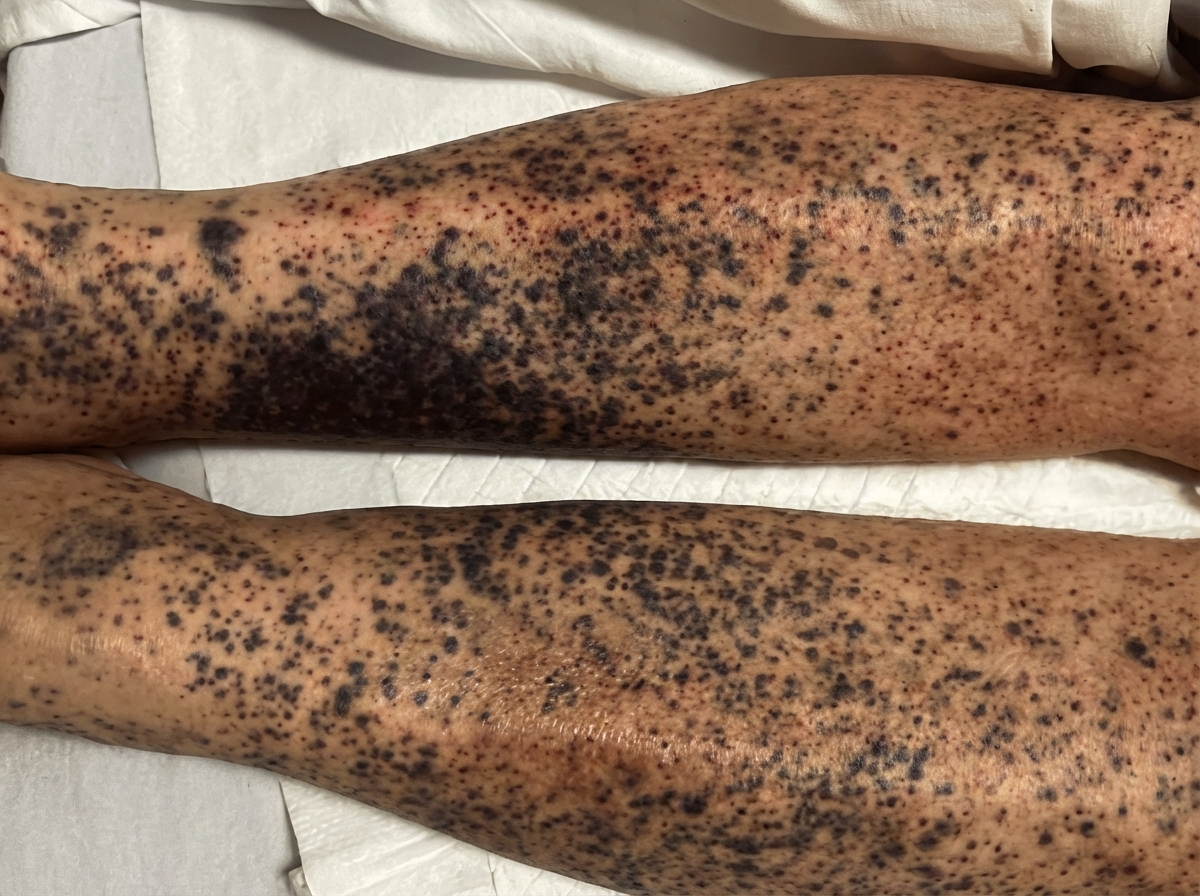
A 59-year-old man is brought to the emergency department with signs of spontaneous bruising of the lower legs. The patient has a history of alcohol use disorder and has been unemployed for the last 2 years. He reports a 1-year history of fatigue and joint pain. Physical examination of the patient’s legs reveals the findings illustrated in the image. Oral examination shows swollen gums, petechiae of the hard palate, and poor dentition. The most likely underlying cause of this patient's current findings involves which of the following metabolic deficiencies?
A 60-year-old male presents with fatigue, dyspnea on exertion, and lower extremity edema. Physical examination reveals an elevated jugular venous pressure and an S3 heart sound. Which of the following medications is most likely to improve this patient's symptoms?
A 35-year-old female presents to her primary care physician complaining of right upper quadrant pain over the last 6 months. Pain is worst after eating and feels like intermittent squeezing. She also admits to lighter colored stools and a feeling of itchiness on her skin. Physical exam demonstrates a positive Murphy's sign. The vitamin level least likely to be affected by this condition is associated with which of the following deficiency syndromes?
A homeless woman presents with shortness of breath on exertion and pedal edema. Cardiac workup performed shows evidence of dilated cardiomyopathy and increased cardiac output. She also has decreased sensation over both extremities bilaterally. Which vitamin deficiency most likely caused these symptoms?
A 38-year-old, working, first-time mother brings her 9-month-old male infant to the pediatrician for "wounds that simply won't heal" and bleeding gums. She exclaims, "I have been extra careful with him making sure to not let him get dirty, I boil his baby formula for 15 minutes each morning before I leave for work to give to the caregiver, and he has gotten all of his vaccinations." This infant is deficient in a molecule that is also an essential co-factor for which of the following reactions?
A 54-year-old man comes to the physician because of generalized fatigue and numbness of his legs and toes for 5 months. He has hypertension and hypercholesterolemia. He underwent a partial gastrectomy for peptic ulcer disease 15 years ago. Current medications include amlodipine and atorvastatin. He is a painter. His temperature is 37°C (98.6°F), pulse is 101/min, respirations are 17/min, and blood pressure is 122/82 mm Hg. Examination shows conjunctival pallor and glossitis. Sensation to vibration and position is absent over the lower extremities. He has a broad-based gait. The patient sways when he stands with his feet together and closes his eyes. His hemoglobin concentration is 10.1 g/dL, leukocyte count is 4300/mm3, and platelet count is 110,000/mm3. Which of the following laboratory findings is most likely to be seen in this patient?
A 25-year-old woman presents her physician with a complaint of feeling tired and low on energy for the past 6 months. She also has noticed she has been having trouble performing daily tasks and at times experiencing near-fainting spells. She has no recollection of similar instances in the past. Her past medical history is insignificant, except for the fact that she has been a strict vegan for the last 5 years. Her vital signs are stable. On physical examination, she is visibly pale and has decreased position and vibratory sensation in her both lower extremities. There is decreased lower limb reflexes with sensation intact. A complete blood count - done last week, - shows hemoglobin of 9.7 g/dL with an MCV of 110 fL. The serum levels of which of the following will most likely aid in the physician’s treatment plan?
Want unlimited practice?
Get full access to all questions, explanations, and performance tracking.
Scan to download app