
Urea cycle reactions and enzymes — MCQs

An investigator is studying a hereditary defect in the mitochondrial enzyme succinyl-CoA synthetase. In addition to succinate, the reaction catalyzed by this enzyme produces a molecule that is utilized as an energy source for protein translation. This molecule is also required for which of the following conversion reactions?
A 2-day-old male infant is brought to the emergency department by ambulance after his parents noticed that he was convulsing and unresponsive. He was born at home and appeared well initially; however, within 24 hours he became increasingly irritable and lethargic. Furthermore, he stopped feeding and began to experience worsening tachypnea. This continued for about 6 hours, at which point his parents noticed the convulsions and called for an ambulance. Laboratories are obtained with the following results: Orotic acid: 9.2 mmol/mol creatinine (normal: 1.4-5.3 mmol/mol creatinine) Ammonia: 135 µmol/L (normal: < 50 µmol/L) Citrulline: 2 µmol/L (normal: 10-45 µmol/L) Which of the following treatments would most likely be beneficial to this patient?
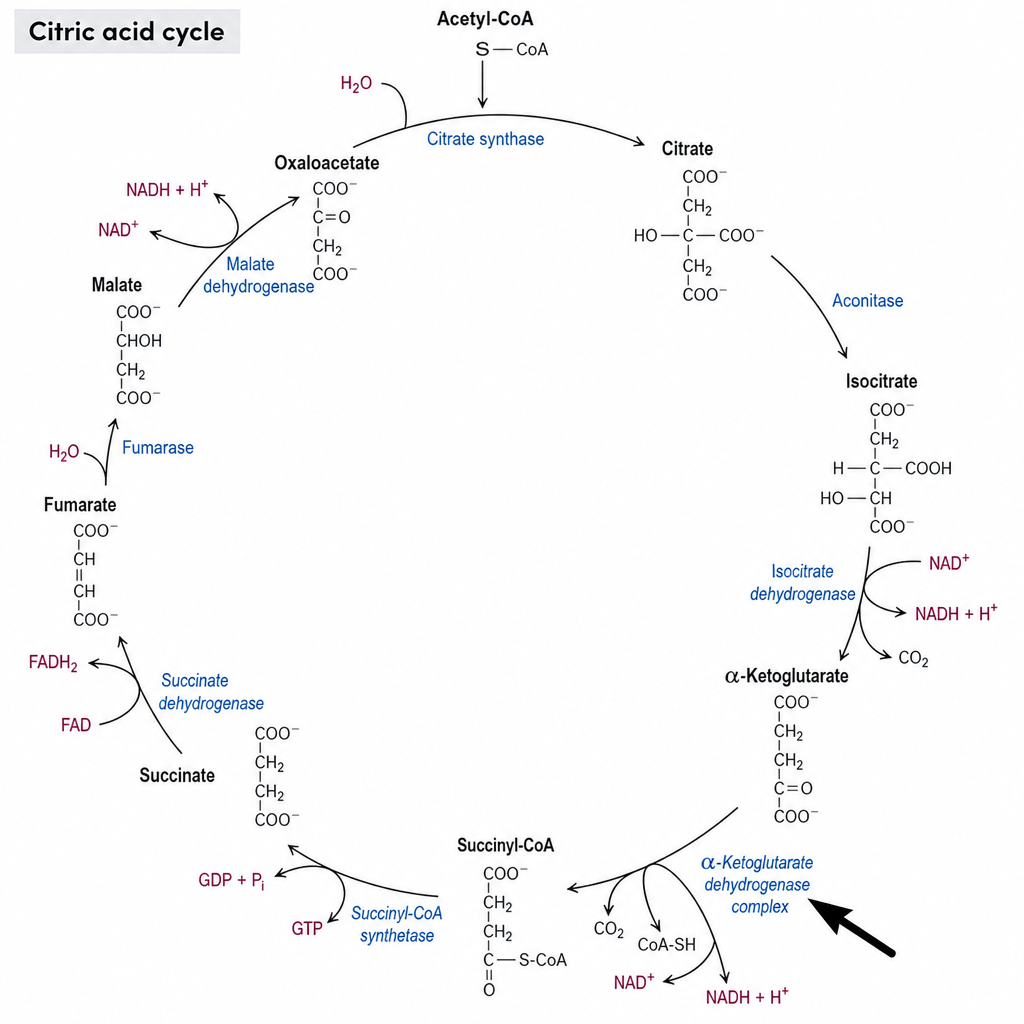
An investigator is studying the effect of extracellular pH changes on the substrates for the citric acid cycle. Which of the following substances is required for the reaction catalyzed by the enzyme marked by the arrow in the overview of the citric acid cycle?
A 2-week-old boy presents to the emergency department because of unusual irritability and lethargy. The patient is admitted to the pediatric intensive care unit and minutes later develops metabolic encephalopathy. This progressed to a coma, followed by death before any laboratory tests are completed. The infant was born at home via vaginal delivery at 39 weeks' of gestation. His mother says that the symptoms started since the infant was 4-days-old, but since he only seemed ‘tired’, she decided not to seek medical attention. Further testing during autopsy shows hyperammonemia, low citrulline, and increased orotic acid. Which of the following enzymes is most likely deficient in this patient?
A 4-year-old girl is brought to the physician by her mother because of fatigue and generalized weakness for 4 months. Examination shows decreased muscle tone. Her fasting serum glucose concentration is 41 mg/dL. The physician suspects a defect in one of the enzymes involved in the carnitine shuttle. Increased serum concentration of which of the following should most raise suspicion of a different diagnosis?
A 20-year-old male presents with confusion, asterixis, and odd behavior. Very early in the morning, his mother found him urinating on the floor of his bedroom. A detailed history taken from the mother revealed that he has been a vegetarian his entire life but decided to "bulk up" by working out and consuming whey protein several times a day. A blood test revealed increased levels of ammonia and orotic acid but a decreased BUN. The patient began hemodialysis and was given oral sodium benzoate and phenylbutyrate, which improved his condition. This patient's condition would be corrected by gene therapy targeting the enzyme that produces which of the following?
A 4-day-old boy is brought to the physician because of somnolence, poor feeding, and vomiting after his first few breast feedings. He appears lethargic. His respiratory rate is 73/min. Serum ammonia is markedly increased. Genetic analysis shows deficiency in N-acetylglutamate synthase. The activity of which of the following enzymes is most likely directly affected by this genetic defect?
A 2-day-old male is seen in the newborn nursery for repeated emesis and lethargy. He was born at 39 weeks to a 24-year-old mother following an uncomplicated pregnancy and birth. He has been breastfeeding every 2 hours and has 10 wet diapers per day. His father has a history of beta-thalassemia minor. Laboratory results are as follows: Hemoglobin: 12 g/dL Platelet count: 200,000/mm³ Mean corpuscular volume: 95 µm³ Reticulocyte count: 0.5% Leukocyte count: 5,000/mm³ with normal differential Serum: Na+: 134 mEq/L Cl-: 100 mEq/L K+: 3.3 mEq/L HCO3-: 24 mEq/L Urea nitrogen: 1 mg/dL Creatinine: 0.6 mg/dL Ammonia: 150 µmol/L (normal: 50-80 µmol/L) Which of the following is the most likely diagnosis?
A 4-day-old male newborn delivered at 39 weeks' gestation is evaluated because of poor feeding, recurrent vomiting, and lethargy. Physical examination shows tachypnea with subcostal retractions. An enzyme assay performed on a liver biopsy specimen shows decreased activity of carbamoyl phosphate synthetase I. This enzyme plays an important role in the breakdown and excretion of amino groups that result from protein digestion. Which of the following is an immediate substrate for the synthesis of the molecule needed for the excretion of amino groups?
A 26-year-old African American man comes to the physician because of a 3-day history of fatigue, back pain, and dark urine. One week ago, he developed a headache and was treated with aspirin. He does not smoke or use illicit drugs. Physical examination shows conjunctival pallor. A peripheral blood smear shows erythrocytes with inclusions of denatured hemoglobin. Which of the following enzymes is involved in providing precursors for nucleotide synthesis in this patient?
Want unlimited practice?
Get full access to all questions, explanations, and performance tracking.
Scan to download app