
Promoters and transcription factors — MCQs

A 33-year-old woman comes to the physician 1 week after noticing a lump in her right breast. Fifteen years ago, she was diagnosed with osteosarcoma of her left distal femur. Her father died of an adrenocortical carcinoma at the age of 41 years. Examination shows a 2-cm, firm, immobile mass in the lower outer quadrant of the right breast. A core needle biopsy of the mass shows adenocarcinoma. Genetic analysis in this patient is most likely to show a defect in which of the following genes?
A 25-year-old female comes to the clinic complaining of fatigue and palpitations. She has been undergoing immense stress from her thesis defense and has been extremely tired. The patient denies any weight loss, diarrhea, cold/heat intolerance. TSH was within normal limits. She reports a family history of "blood disease" and was later confirmed positive for β-thalassemia minor. It is believed that abnormal splicing of the beta globin gene results in β-thalassemia. What is removed during this process that allows RNA to be significantly shorter than DNA?
An investigator studying protein synthesis in human stem cells isolates tRNA molecules bound to mRNA molecules. The isolated tRNA molecules have inosine in the 5' position of the anticodon; of these, some are bound to adenine, some to cytosine, and some to uracil at the 3' position of the mRNA codon. Which of the following properties of the genetic code is best illustrated by this finding?
A clinical trial is being run with patients that have a genetic condition characterized by abnormal hemoglobin that can undergo polymerization when exposed to hypoxia, acidosis, or dehydration. This process of polymerization is responsible for the distortion of the red blood cell (RBC) that acquires a crescent shape and the hemolysis of RBCs. Researchers are studying the mechanisms of the complications commonly observed in these patients such as stroke, aplastic crisis, and auto-splenectomy. What kind of mutation leads to the development of the disease?
A mutant stem cell was created by using an inducible RNAi system, such that when doxycycline is added, the siRNA targeting DNA helicase is expressed, effectively knocking down the gene for DNA helicase. Which of the following will occur during DNA replication?
An investigator is studying the rate of multiplication of hepatitis C virus in hepatocytes. The viral genomic material is isolated, enzymatically cleaved into smaller fragments and then separated on a formaldehyde agarose gel membrane. Targeted probes are then applied to the gel and visualized under x-ray. Which of the following is the most likely structure being identified by this test?
A 24-year-old male presents to the emergency room with a cough and shortness of breath for the past 3 weeks. You diagnose Pneumocystis jiroveci pneumonia (PCP). An assay of the patient's serum reveals the presence of viral protein p24. Which of the following viral genes codes for this protein?
The lac operon allows E. coli to effectively utilize lactose when it is available, and not to produce unnecessary proteins. Which of the following genes is constitutively expressed and results in the repression of the lac operon?
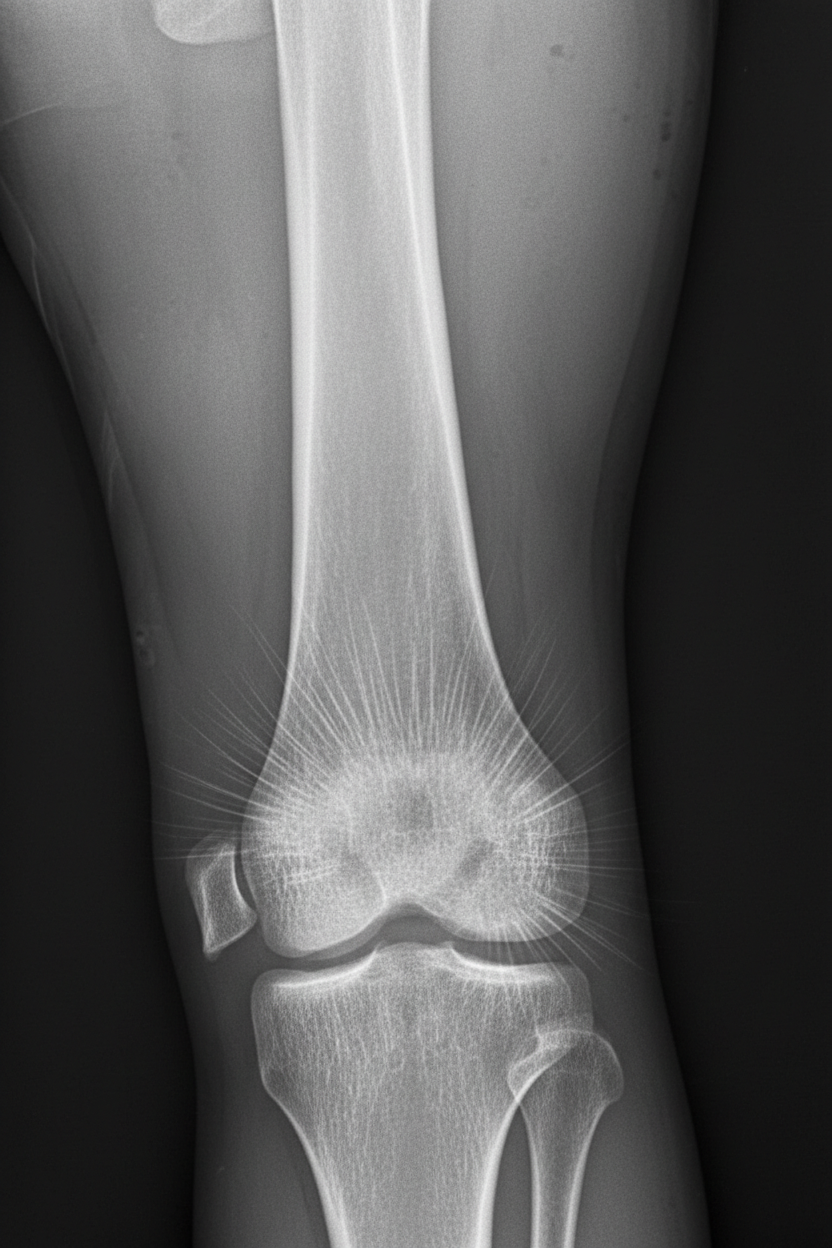
A 13-year-old boy is brought to his pediatrician for evaluation of leg pain. Specifically, he has been having pain around his right knee that has gotten progressively worse over the last several months. On presentation, he has swelling and tenderness over his right distal femur. Radiographs are obtained and the results are shown in figure A. His family history is significant in that several family members also had this disorder and others had pathology in the eye near birth. The patient is referred for a genetic consult, and a mutation is found on a certain chromosome. The chromosome that is most likely affected also contains a gene that is associated with which of the following pathologies?
An investigator is studying the effects of zinc deprivation on cancer cell proliferation. It is hypothesized that because zinc is known to be a component of transcription factor motifs, zinc deprivation will result in slower tumor growth. To test this hypothesis, tumor cells are cultured on media containing low and high concentrations of zinc. During the experiment, a labeled oligonucleotide probe is used to identify the presence of a known transcription factor. The investigator most likely used which of the following laboratory techniques?
Want unlimited practice?
Get full access to all questions, explanations, and performance tracking.
Scan to download app