
MAP kinase pathways — MCQs

A 38-year-old man presents with concerns after finding out that his father was recently diagnosed with colon cancer. Family history is only significant for his paternal grandfather who also had colon cancer. A screening colonoscopy is performed, and a polyp is found in the ascending (proximal) colon, which on biopsy shows adenocarcinoma. A mutation in a gene that is responsible for which of the following cellular functions is the most likely etiology of this patient’s cancer?
A 62-year-old woman comes to the physician for evaluation of a mole on her forearm that has increased in size over the last several months. Physical examination shows a 9-mm skin lesion on the right forearm with irregular borders. An excisional biopsy is performed, and genetic analysis shows a mutation in the gene that encodes B-Raf. Which of the following cellular events most likely predisposed this patient to developing this skin lesion?
A 28-year-old patient presents to a medical office for a consultation regarding a mole on her nose that is increasing in size. She also complains of frequent headaches, which she associates with stress on the job. She works as a civil engineer and spends much of her time outside. Her past medical history is positive for bronchial asthma; nevertheless, her vitals are stable. The mole is 8 mm in diameter, has irregular borders, and is brown in color. A biopsy is performed and sent for genetic analysis. A mutation is found. A mutation in which gene is characteristic of this patient’s main diagnosis?
A 55-year-old man with a history of sun exposure presents with a slowly growing, pearly nodule with telangiectasias on his nose. The lesion occasionally bleeds when traumatized. Biopsy shows basaloid cells arranged in palisading patterns. Which of the following mutations is most likely involved in the pathogenesis?
A 16-year-old boy is brought to the physician because of a lesion that has been growing on his jaw over the past several months. He recently immigrated to the USA from Kenya with his family. Physical examination shows a 3-cm solid mass located above the left mandible. There is cervical lymphadenopathy. Biopsy of the mass shows sheets of lymphocytes and interspersed reactive histiocytes with abundant, clear cytoplasm and phagocytosed debris. Which of the following mechanisms is most likely directly responsible for the malignant transformation of this patient's cells?
A 51-year-old woman comes to the physician because of a persistent cough and a 5-kg (11-lb) weight loss over the past 2 months. Yesterday, she coughed up bloody sputum. She does not smoke. Pulmonary examination shows decreased breath sounds over the right upper lobe. A CT scan of the chest shows a mass in the periphery of the right upper lobe. Histopathologic examination of a specimen obtained on CT-guided biopsy shows glandular cells with papillary components and signet ring cells that stain positive for mucin. An alteration in which of the following genes is most likely to have occurred in this patient?
A 13-year-old boy is brought to his pediatrician for evaluation of leg pain. Specifically, he has been having pain around his right knee that has gotten progressively worse over the last several months. On presentation, he has swelling and tenderness over his right distal femur. Radiographs are obtained and the results are shown in figure A. His family history is significant in that several family members also had this disorder and others had pathology in the eye near birth. The patient is referred for a genetic consult, and a mutation is found on a certain chromosome. The chromosome that is most likely affected also contains a gene that is associated with which of the following pathologies?
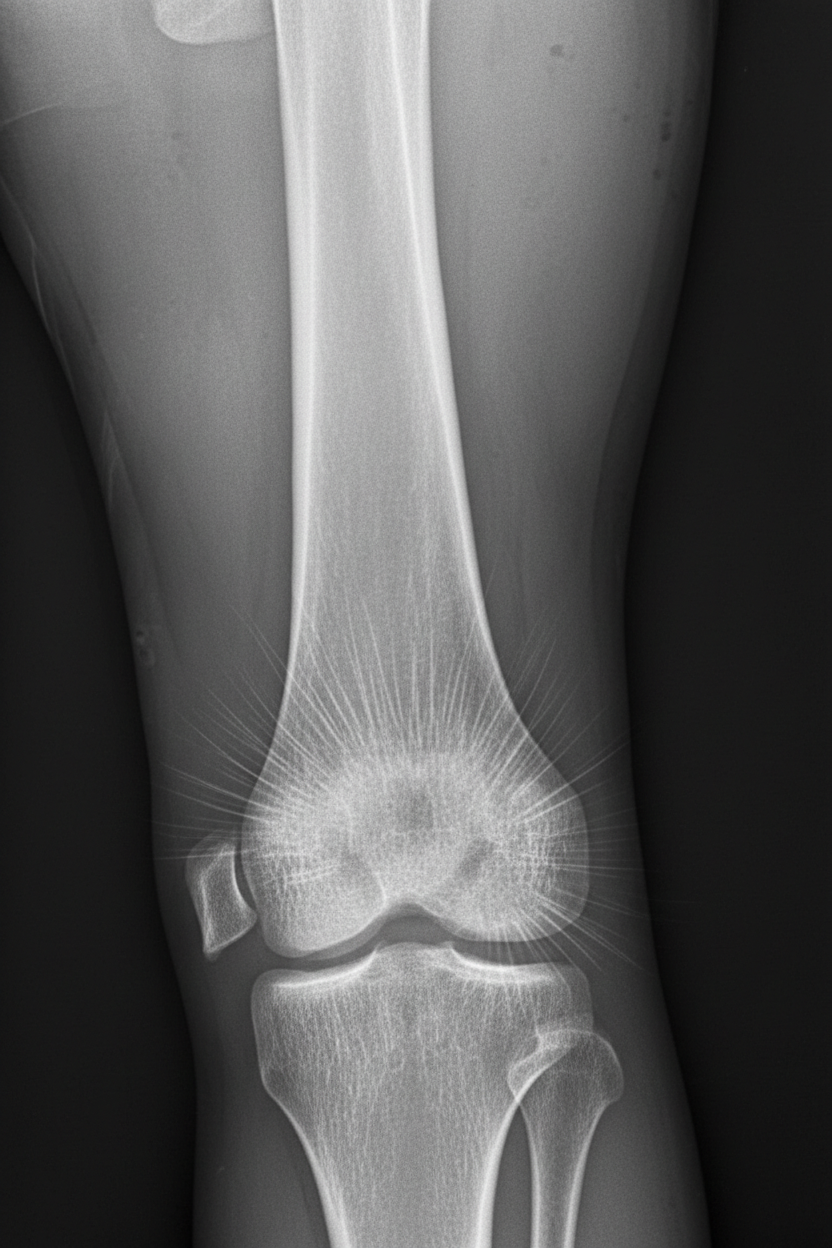
A 28-year-old man is brought in by ambulance to the ER, barely conscious, after feeling drowsy and falling to the floor during a presentation several hours ago. His colleague who accompanied him says he has had similar episodes 5 times in the past 3 months. No significant past medical history. His blood pressure is 110/80 mm Hg and pulse is 114/min. His capillary blood glucose is 15 mg/dL. Immediate IV dextrose with thiamine is started, and he rapidly regains consciousness. A contrast CT of the abdomen is performed which reveals a tumor in the pancreas. Which of the following relative laboratory findings would you most likely expect to find in this patient?
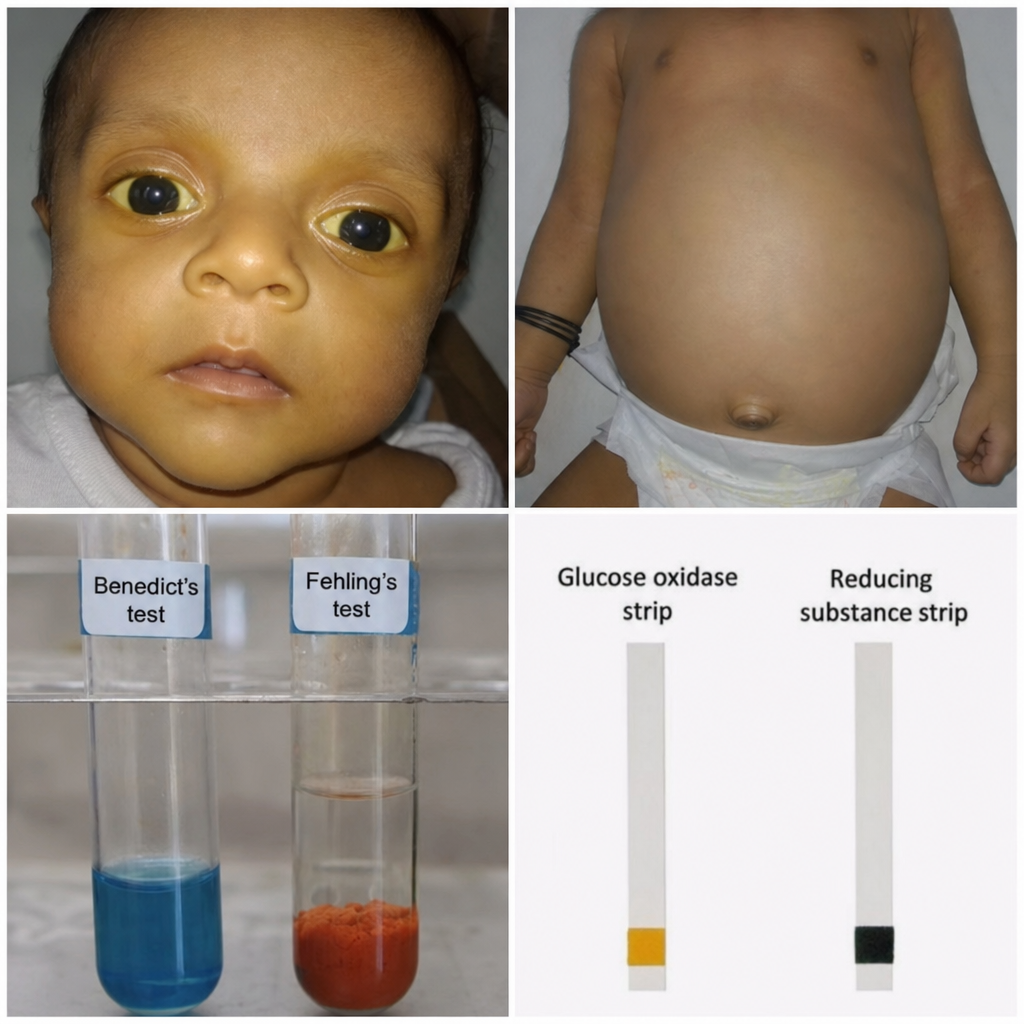
A 6-week-old infant presents with vomiting, jaundice, hepatomegaly, and cataracts. Urine reducing substances are positive, but glucose oxidase strip is negative. The infant is being breastfed. Red blood cell galactose-1-phosphate levels are markedly elevated. Based on the biochemical findings, which enzyme is most likely deficient?
A research team discovers a novel bacterial toxin that causes severe hypotension in infected patients. In vitro studies show the toxin ADP-ribosylates a specific amino acid on Gq alpha subunits, preventing their activation by GPCRs. Patients develop hypotension despite elevated levels of vasopressin, angiotensin II, and endothelin-1. Synthesize the pathophysiological mechanism explaining why multiple vasopressor hormones fail to maintain blood pressure in these patients.
Want unlimited practice?
Get full access to all questions, explanations, and performance tracking.
Scan to download app