
Mendelian inheritance patterns — MCQs

A 25-year-old man with a genetic disorder presents for genetic counseling because he is concerned about the risk that any children he has will have the same disease as himself. Specifically, since childhood he has had difficulty breathing requiring bronchodilators, inhaled corticosteroids, and chest physiotherapy. He has also had diarrhea and malabsorption requiring enzyme replacement therapy. If his wife comes from a population where 1 in 10,000 people are affected by this same disorder, which of the following best represents the likelihood a child would be affected as well?
A healthy 30-year-old woman comes to the physician with her husband for preconception counseling. Her husband is healthy but she is concerned because her brother was recently diagnosed with a genetic liver condition for which he takes penicillamine. Her father-in-law has liver cirrhosis and a tremor. The results of genetic testing show that both the patient and her husband are carriers of a mutation in the ATP7B gene. Which of the following is the chance that this patient’s offspring will eventually develop the hereditary condition?
A 16-year-old boy is brought to the emergency department after losing consciousness. He had no preceding chest pain or palpitations. His father has cataracts and had frontal balding in his twenties but has no history of cardiac disease. His paternal grandfather also had early-onset balding. His pulse is 43/min. Physical examination shows frontal hair loss, temporal muscle wasting, and testicular atrophy. Neurologic examination shows bilateral foot drop and weakness of the intrinsic hand muscles. An ECG shows bradycardia with third-degree atrioventricular block. The severity of this patient's symptoms compared to that of his father is most likely due to which of the following genetic properties?
A 34-year-old woman, gravida 1, para 0, at 18 weeks' gestation, comes to the physician for a prenatal visit. She recently read about a genetic disorder that manifests with gait ataxia, kyphoscoliosis, and arrhythmia and is concerned about the possibility of her child inheriting the disease. There is no personal or family history of this disorder. The frequency of unaffected carriers in the general population is 1/100. Assuming the population is in a steady state without selection, what is the probability that her child will develop this disease?
A 23-year-old woman and her husband come to a genetic counselor because she is concerned about the chance of having an inherited defect if they had a child. Family history reveals no significant family history in her husband; however, her sister had a son who has seizures, failure to thrive, and neurodegeneration. She does not remember the name of the disease but remembers that her nephew had sparse, brittle hair that kinked in odd directions. She does not think that any other members of her family including her sister's husband have had this disorder. If this couple had a son, what is the most likely chance that he would have the same disorder that affected the patient's nephew?
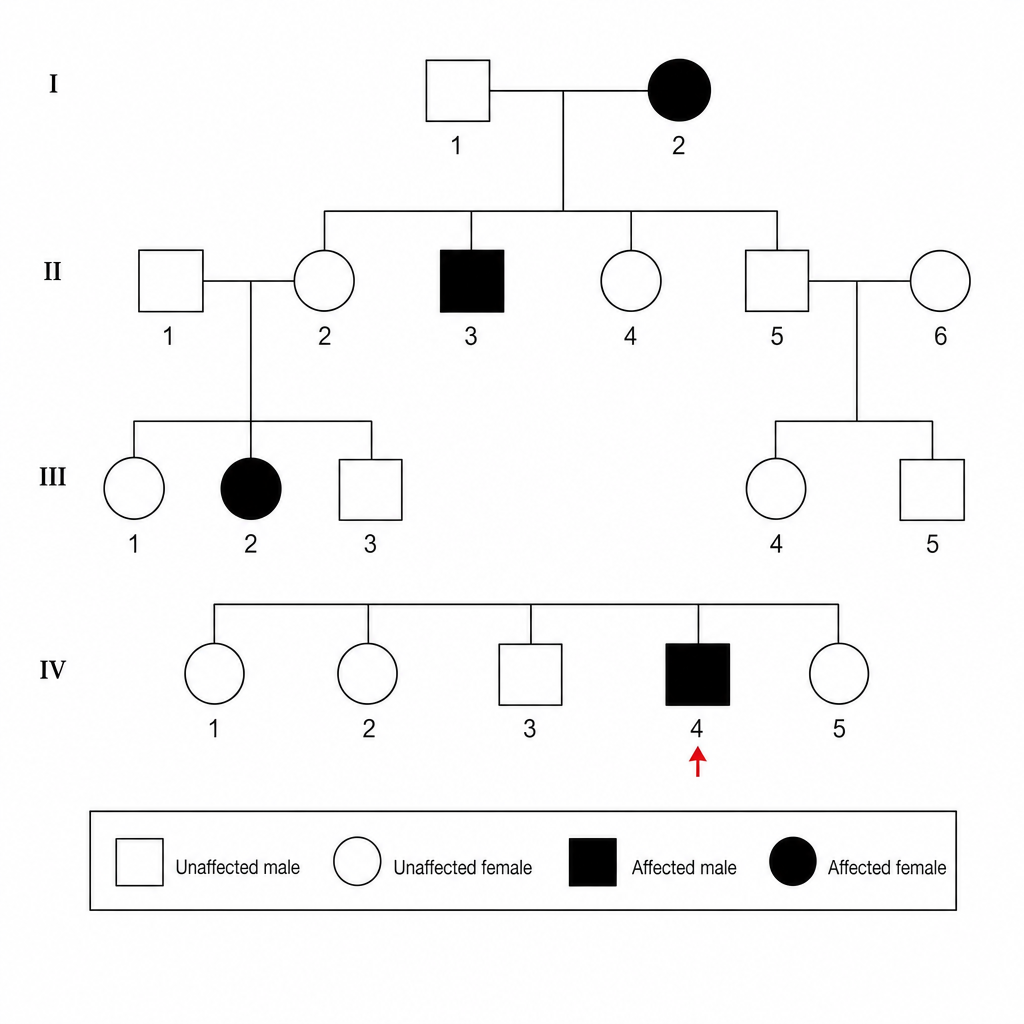
A 4-year-old boy is brought to the physician by his mother for a well-child examination. At the visit, the mother says that she is worried about the child's vision because of an “eye condition that runs in the family.” She says that the child is doing well in all activities at his preschool, except one in which he is required to sort different colored balls into baskets of a corresponding color. A pedigree chart of the family, with the patient identified by a red arrow, is shown. The most likely cause of these changes in the patient's vision involves which of the following modes of inheritance?
A 9-month-old female infant is brought in by her mother to the pediatrician because she is concerned that her daughter is not growing normally. On physical exam, the head circumference is 95th percentile and the height is 5th percentile. The child has disproportionate growth such that both the upper and lower extremities show a rhizomelic pattern of shortening, but the axial skeleton appears to be normal. The child appears to have normal intelligence, but has delayed motor milestones; specifically, she is not able to roll or sit up by herself. Which of the following best describes the mode of inheritance for this disorder?
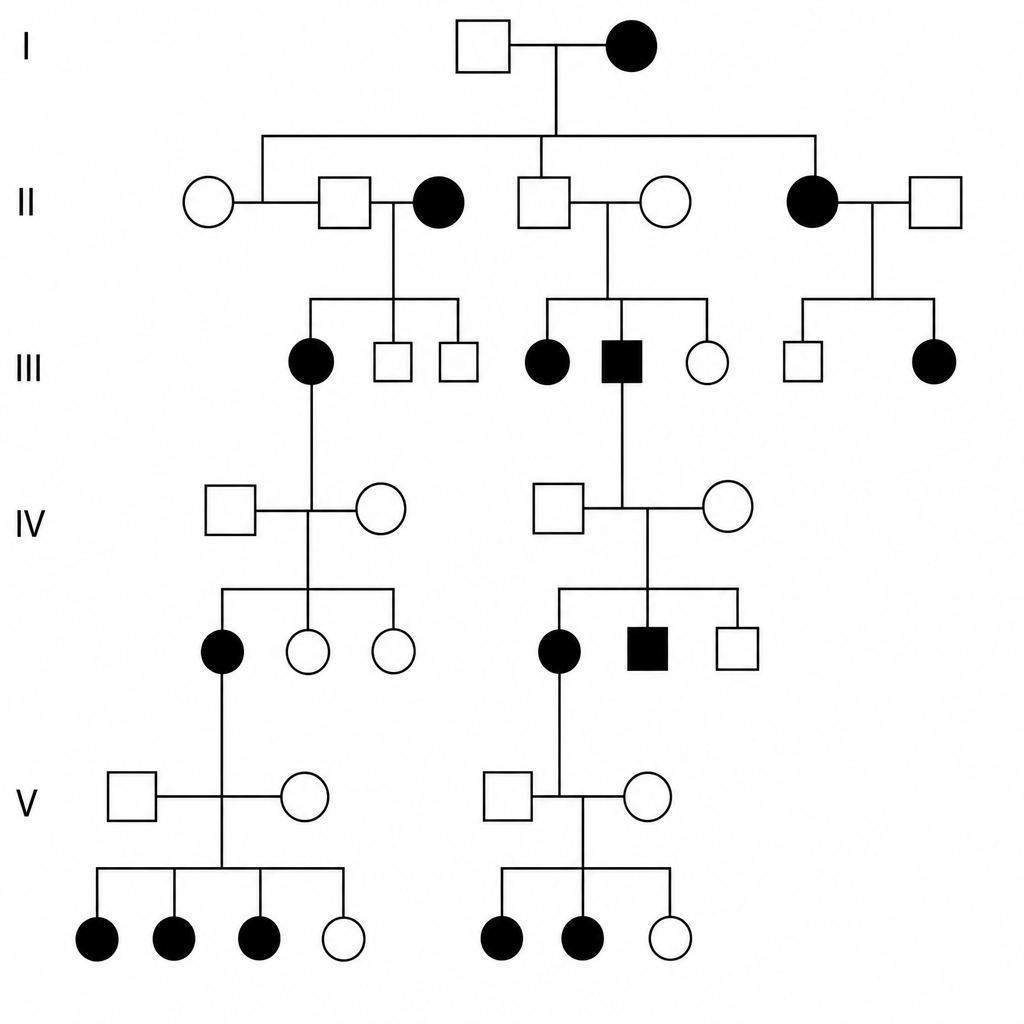
Given the pattern of inheritance shown in the pedigree, where might you find the disease gene in question?
A 1-year-old male with a history of recurrent pseudomonal respiratory infections and steatorrhea presents to the pediatrician for a sweat test. The results demonstrate a chloride concentration of 70 mEq/L (nl < 40 mEq/L). Which of the following defects has a similar AUTOSOMAL RECESSIVE mode of inheritance as the disorder experienced by this patient?
A Caucasian 32-year-old woman has an uncomplicated vaginal delivery, giving birth to male and female fraternal twins at term. At 2 days of life, the twin sister develops abdominal distension without emesis, and the mother states that she has not noticed the passage of stool for this infant. Genetic testing identifies deletion of an amino acid in a membrane channel for the girl. Both parents are healthy. Assuming that twin brother's disease status/symptomatology is unclear, which of the following best approximates the probability that the twin brother is a carrier of the disease allele?
Want unlimited practice?
Get full access to all questions, explanations, and performance tracking.
Scan to download app