
Amino acid metabolism — MCQs

An 8-day-old boy is brought to the physician by his mother because of vomiting and poor feeding. The pregnancy was uncomplicated, and he was born at full term. He appears pale and lethargic. Physical examination shows diffusely increased muscle tone. His urine is noted to have a sweet odor. This patient's symptoms are most likely caused by the accumulation of which of the following?
A 36-year-old woman comes to the physician because of prolonged stiffness in the morning and progressive pain and swelling of her wrists and hands over the past 4 months. Examination shows bilateral swelling and mild tenderness of the wrists and the second, third, and fourth metacarpophalangeal joints. Her range of motion is limited by pain. Serum studies show elevated anti-cyclic citrullinated peptide antibodies. Treatment with methotrexate is begun. At a follow-up examination, her serum aspartate aminotransferase (AST) concentration is 75 U/L and her serum alanine aminotransferase (ALT) concentration is 81 U/L. Which of the following substances is essential for the function of these enzymes?
A 30-year-old African American G1P0 mother gives birth to a male infant at 33 weeks' gestation. The mother had no prenatal care and took no prenatal vitamins. The child’s postnatal period was complicated by neonatal sepsis due to group B Streptococcus. He required a two week stay in the neonatal intensive care unit to receive antibiotics, cardiopulmonary support, and intravenous nutrition. He eventually recovered and was discharged. At a normal follow-up visit to the pediatrician’s office one month later, the mother asks about the child’s skin color and hair color. On examination, the child has white hair and diffusely pale skin. The child’s irises appear translucent. Further questioning of the mother reveals that there is a distant family history of blindness. This child most likely has a defect in an enzyme involved in the metabolism of which of the following molecules?
A 2-year-old boy is brought to the emergency department by his mother 30 minutes after having a generalized tonic-clonic seizure. He was born at home and has not attended any well-child visits. He is not yet able to walk and does not use recognizable words. His paternal uncle has a severe intellectual disability and has been living in an assisted-living facility all of his life. The boy's urine phenylacetate level is markedly elevated. Which of the following amino acids is most likely nutritionally essential for this patient because of his underlying condition?
A 4-day-old male newborn delivered at 39 weeks' gestation is evaluated because of poor feeding, recurrent vomiting, and lethargy. Physical examination shows tachypnea with subcostal retractions. An enzyme assay performed on a liver biopsy specimen shows decreased activity of carbamoyl phosphate synthetase I. This enzyme plays an important role in the breakdown and excretion of amino groups that result from protein digestion. Which of the following is an immediate substrate for the synthesis of the molecule needed for the excretion of amino groups?
A 2-day-old male infant is brought to the emergency department by ambulance after his parents noticed that he was convulsing and unresponsive. He was born at home and appeared well initially; however, within 24 hours he became increasingly irritable and lethargic. Furthermore, he stopped feeding and began to experience worsening tachypnea. This continued for about 6 hours, at which point his parents noticed the convulsions and called for an ambulance. Laboratories are obtained with the following results: Orotic acid: 9.2 mmol/mol creatinine (normal: 1.4-5.3 mmol/mol creatinine) Ammonia: 135 µmol/L (normal: < 50 µmol/L) Citrulline: 2 µmol/L (normal: 10-45 µmol/L) Which of the following treatments would most likely be beneficial to this patient?
A 29-year-old female presents to the family physician concerned over the blue-black discoloration of her sclera and skin. She notes that at the end of her day, there are black stains in her underwear. The incomplete breakdown of which of the following amino acids is responsible for this presentation?
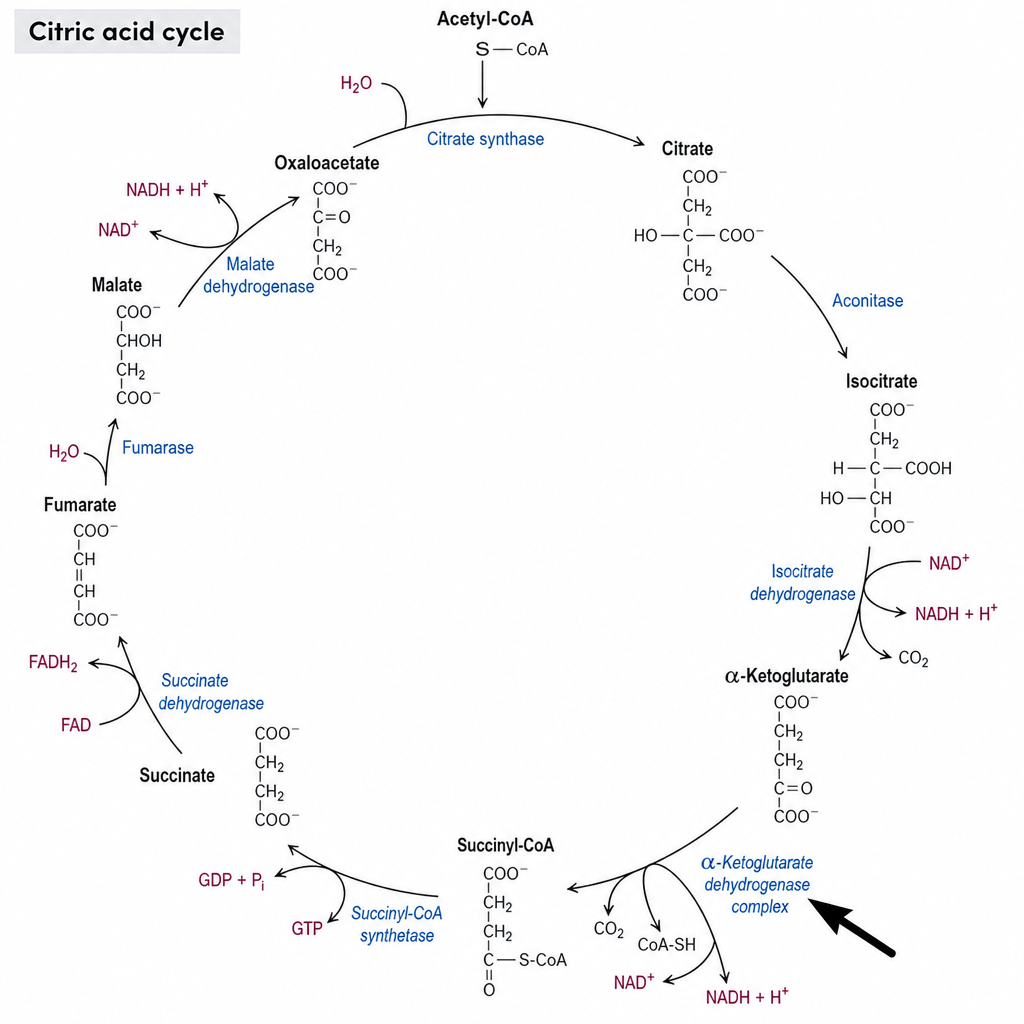
An investigator is studying the effect of extracellular pH changes on the substrates for the citric acid cycle. Which of the following substances is required for the reaction catalyzed by the enzyme marked by the arrow in the overview of the citric acid cycle?
On a medical trip to Nicaragua, you observe a sweet odor in the cerumen of a 12-hour-old female newborn. Within 48 hours, the newborn develops ketonuria, poor feeding, and a sweet odor is also noticed in the urine. By 96 hours, the newborn is extremely lethargic and opisthotonus is observed. In order to prevent a coma and subsequent death, which of the following amino acids is one of those that should be withheld from this newborn's diet?
A 4-day-old boy is brought to the physician because of somnolence, poor feeding, and vomiting after his first few breast feedings. He appears lethargic. His respiratory rate is 73/min. Serum ammonia is markedly increased. Genetic analysis shows deficiency in N-acetylglutamate synthase. The activity of which of the following enzymes is most likely directly affected by this genetic defect?
Want unlimited practice?
Get full access to all questions, explanations, and performance tracking.
Scan to download app