
Glycoproteinoses — MCQs

An 18-month-old girl is brought to the pediatrician’s office for failure to thrive and developmental delay. The patient’s mother says she has not started speaking and is just now starting to pull herself up to standing position. Furthermore, her movement appears to be restricted. Physical examination reveals coarse facial features and restricted joint mobility. Laboratory studies show increased plasma levels of several enzymes. Which of the following is the underlying biochemical defect in this patient?
A 15-year-old boy is sent from gym class with a chief complaint of severe muscle aches. In class today he was competing with his friends and therefore engaged in weightlifting for the first time. A few hours later he was extremely sore and found that his urine was red when he went to urinate. This concerned him and he was sent to the emergency department for evaluation. Upon further questioning, you learn that since childhood he has always had muscle cramps with exercise. Physical exam was unremarkable. Upon testing, his creatine kinase level was elevated and his urinalysis was negative for blood and positive for myoglobin. Thinking back to biochemistry you suspect that he may be suffering from a hereditary glycogen disorder. Given this suspicion, what would you expect to find upon examination of his cells?
A 47-year-old woman presents to her primary care physician because of pain on urination, urinary urgency, and urinary frequency for 4 days. This is the third time for her to have these symptoms over the past 7 months. She was recently treated for candidal intertrigo. Vital signs reveal a temperature of 36.7°C (98.0°F), blood pressure of 110/70 mm Hg and pulse of 75/min. Physical examination is unremarkable except for morbid obesity. Her father has type 2 diabetes complicated by end-stage chronic kidney disease. A1C is found to be 8.5%. The patient is given a prescription for her urinary symptoms. Which of the following is the best next step for this patient?
An 8-month-old female infant from a first-degree consanguineous couple was brought to the physician because the mother noticed abnormalities in the growth of her child as well as the different lengths of her child's legs. The infant had gingival hyperplasia, restricted movement in both shoulders, a prominent, pointed forehead, and enophthalmos with a slight opacity in both corneas. A blood test revealed 10 fold higher than normal levels of the following enzymes: N-acetyl-ß-glucosaminidase, ß-glucuronidase, ß-hexosaminidase A, and alkaline phosphatase. Which of the following is most likely deficient in this patient?
A 5-month-old boy presents with increasing weakness for the past 3 months. The patient’s mother says that the weakness is accompanied by dizziness, sweating, and vertigo early in the morning. Physical examination shows hepatomegaly. Laboratory findings show an increased amount of lactate, uric acid, and elevated triglyceride levels. Which of the following enzymes is most likely deficient in this patient?
A 12-year-old boy is brought to the physician for a well-child examination. He feels well. He has no history of serious illness. He has received all age-appropriate screenings and immunizations. His 7-year-old brother was treated for nephrotic syndrome 1 year ago. He is at 50th percentile for height and 60th percentile for weight. His temperature is 37°C (98.6°F), pulse is 90/min, and blood pressure is 96/54 mm Hg. Physical examination shows no abnormalities. Urine dipstick shows 1+ protein. A subsequent urinalysis of an early morning sample shows: Blood negative Glucose negative Protein trace Leukocyte esterase negative Nitrite negative RBC none WBC 0–1/hpf Protein/creatinine ratio 0.2 (N ≤ 0.2) Which of the following is the most appropriate next step in management?
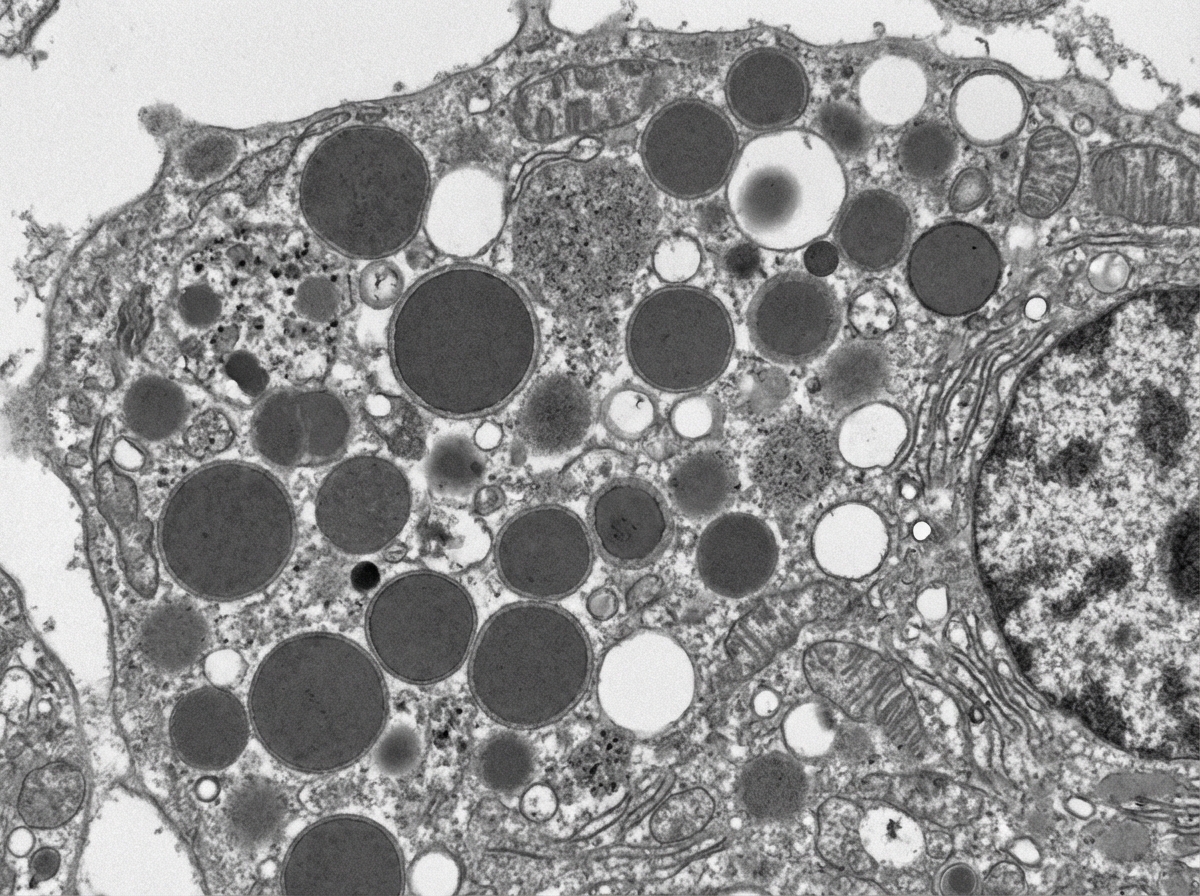
A 3-month-old boy presents for routine health maintenance. The patient has coarse facial features and stiff joint movements with restricted passive and active range of motion. He also has problems following objects with his eyes and seems not to focus on anything. On physical examination, the corneas are clouded, and the patient fails to meet any 3-month developmental milestones. Genetic testing and histopathology are performed and reveal failure of a cellular structure to phosphorylate mannose residues on glycoproteins. An electron microscopy image of one of this patient’s cells is shown. Which of the following is the most likely diagnosis in this patient?
A 9-month-old girl is brought to the physician because of a 1-month history of poor feeding and irritability. She is at the 15th percentile for height and 5th percentile for weight. Examination shows hypotonia and wasting of skeletal muscles. Cardiopulmonary examination shows no abnormalities. There is hepatomegaly. Her serum glucose is 61 mg/dL, creatinine kinase is 100 U/L, and lactic acid is within the reference range. Urine ketone bodies are elevated. Which of the following enzymes is most likely deficient in this patient?
A 13-year-old girl is brought to the physician by her mother because of a 1-month history of abnormal movements of her muscles that she cannot control. She has a younger brother with cognitive disabilities and epilepsy. Examination shows frequent, brief, involuntary contractions of the muscle groups of the upper arms, legs, and face that can be triggered by touch. An EEG shows generalized epileptiform activity. A trichrome stain of a skeletal muscle biopsy specimen shows muscle fibers with peripheral red inclusions that disrupt the normal fiber contour. Which of the following is the most likely underlying mechanism of the patient's symptoms?
An 8-year-old boy presents with recurrent infections including multiple episodes of pneumonia and diarrhea. He reports difficulty seeing in the dark. Physical examination reveals white patches on the sclera and conjunctival dryness. What is the most likely cause of these findings?
Want unlimited practice?
Get full access to all questions, explanations, and performance tracking.
Scan to download app