
Phospholipid metabolism — MCQs

A newborn infant is resuscitated and transferred to the neonatal intensive care unit. The infant has notable limb deformities as well as low-set ears and a flattened nose. He was born at 34 weeks gestation to a healthy mother who received regular obstetric follow-up. Resuscitation was notable for difficulty maintaining oxygenation in the newborn. Despite appropriate interventions, the infant is still struggling to maintain adequate oxygenation. Which of the following is most likely the cause of this patient's symptoms?
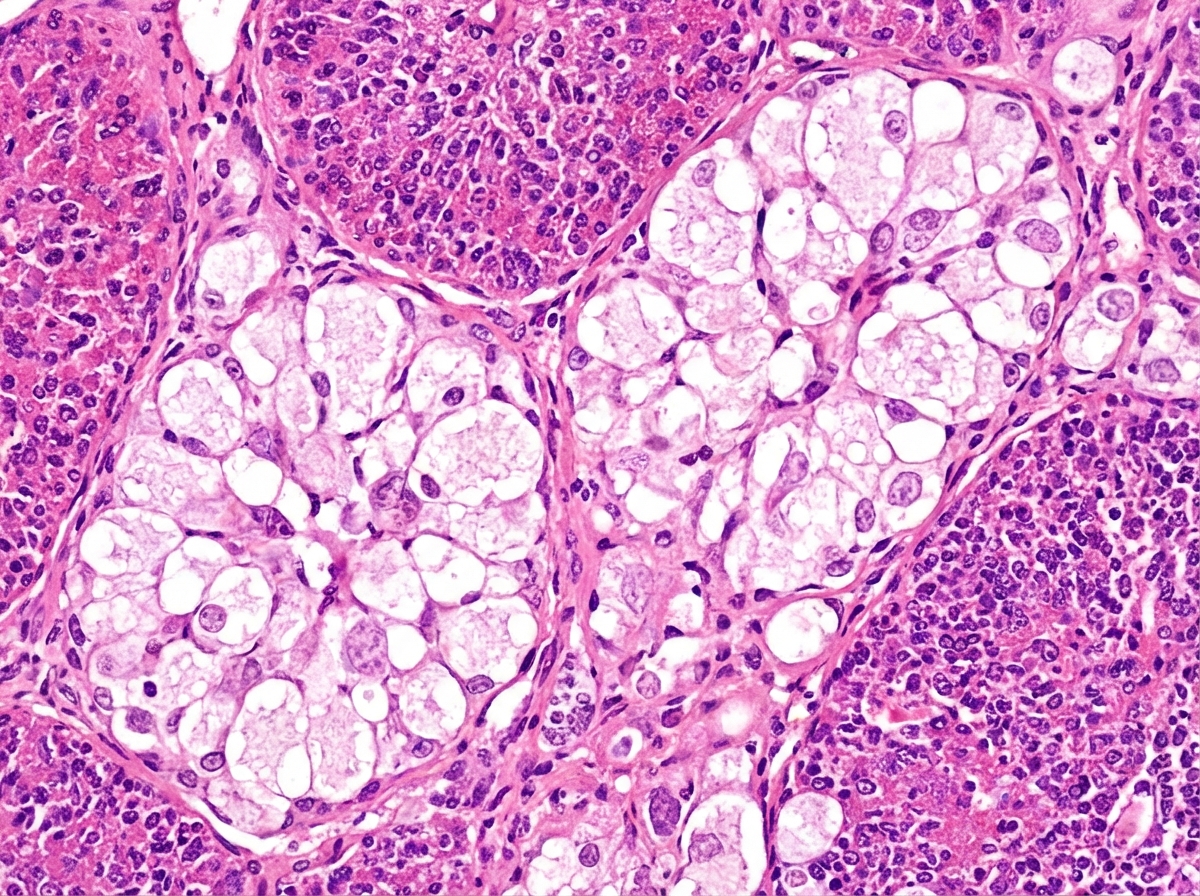
An 18-month-old boy is brought to the physician because of a 2-day history of cough, fever, and lethargy. He has been admitted to the hospital twice during the past year for pneumonia. He can stand without support but has not started to walk. He speaks in bisyllables. He is at the 3rd percentile for height and 4th percentile for weight. Examination shows diffuse crackles over bilateral lung fields. Abdominal examination shows hepatosplenomegaly. Fundoscopy shows bright red macular spots. Despite being given appropriate antibiotic therapy, the patient dies. A photomicrograph of a section of the spleen obtained during autopsy is shown. Accumulation of which of the following substances is the most likely cause of this patient's condition?
A 61-year-old woman comes to the physician because of a 6-month history of left knee pain and stiffness. Examination of the left knee shows tenderness to palpation along the joint line; there is crepitus with full flexion and extension. An x-ray of the knee shows osteophytes with joint-space narrowing. Arthrocentesis of the knee joint yields clear fluid with a leukocyte count of 120/mm3. Treatment with ibuprofen during the next week significantly improves her condition. The beneficial effect of this drug is most likely due to inhibition of which of the following?
A 12-year-old boy is brought to the emergency department because of acute onset abdominal pain. On arrival, he also complains of nausea and shortness of breath in addition to epigastric pain. He has previously been admitted to the hospital several times for respiratory infections with Pseudomonas species and uses a nebulizer and a chest wall oscillation vest at home. The patient's acute condition is found to be due to premature activation of an enzyme that normally interacts with the brush border. Which of the following describes the activity of this enzyme?
A P2G1 diabetic woman is at risk of delivering at 29 weeks gestation. Her obstetrician counsels her that there is a risk the baby could have significant pulmonary distress after it is born. However, she states she will give the mother corticosteroids, which will help prevent this from occurring. Additionally, the obstetrician states she will perform a test on the amniotic fluid which will indicate the likelihood of the infant being affected by this syndrome. Which of the following ratios would be most predictive of the infant having pulmonary distress?
A P1G0 diabetic woman is at risk of delivering at 30 weeks gestation. Her obstetrician counsels her that there is a risk the baby could have significant pulmonary distress after it is born. However, she states she will administer a drug to the mother to help prevent this from occurring. By what action will this drug prevent respiratory distress in the premature infant?
Steroid hormone synthesis, lipid synthesis, and chemical detoxification are activities of which of the following?
A 16-year-old boy presents with shortness of breath after prolonged exposure to cold air during a recent hike with his friends. Past medical history is significant for asthma, untreated because he doesn't like using medications. The patient says he is a non-smoker and occasionally drinks alcohol. On physical examination, his temperature is 37.0°C (98.6°F), pulse rate is 120/min, blood pressure is 114/76 mm Hg, and respiratory rate is 32/min. Auscultation of the chest reveals bilateral wheezing. Nebulized ipratropium bromide results in significant clinical improvement. Which of the following second messenger systems is affected by this drug?
A 12-year-old boy is brought to the physician because of difficulty in walking for 5 months. His mother reports that he has trouble keeping his balance and walking without support. Over the past year, he has started to have difficulty seeing in the dark and his hearing has been impaired. Examination shows marked scaling of the skin on the face and feet and a shortened 4th toe. Muscle strength is 3/5 in the lower extremities and 4/5 in the upper extremities. Sensation to pinprick is symmetrically decreased over the legs. Fundoscopy shows peripheral pigment deposits and retinal atrophy. His serum phytanic acid concentration is markedly elevated. The patient's condition is most likely caused by a defect in which of the following cellular structures?
A 35-year-old man comes to the physician because of fatigue and generalized weakness for the past year. He has noticed he has been having fewer bowel movements. He has had pain with defecation and small amounts of blood when wiping. He has not lost weight despite increased efforts to diet and exercise. He has had no fever, throat pain, or difficulty swallowing. His temperature is 36.5°C (97.7°F), pulse is 50/min, blood pressure is 120/90 mm Hg, and BMI is 35 kg/m2. Physical examination shows dry skin and a distended abdomen. There is 1+ pitting edema in the lower extremities. On neurological examination, deep tendon reflexes are 1+. Further evaluation of this patient is most likely to show which of the following findings?
Want unlimited practice?
Get full access to all questions, explanations, and performance tracking.
Scan to download app