
DNA damage response signaling — MCQs

A 33-year-old woman comes to the physician 1 week after noticing a lump in her right breast. Fifteen years ago, she was diagnosed with osteosarcoma of her left distal femur. Her father died of an adrenocortical carcinoma at the age of 41 years. Examination shows a 2-cm, firm, immobile mass in the lower outer quadrant of the right breast. A core needle biopsy of the mass shows adenocarcinoma. Genetic analysis in this patient is most likely to show a defect in which of the following genes?
A 71-year-old man with colorectal cancer comes to the physician for follow-up examination after undergoing a sigmoid colectomy. The physician recommends adjuvant chemotherapy with an agent that results in single-stranded DNA breaks. This chemotherapeutic agent most likely has an effect on which of the following enzymes?
A 3-year-old male child is found to have a disease involving DNA repair. Specifically, he is found to have a defect in the endonucleases involved in the nucleotide excision repair of pyrimidine dimers. Which of the following is a unique late-stage complication of this child's disease?
While performing a Western blot, a graduate student spilled a small amount of the radiolabeled antibody on her left forearm. Although very little harm was done to the skin, the radiation did cause minor damage to the DNA of the exposed skin by severing covalent bonds between the nitrogenous bases and the deoxyribose sugar, leaving several apurinic/apyrimidinic sites. Damaged cells would most likely repair these sites by which of the following mechanisms?
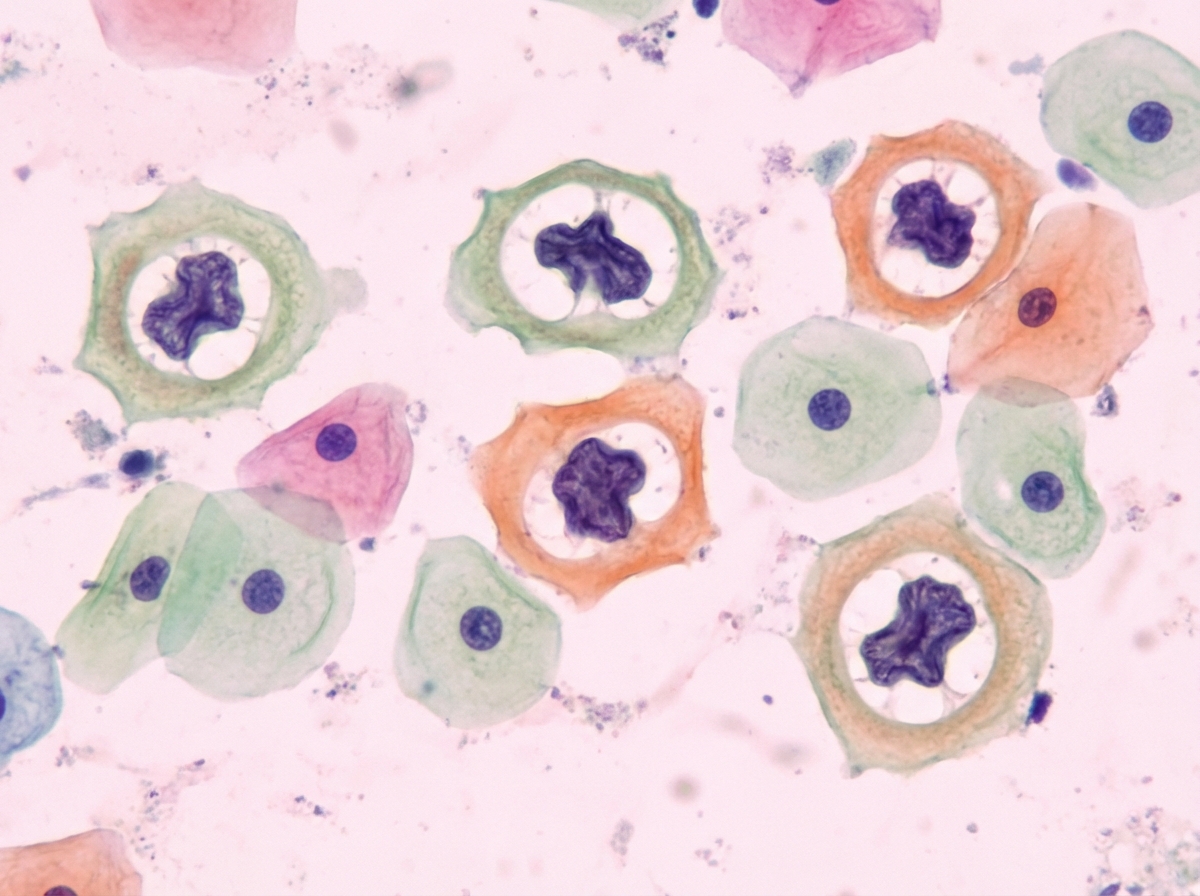
A 29-year-old woman presents to her gynecologist for a routine check-up. She is sexually active with multiple partners and intermittently uses condoms for contraception. She denies vaginal discharge, burning, itching, or rashes in her inguinal region. Pelvic examination is normal. Results from a routine pap smear are shown. The cellular changes seen are attributable to which of the following factors?
A 54-year-old woman with breast cancer comes to the physician because of redness and pain in the right breast. She has been undergoing ionizing radiation therapy daily for the past 2 weeks as adjuvant treatment for her breast cancer. Physical examination shows erythema, edema, and superficial desquamation of the skin along the right breast at the site of radiation. Sensation to light touch is intact. Which of the following is the primary mechanism of DNA repair responsible for preventing radiation-induced damage to neighboring neurons?
A 5-month-old male infant from a consanguineous marriage presents with severe sunburns and freckling in sun exposed areas. The mother explains that the infant experiences these sunburns every time the infant goes outside despite applying copious amounts of sunscreen. Which of the following DNA repair mechanisms is defective in this child?
A mutant stem cell was created by using an inducible RNAi system, such that when doxycycline is added, the siRNA targeting DNA helicase is expressed, effectively knocking down the gene for DNA helicase. Which of the following will occur during DNA replication?
An 84-year-old man comes to the emergency department because of lower back pain and lower extremity weakness for 3 weeks. Over the past week, he has also found it increasingly difficult to urinate. He has a history of prostate cancer, for which he underwent radical prostatectomy 8 years ago. His prostate-specific antigen (PSA) level was undetectable until a routine follow-up visit last year, when it began to increase from 0.8 ng/mL to its present value of 64.3 ng/mL (N < 4). An MRI of the spine shows infiltrative vertebral lesions with a collapse of the L5 vertebral body, resulting in cord compression at L4–L5. The patient receives one dose of intravenous dexamethasone and subsequently undergoes external beam radiation. Which of the following cellular changes is most likely to occur as a result of this treatment?
An investigator is studying the replication of bacterial DNA with modified nucleotides. After unwinding, the double-stranded DNA forms a Y-shaped replication fork that separates into two strands. At each of these strands, daughter strands are synthesized. One strand is continuously extended from the template strands in a 5′ to 3′ direction. Which of the following is exclusively associated with the strand being synthesized away from the replication fork?
Want unlimited practice?
Get full access to all questions, explanations, and performance tracking.
Scan to download app