
Urea cycle disorders — MCQs

A 4-day-old male newborn delivered at 39 weeks' gestation is evaluated because of poor feeding, recurrent vomiting, and lethargy. Physical examination shows tachypnea with subcostal retractions. An enzyme assay performed on a liver biopsy specimen shows decreased activity of carbamoyl phosphate synthetase I. This enzyme plays an important role in the breakdown and excretion of amino groups that result from protein digestion. Which of the following is an immediate substrate for the synthesis of the molecule needed for the excretion of amino groups?
A 56-year-old woman with a history of alcoholic cirrhosis and recurrent esophageal varices who recently underwent transjugular intrahepatic portosystemic shunt (TIPS) placement is brought to the emergency room by her daughter due to confusion and agitation. Starting this morning, the patient has appeared sleepy, difficult to arouse, and slow to respond to questions. Her temperature is 97.6°F (36.4°C), blood pressure is 122/81 mmHg, pulse is 130/min, respirations are 22/min, and oxygen saturation is 98% on room air. She repeatedly falls asleep and is combative during the exam. Laboratory values are notable for a potassium of 3.0 mEq/L. The patient is given normal saline with potassium. Which of the following is the most appropriate treatment for this patient?
A 3-week old boy is brought to the physician for the evaluation of lethargy, recurrent vomiting, and poor weight gain since birth. Physical examination shows decreased skin turgor and a bulging frontal fontanelle. Serum studies show an ammonia concentration of 170 μmol/L (N < 30) and low serum citrulline levels. The oral intake of which of the following nutrients should be restricted in this patient?
A 2-day-old male is seen in the newborn nursery for repeated emesis and lethargy. He was born at 39 weeks to a 24-year-old mother following an uncomplicated pregnancy and birth. He has been breastfeeding every 2 hours and has 10 wet diapers per day. His father has a history of beta-thalassemia minor. Laboratory results are as follows: Hemoglobin: 12 g/dL Platelet count: 200,000/mm³ Mean corpuscular volume: 95 µm³ Reticulocyte count: 0.5% Leukocyte count: 5,000/mm³ with normal differential Serum: Na+: 134 mEq/L Cl-: 100 mEq/L K+: 3.3 mEq/L HCO3-: 24 mEq/L Urea nitrogen: 1 mg/dL Creatinine: 0.6 mg/dL Ammonia: 150 µmol/L (normal: 50-80 µmol/L) Which of the following is the most likely diagnosis?
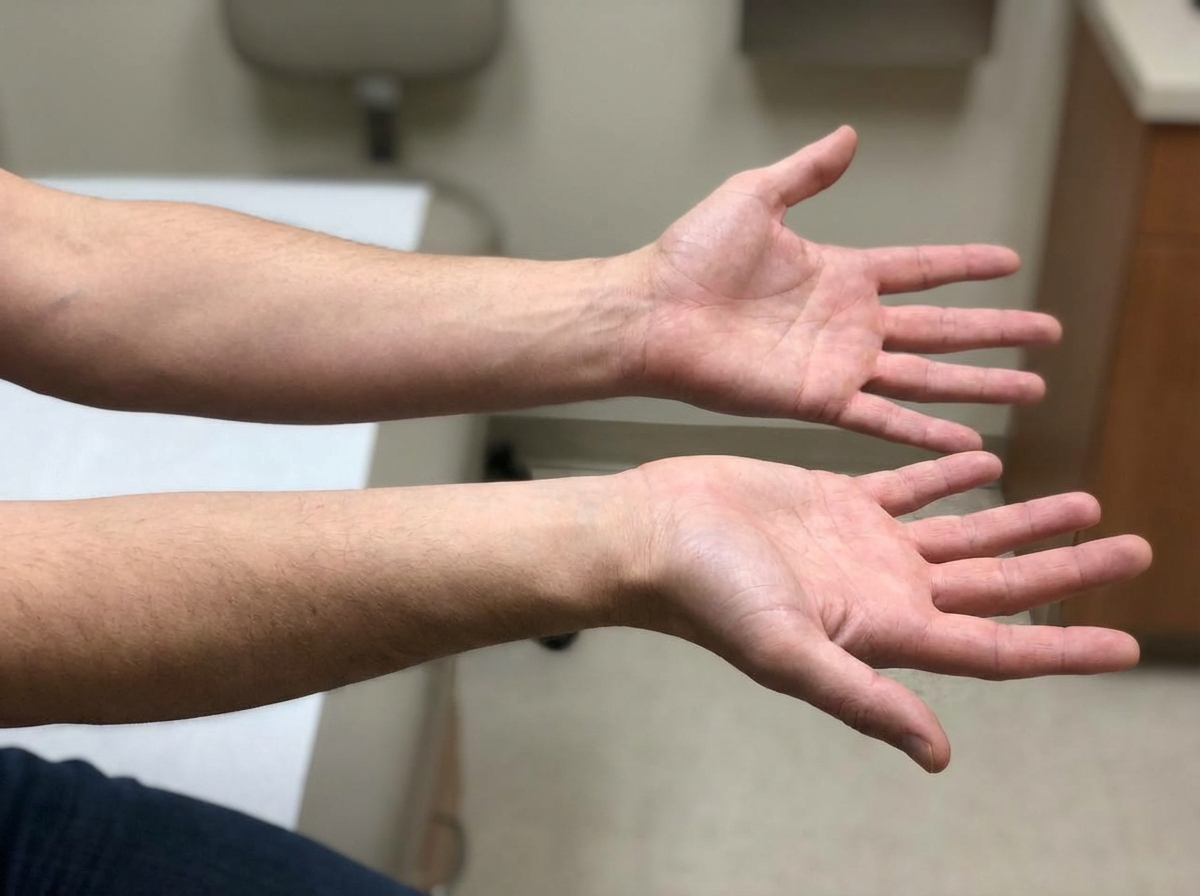
A 56-year-old male with a history of hepatitis C cirrhosis status post TIPS procedure is brought in by his wife to the emergency department because he has been acting disoriented, slurring his speech, and sleeping throughout the day. On arrival the patient is afebrile and his vital signs are pulse is 87/min, blood pressure is 137/93 mmHg, and respirations are 12/min with shallow breaths. Examination reveals a jaundiced male who appears older than stated age. Abdominal exam is positive for a fluid wave and shifting dullness to percussion. You note enlarged breasts, decreased facial hair, 3+ patellar reflexes bilaterally, and the following in the upper extremity (Image A). Paracentesis reveals ascitic fluid with neutrophil counts of < 100 cells/mcL. Serum creatinine is 1.0 and BUN is 15. Which of the following is the next best step in management?
A 20-year-old male presents with confusion, asterixis, and odd behavior. Very early in the morning, his mother found him urinating on the floor of his bedroom. A detailed history taken from the mother revealed that he has been a vegetarian his entire life but decided to "bulk up" by working out and consuming whey protein several times a day. A blood test revealed increased levels of ammonia and orotic acid but a decreased BUN. The patient began hemodialysis and was given oral sodium benzoate and phenylbutyrate, which improved his condition. This patient's condition would be corrected by gene therapy targeting the enzyme that produces which of the following?
A 4-day-old boy is brought to the physician because of somnolence, poor feeding, and vomiting after his first few breast feedings. He appears lethargic. His respiratory rate is 73/min. Serum ammonia is markedly increased. Genetic analysis shows deficiency in N-acetylglutamate synthase. The activity of which of the following enzymes is most likely directly affected by this genetic defect?
A 2-week-old boy presents to the emergency department because of unusual irritability and lethargy. The patient is admitted to the pediatric intensive care unit and minutes later develops metabolic encephalopathy. This progressed to a coma, followed by death before any laboratory tests are completed. The infant was born at home via vaginal delivery at 39 weeks' of gestation. His mother says that the symptoms started since the infant was 4-days-old, but since he only seemed ‘tired’, she decided not to seek medical attention. Further testing during autopsy shows hyperammonemia, low citrulline, and increased orotic acid. Which of the following enzymes is most likely deficient in this patient?
A 7-year-old boy is brought to the emergency department because of sudden-onset abdominal pain that began 1 hour ago. Three days ago, he was diagnosed with a urinary tract infection and was treated with nitrofurantoin. There is no personal history of serious illness. His parents emigrated from Kenya before he was born. Examination shows diffuse abdominal tenderness, mild splenomegaly, and scleral icterus. Laboratory studies show: Hemoglobin 9.8 g/dL Mean corpuscular volume 88 μm3 Reticulocyte count 3.1% Serum Bilirubin Total 3.8 mg/dL Direct 0.6 mg/dL Haptoglobin 16 mg/dL (N=41–165 mg/dL) Lactate dehydrogenase 179 U/L Which of the following is the most likely underlying cause of this patient's symptoms?
A 23-year-old woman presents to her primary care physician due to amenorrhea. The patient states that historically she has her period once every three months but recently has not had it at all. Otherwise, she has no other complaints. The patient recently started college and is a varsity athlete for the track team. She works part time in a coffee shop and is doing well in school. The patient is not sexually active and does not drink alcohol, use illicit drugs, or smoke. She has no significant past medical history and occasionally takes ibuprofen for headaches. Her temperature is 99.5°F (37.5°C), blood pressure is 100/55 mmHg, pulse is 50/min, respirations are 10/min, and oxygen saturation is 98% on room air. On physical exam, you note a young, lean, muscular woman in no acute distress. Which of the following is the most likely long-term outcome in this patient?
Want unlimited practice?
Get full access to all questions, explanations, and performance tracking.
Scan to download app