
Sulfur-containing amino acid metabolism — MCQs

A 21-year-old man presents to the emergency department with acute back pain. The pain began a few hours prior to presentation and is located on the left lower back. The pain is described to be “shock-like,” 9/10 in pain severity, and radiates to the left groin. His temperature is 98.6°F (37°C), blood pressure is 120/75 mmHg, pulse is 101/min, and respirations are 18/min. The patient appears uncomfortable and is mildly diaphoretic. There is costovertebral angle tenderness and genitourinary exam is unremarkable. A non-contrast computerized tomography (CT) scan of the abdomen and pelvis demonstrates an opaque lesion affecting the left ureter with mild hydronephrosis. Straining of the urine with urine crystal analysis is demonstrated. Which of the following amino acids is most likely poorly reabsorbed by this patient’s kidney?
A 35-year-old woman comes to the physician because of a 1-day history of swelling and pain in the left leg. Two days ago, she returned from a business trip on a long-distance flight. She has alcohol use disorder. Physical examination shows a tender, swollen, and warm left calf. Serum studies show an increased homocysteine concentration and a methylmalonic acid concentration within the reference range. Further evaluation of this patient is most likely to show which of the following serum findings?
A 48-year-old woman is brought to the emergency department by police because of confusion and agitation. Her medical record indicates that she has peptic ulcer disease that is treated with omeprazole. The patient's brother arrives shortly after. He reports that she drinks around 17 oz. of vodka daily. Neurological examination shows horizontal nystagmus. Her gait is wide-based with small steps. Her hemoglobin concentration is 9.1 g/dL. A peripheral blood smear shows hypersegmented neutrophils. Homocysteine levels are elevated. Methylmalonic acid levels are within normal limits. Which of the following is the most likely direct cause of this patient's anemia?
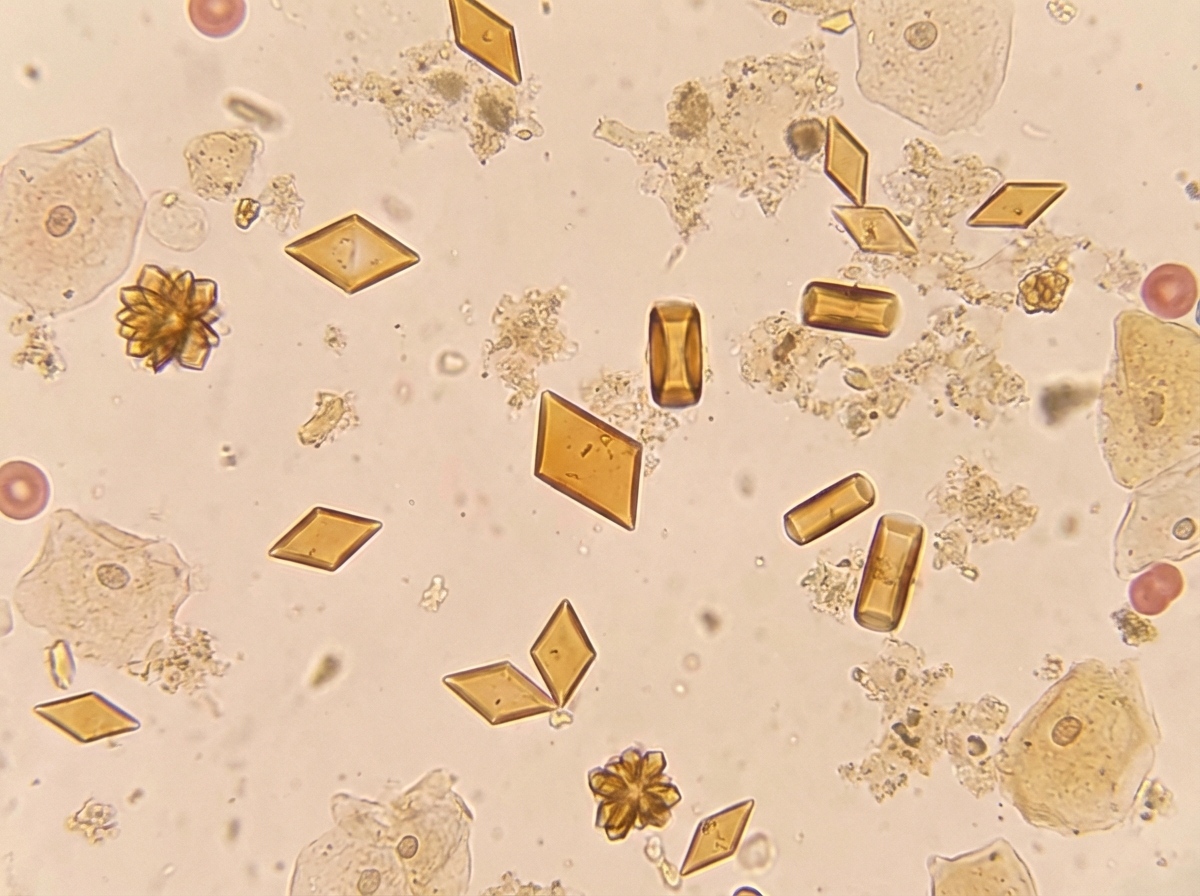
A 45-year-old woman presents with severe, acute-onset colicky abdominal pain and nausea. She also describes bone pain, constipation, headache, decreased vision, and menstrual irregularity. Past medical history is significant for surgical removal of an insulinoma one year ago. Two months ago, she was prescribed fluoxetine for depression but hasn’t found it very helpful. Family history is significant for a rare genetic syndrome. Non-contrast CT, CBC, CMP, and urinalysis are ordered in the diagnostic work-up. Urine sediment is significant for the findings shown in the picture. Which of the following will also be a likely significant finding in the diagnostic workup?
A 17-year-old girl is brought in by her mother due to rapid weight loss over the past month. The patient says she has been having episodes of diarrhea, which she attributes to laxatives she takes regularly to keep her weight down. She also says she has not had her period yet. The patient’s mother adds that the patient has been underperforming at school and acting very strangely at home. Her current BMI is 16.8 kg/m2. On physical examination, the skin on her limbs and around her neck is inflamed and erythematous. Her tongue is bright red and smooth. She states that over the last 2 weeks, she has been eating nothing but small portions of fruit. She is diagnosed with a vitamin deficiency. Which of the following statements is true about the vitamin most likely deficient in this patient?
A 4-year-old boy presents to the ophthalmologist for a down- and inward dislocation of the lens in his left eye. On physical exam, the boy has a marfanoid habitus and intellectual disability. Biochemical tests were performed to locate the exact defect in this boy. It was found that there was a significant deficiency in cystathionine beta-synthase activity with elevated homocysteine levels. Which of the following is the diagnosis?
A 38-year-old, working, first-time mother brings her 9-month-old male infant to the pediatrician for "wounds that simply won't heal" and bleeding gums. She exclaims, "I have been extra careful with him making sure to not let him get dirty, I boil his baby formula for 15 minutes each morning before I leave for work to give to the caregiver, and he has gotten all of his vaccinations." This infant is deficient in a molecule that is also an essential co-factor for which of the following reactions?
A 9-month-old infant presents to your office for a check-up. Exam reveals developmental delay, microcephaly, and a mousy odor to his breath. You should be concerned that the infant may have which of the following?
An 8-day-old boy is brought to the physician by his mother because of vomiting and poor feeding. The pregnancy was uncomplicated, and he was born at full term. He appears pale and lethargic. Physical examination shows diffusely increased muscle tone. His urine is noted to have a sweet odor. This patient's symptoms are most likely caused by the accumulation of which of the following?
A 5 year old child was brought to the physician with a history of black urine. There is no history of fever or any other complaints. There is no growth retardation and all the developmental milestones are normal. The child is suspected to have an enzyme defect for metabolism of an aromatic amino acid. What is the enzyme deficient
Want unlimited practice?
Get full access to all questions, explanations, and performance tracking.
Scan to download app