
Homocystinuria and methionine metabolism disorders — MCQs

An 8-day-old boy is brought to the physician by his mother because of vomiting and poor feeding. The pregnancy was uncomplicated, and he was born at full term. He appears pale and lethargic. Physical examination shows diffusely increased muscle tone. His urine is noted to have a sweet odor. This patient's symptoms are most likely caused by the accumulation of which of the following?
A 52-year-old female presents to her rheumatologist with complaints of fatigue, a sore mouth, and occasional nausea and abdominal pain over the past several months. Her medical history is significant for 'pre-diabetes' treated with diet and exercise, hypertension managed with lisinopril, and rheumatoid arthritis well-controlled with methotrexate. Her vital signs are within normal limits. Physical examination is significant for an overweight female with the findings as shown in Figures A and B. The physician orders laboratory work-up including complete blood count with peripheral blood smear as well as basic metabolic panel and serum methylmalonic acid and homocysteine levels. These tests are significant for a hematocrit of 29.5, a decreased reticulocyte count, normal serum methylmalonic acid level, increased homocysteine level, as well as the peripheral smear shown in Figure C. Which of the following could have reduced this patient's risk of developing their presenting condition?
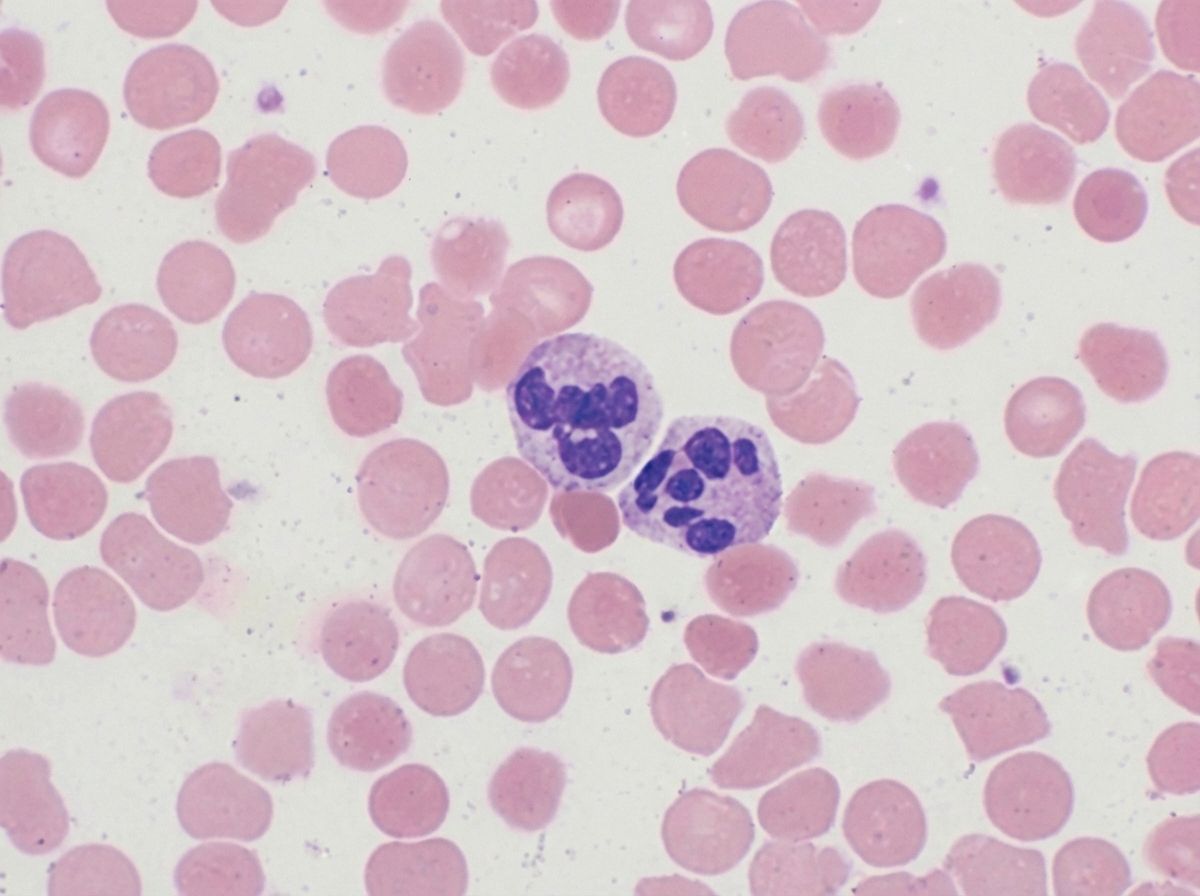
A 35-year-old woman comes to the physician because of a 1-day history of swelling and pain in the left leg. Two days ago, she returned from a business trip on a long-distance flight. She has alcohol use disorder. Physical examination shows a tender, swollen, and warm left calf. Serum studies show an increased homocysteine concentration and a methylmalonic acid concentration within the reference range. Further evaluation of this patient is most likely to show which of the following serum findings?
A 48-year-old woman is brought to the emergency department by police because of confusion and agitation. Her medical record indicates that she has peptic ulcer disease that is treated with omeprazole. The patient's brother arrives shortly after. He reports that she drinks around 17 oz. of vodka daily. Neurological examination shows horizontal nystagmus. Her gait is wide-based with small steps. Her hemoglobin concentration is 9.1 g/dL. A peripheral blood smear shows hypersegmented neutrophils. Homocysteine levels are elevated. Methylmalonic acid levels are within normal limits. Which of the following is the most likely direct cause of this patient's anemia?
A 43-year-old woman visits her primary care provider complaining of fatigue. Although she has had it for several months, her fatigue has been worsening over the past few weeks. She has no other symptoms. Past medical history is significant for hypertension. She takes chlorthalidone, an oral contraceptive pill, and a multivitamin every day. Family history is noncontributory. She drinks about 1 bottle of wine every day and started taking a shot or two of whisky or vodka every morning before work to “clear out the cobwebs”. She was recently fired from her job. Today, her heart rate is 90/min, respiratory rate is 17/min, blood pressure is 110/65 mm Hg, and temperature is 36.7°C (98.1°F). On physical exam, she appears malnourished and anxious. Her conjunctiva are pale, and glossitis is noted on oral exam. Her heart has a regular rate and rhythm and her lungs are clear to auscultation bilaterally. She has no gait or balance abnormalities. Lab results show a hemoglobin of 10 g/dL, with a mean corpuscular volume (MCV) of 108 fl. Elevated level of which of the following will most likely to be found in this patient?
A 6-year-old boy is brought to the office by his mother. She reports that her son is well but has some concerns about his overall health: he is shorter and, physically, seems less developed compared to his siblings when they were the same age. He recently started school and the mother reports that the boy’s teachers are concerned with his learning capability. His height and weight are in the 10th and 15th percentiles, respectively. Lab results reveal: Hemoglobin 10 gm/dL Mean corpuscular volume 110 fL Multi-segmented neutrophils are seen on peripheral blood smear. Urinary orotic acid levels are found to be high. What is the most likely cause of this patient’s condition?
A 4-year-old boy presents to the ophthalmologist for a down- and inward dislocation of the lens in his left eye. On physical exam, the boy has a marfanoid habitus and intellectual disability. Biochemical tests were performed to locate the exact defect in this boy. It was found that there was a significant deficiency in cystathionine beta-synthase activity with elevated homocysteine levels. Which of the following is the diagnosis?
A 38-year-old, working, first-time mother brings her 9-month-old male infant to the pediatrician for "wounds that simply won't heal" and bleeding gums. She exclaims, "I have been extra careful with him making sure to not let him get dirty, I boil his baby formula for 15 minutes each morning before I leave for work to give to the caregiver, and he has gotten all of his vaccinations." This infant is deficient in a molecule that is also an essential co-factor for which of the following reactions?
A 4-year-old boy is brought to the physician for a well-child examination. He started walking at 20 months of age. He can use a cup to drink but cannot use silverware. He speaks in 2-word sentences and can build a tower of 4 blocks. He can scribble but cannot draw a circle. He is above the 99th percentile for height and at the 15th percentile for weight. Vital signs are within normal limits. Examination shows bilateral inferior lens dislocation. His fingers are long and slender. He has a high-arched palate. The thumb and 5th finger overlap when he grips a wrist with the opposite hand. The skin over the neck can be extended and stretched easily. Which of the following is the most likely cause of these findings?
A 9-year-old girl is brought to the emergency department for sudden-onset slurring of speech and weakness of her right arm and leg. She has a mild intellectual disability. She is at the 10th percentile for weight and at the 85th percentile for height. Physical examination shows bilateral inferonasal subluxation of the lens and a high-arched palate. Her fingers are long and slender. Neurological examination shows an extensor plantar response on the left. This patient is most likely to respond to treatment with which of the following?
Want unlimited practice?
Get full access to all questions, explanations, and performance tracking.
Scan to download app