
Comparison of upper and lower limb structures — MCQs

A 16-year-old boy is brought to the emergency department after being tackled at a football game. Per his mom, he is the quarterback of his team and was head-butted in the left shoulder region by the opposing team. Shortly after, the mother noticed that his left arm was hanging by his torso and his hand was “bent backwards and facing the sky.” The patient denies head trauma, loss of consciousness, sensory changes, or gross bleeding. A physical examination demonstrates weakness in abduction, lateral rotation, flexion, and supination of the left arm and tenderness of the left shoulder region with moderate bruising. Radiograph of the left shoulder and arm is unremarkable. Which of the following is most likely damaged in this patient?
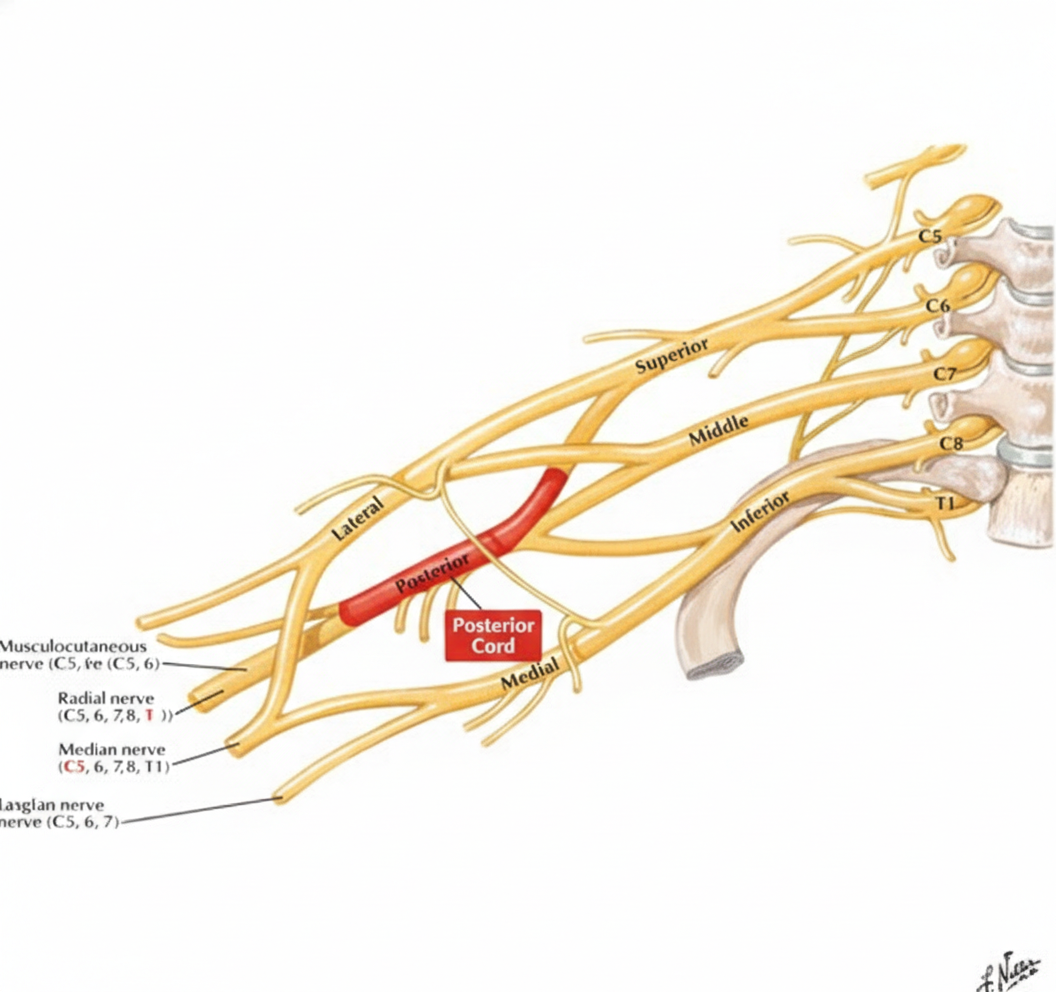
A 43-year-old woman comes to the physician because of tingling and weakness in her left arm for the past 2 days. An image of the brachial plexus is shown. Nerve conduction study shows decreased transmission of electrical impulses in the labeled structure. Physical examination is most likely to show impairment of which of the following movements?
A 31-year-old woman presents with difficulty walking and climbing stairs for the last 3 weeks. She has no history of trauma. The physical examination reveals a waddling gait with the trunk swaying from side-to-side towards the weight-bearing limb. When she stands on her right leg, the pelvis on the left side falls. When she stands on her left leg, the pelvis remains level. Which of the following nerves is most likely injured in this patient?
A 13-year-old girl presents to an orthopedic surgeon for evaluation of a spinal curvature that was discovered during a school screening. She has otherwise been healthy and does not take any medications. On presentation, she is found to have significant asymmetry of her back and is sent for a spine radiograph. The radiograph reveals a unilateral rib attached to the left transverse process of the C7 vertebrae. Abnormal expression of which of the following genes is most likely responsible for this finding?
A 78-year-old woman is brought to the emergency department after she fell while gardening and experienced severe pain in her right arm. She has a history of well controlled hypertension and has been found to have osteoporosis. On presentation she is found to have a closed midshaft humerus fracture. No other major findings are discovered on a trauma survey. She is placed in a coaptation splint. The complication that is most associated with this injury has which of the following presentations?
A 56-year-old man presents to the emergency room after being in a motor vehicle accident. He was driving on an icy road when his car swerved off the road and ran head on into a tree. He complains of severe pain in his right lower extremity. He denies loss of consciousness during the accident. His past medical history is notable for poorly controlled hypertension, hyperlipidemia, and major depressive disorder. He takes enalapril, atorvastatin, and sertraline. His temperature is 99.1°F (37.3°C), blood pressure is 155/85 mmHg, pulse is 110/min, and respirations are 20/min. On exam, he is alert and fully oriented. He is unable to move his right leg due to pain. Sensation is intact to light touch in the sural, saphenous, tibial, deep peroneal, and superficial peroneal distributions. His leg appears adducted, flexed, and internally rotated. An anteroposterior radiograph of his pelvis would most likely demonstrate which of the following findings?
A 24-year-old professional soccer player presents to the clinic with discomfort and pain while walking. He says that he has an unstable knee joint that started after an injury during a match last week. He adds that he heard a popping sound at the time of the injury. Physical examination of the knee reveals swelling of the knee joint with a positive anterior drawer test. Which of the following structures is most likely damaged in this patient?
A 25-year-old woman is brought to the emergency department after being involved in a rear-end collision, in which she was the restrained driver of the back car. On arrival, she is alert and active. She reports pain in both knees and severe pain over the right groin. Temperature is 37°C (98.6°F), pulse is 116/min, respirations are 19/min, and blood pressure is 132/79 mm Hg. Physical examination shows tenderness over both knee caps. The right groin is tender to palpation. The right leg is slightly shortened, flexed, adducted, and internally rotated. The remainder of the examination shows no abnormalities. Which of the following is the most likely diagnosis?
A 23-year-old college student was playing basketball when he fell directly onto his left elbow. He had sudden, intense pain and was unable to move his elbow. He was taken immediately to the emergency room by his teammates. He has no prior history of trauma or any chronic medical conditions. His blood pressure is 128/84 mm Hg, the heart rate is 92/min, and the respiratory rate is 14/min. He is in moderate distress and is holding onto his left elbow. On physical examination, pinprick sensation is absent in the left 5th digit and the medial aspect of the left 4th digit. Which of the following is the most likely etiology of this patient’s condition?
A 30-year-old male presents with pain and limited movement in his shoulder following a fall. X-ray reveals an anterior dislocation of the glenohumeral joint. Which of the following structures is most likely to be damaged in this injury?
Want unlimited practice?
Get full access to all questions, explanations, and performance tracking.
Scan to download app