
Retroperitoneal structures — MCQs

A 72-year-old man presents to his primary care physician because he has been having flank and back pain for the last 8 months. He said that it started after he fell off a chair while doing yard work, but it has been getting progressively worse over time. He reports no other symptoms and denies any weight loss or tingling in his extremities. His medical history is significant for poorly controlled hypertension and a back surgery 10 years ago. He drinks socially and has smoked 1 pack per day since he was 20. His family history is significant for cancer, and he says that he is concerned that his father had similar symptoms before he was diagnosed with multiple myeloma. Physical exam reveals a painful, pulsatile enlargement in the patient's abdomen. Between which of the following locations has the highest risk of developing this patient's disorder?
A 45-year-old male is brought to the emergency department by emergency medical services after sustaining a gunshot wound to the abdomen. He is unresponsive. His temperature is 99.0°F (37.2°C), blood pressure is 95/58 mmHg, pulse is 115/min, and respirations are 20/min. Physical examination reveals an entry wound in the left abdominal quadrant just inferior to the left lateral costal border. Abdominal CT shows the bullet trajectory through the left abdominal cavity. Which of the following structures has the bullet most likely penetrated?
A 65-year-old man presents to his primary care provider after noticing increasing fatigue over the past several weeks. He now becomes short of breath after going up 1 flight of stairs. He was previously healthy and has not seen a doctor for several years. He denies any fever or changes to his bowel movements. On exam, his temperature is 98.8°F (37.1°C), blood pressure is 116/76 mmHg, pulse is 74/min, and respirations are 14/min. On basic labs, his hemoglobin is found to be 9.6 g/dL and MCV is 75 fL. Fecal blood testing is positive for occult blood. Imaging is notable for a mass in the cecum that is partially obstructing the lumen, as well as several small lesions in the liver. Which of the following structures is most at risk for involvement in this patient’s disease?
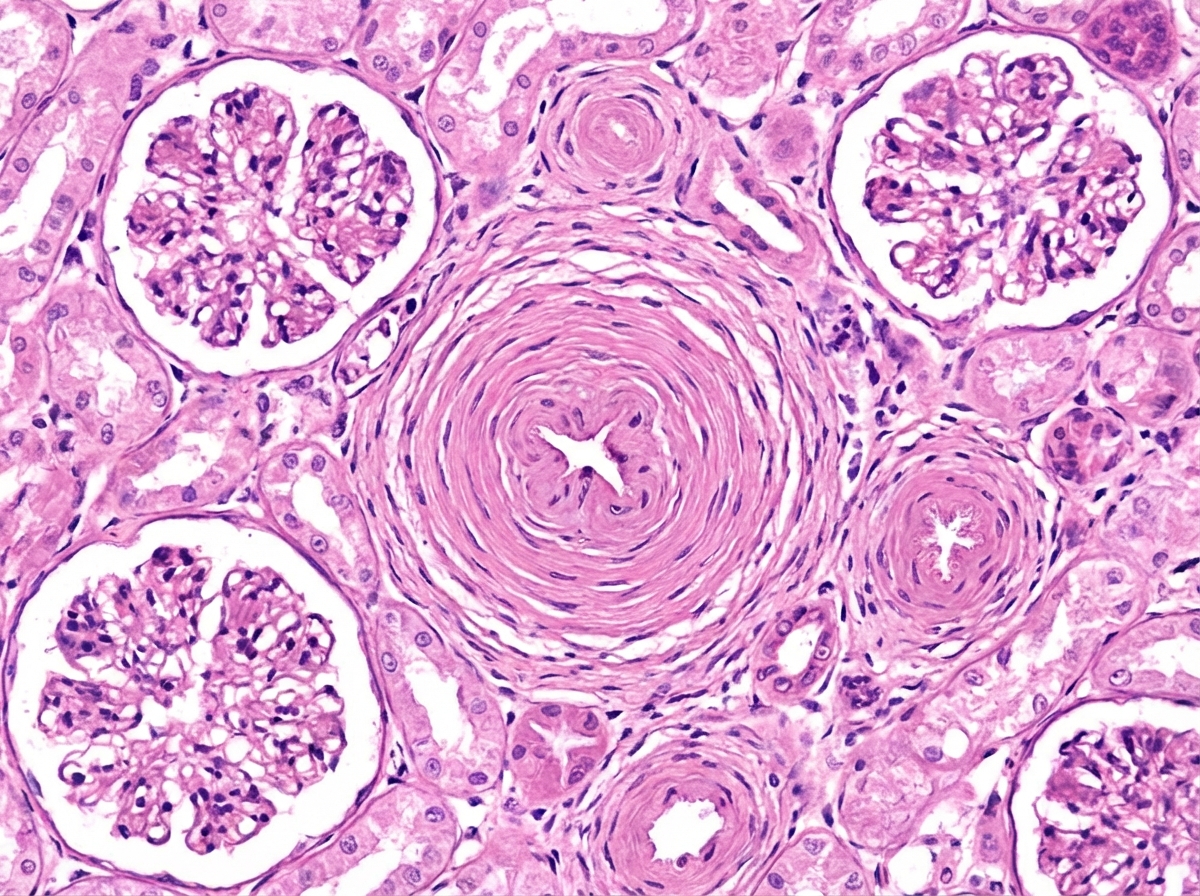
A 53-year-old man is brought to the emergency department by his wife because of a 1-day history of headache, blurry vision, and confusion. His wife also says that he hasn't urinated in the past 24 hours. Despite appropriate measures, the patient dies shortly after admission. A photomicrograph of a section of the kidney obtained at autopsy is shown. Which of the following is the most likely explanation for the findings indicated by the arrow?
A 43-year-old man is brought to the emergency department 30 minutes after falling from the roof of a construction site. He reports abdominal and right-sided flank pain. His temperature is 37.1°C (98.8°F), pulse is 114/min, and blood pressure is 100/68 mm Hg. Physical examination shows numerous ecchymoses over the trunk and flanks and a tender right abdomen without a palpable mass. Focused assessment with sonography for trauma (FAST) shows no intraperitoneal fluid collections. His hemoglobin concentration is 7.6 g/dL. The most likely cause of his presentation is injury to which of the following organs?
A CT scan of the abdomen reveals a mass in the pancreatic uncinate process. Which of the following structures is most likely to be compressed by this mass?
An investigator is studying the effects of an antihypertensive drug during pregnancy. Follow-up studies show that the drug can adversely affect differentiation of the ureteric bud into its direct derivatives in fetuses exposed during the first trimester. Which of the following structures is most likely to develop incorrectly in the affected fetus?
A 65-year-old man presents to the emergency department with abdominal pain and a pulsatile abdominal mass. Further examination of the mass shows that it is an abdominal aortic aneurysm. A computed tomography scan with contrast reveals an incidental finding of a horseshoe kidney, and the surgeon is informed of this finding prior to operating on the aneurysm. Which of the following may complicate the surgical approach in this patient?
A 55-year-old man comes to the physician because of a 3-week history of intermittent burning epigastric pain. His pain improves with antacid use and eating but returns approximately 2 hours following meals. He has a history of chronic osteoarthritis and takes ibuprofen daily. Upper endoscopy shows a deep ulcer located on the posterior wall of the duodenal bulb. This ulcer is most likely to erode into which of the following structures?
What is the most common site of congenital diaphragmatic hernia?
Want unlimited practice?
Get full access to all questions, explanations, and performance tracking.
Scan to download app