
Pleura and lungs — MCQs

A 56-year-old man is brought to the emergency department 30 minutes after falling from a height of 3 feet onto a sharp metal fence pole. He is unconscious. Physical examination shows a wound on the upper margin of the right clavicle in the parasternal line that is 3-cm-deep. Which of the following is the most likely result of this patient's injury?
A 60-year-old man comes to the clinic complaining of a persistent cough for the last few months. His cough started gradually about a year ago, and it became more severe and persistent despite all his attempts to alleviate it. During the past year, he also noticed some weight loss and a decrease in his appetite. He also complains of progressive shortness of breath. He has a 40-pack-year smoking history but is a nonalcoholic. Physical examination findings are within normal limits. His chest X-ray shows a mass in the right lung. A chest CT shows a 5 cm mass with irregular borders near the lung hilum. A CT guided biopsy is planned. During the procedure, just after insertion of the needle, the patient starts to feel pain in his right shoulder. Which of the following nerves is responsible for his shoulder pain?
A 27-year-old man presents to the emergency department with severe dyspnea and sharp chest pain that suddenly started an hour ago after he finished exercising. He has a history of asthma as a child, and he achieves good control of his acute attacks with Ventolin. On examination, his right lung field is hyperresonant along with diminished lung sounds. Chest wall motion during respiration is asymmetrical. His blood pressure is 105/67 mm Hg, respirations are 22/min, pulse is 78/min, and temperature is 36.7°C (98.0°F). The patient is supported with oxygen, given corticosteroids, and has had analgesic medications via a nebulizer. Considering the likely condition affecting this patient, what is the best step in management?
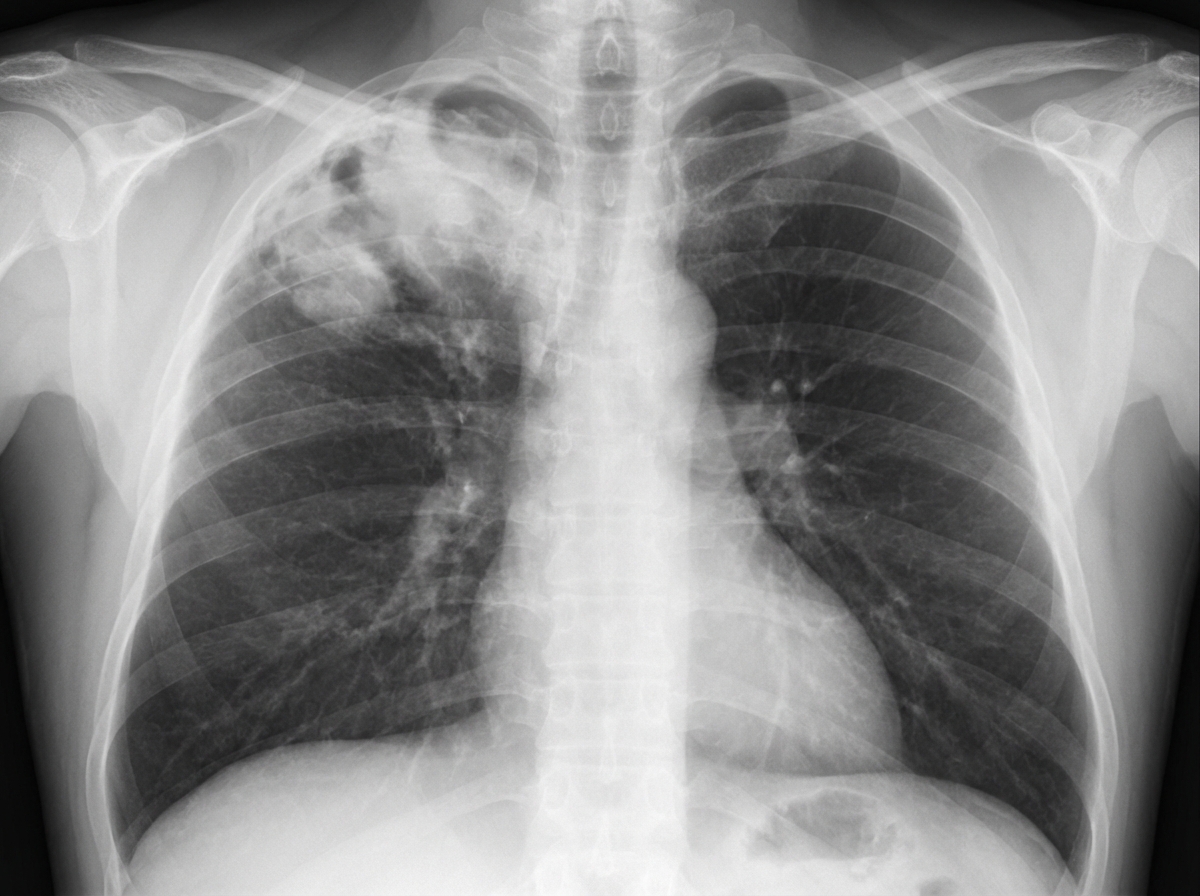
A 68-year-old male is diagnosed with squamous cell carcinoma in the upper lobe of his right lung. A chest radiograph can be seen in image A. Which of the following would you most expect to find in this patient?
A 17-year-old boy is brought to the emergency department by his parents 6 hours after he suddenly began to experience dyspnea and pleuritic chest pain at home. He has a remote history of asthma in childhood but has not required any treatment since the age of four. His temperature is 98.4°F (36.9°C), blood pressure is 100/76 mmHg, pulse is 125/min, respirations are 24/min. On exam, he has decreased lung sounds and hyperresonance in the left upper lung field. A chest radiograph shows a slight tracheal shift to the right. What is the best next step in management?
A 15-year-old boy is brought to the emergency department with a 30 minute history of difficulty breathing. He was playing basketball in gym class when he suddenly felt pain in the right side of his chest that got worse when he tried to take a deep breath. Physical exam reveals a tall, thin boy taking rapid shallow breaths. There are decreased breath sounds in the right lung fields and the right chest is hyperresonant to percussion. Which of the following is true of the lesions that would most likely be seen in this patient's lungs?
A 35-year-old male presents to the emergency room with difficulty breathing. He is accompanied by his wife who reports that they were eating peanuts while lying in bed on their backs when he suddenly started coughing profusely. He has a significant cough and has some trouble breathing. His past medical history is notable for obesity, obstructive sleep apnea, seasonal allergies, and alcohol abuse. He uses a continuous positive airway pressure machine nightly. His medications include cetirizine and fish oil. He has a 10 pack-year smoking history. His temperature is 98.6°F (37°C), blood pressure is 125/30 mmHg, pulse is 110/min, and respirations are 23/min. Which of the following lung segments is most likely affected in this patient?
A 21-year-old lacrosse player comes to the doctor for an annual health assessment. She does not smoke or drink alcohol. She is 160 cm (5 ft 3 in) tall and weighs 57 kg (125 lb); BMI is 22 kg/m2. Pulmonary function tests show an FEV1 of 90% and an FVC of 3600 mL. Whole body plethysmography is performed to measure airway resistance. Which of the following structures of the respiratory tree is likely to have the highest contribution to total airway resistance?
An 18-year-old man is brought to the emergency department 30 minutes after being stabbed in the chest during a fight. He has no other injuries. His pulse is 120/min, blood pressure is 90/60 mm Hg, and respirations are 22/min. Examination shows a 4-cm deep, straight stab wound in the 4th intercostal space 2 cm medial to the right midclavicular line. The knife most likely passed through which of the following structures?
A 23-year-old man is brought to the emergency department by a coworker for an injury sustained at work. He works in construction and accidentally shot himself in the chest with a nail gun. Physical examination shows a bleeding wound in the left hemithorax at the level of the 4th intercostal space at the midclavicular line. Which of the following structures is most likely injured in this patient?
Want unlimited practice?
Get full access to all questions, explanations, and performance tracking.
Scan to download app