
Male reproductive organs — MCQs

A 32-year-old man presents to his primary care physician complaining of pain accompanied by a feeling of heaviness in his scrotum. He is otherwise healthy except for a broken arm he obtained while skiing several years ago. Physical exam reveals an enlarged “bag of worms” upon palpation of the painful scrotal region. Shining a light over this area shows that the scrotum does not transilluminate. Which of the following statements is true about the most likely cause of this patient's symptoms?
A 57-year-old male is found to have an elevated prostate specific antigen (PSA) level on screening labwork. PSA may be elevated in prostate cancer, benign prostatic hypertrophy (BPH), or prostatitis. Which of the following best describes the physiologic function of PSA?
A 68-year-old man presents to his primary care physician complaining of a bulge in his scrotum that has enlarged over the past several months. He is found to have a right-sided inguinal hernia and undergoes elective hernia repair. At his first follow-up visit, he complains of a tingling sensation on his scrotum. Which of the following nerve roots communicates with the injured tissues?
A 39-year-old man presents with painless swelling of the right testis and a sensation of heaviness. The physical examination revealed an intra-testicular solid mass that could not be felt separately from the testis. After a thorough evaluation, he was diagnosed with testicular seminoma. Which of the following group of lymph nodes are most likely involved?
A newborn infant with karyotype 46, XY has male internal and external reproductive structures. The lack of a uterus in this infant can be attributed to the actions of which of the following cell types?
After a year of trying to conceive, a young couple in their early twenties decided to try in vitro fertilization. During preliminary testing of fertility, it was found that the male partner had dysfunctional sperm. Past medical history revealed that he had frequent sinus and lung infections throughout his life. The physician noted an abnormal exam finding on palpation of the right fifth intercostal space at the midclavicular line. What would be the most likely diagnosis responsible for this patient's infertility?
A 51-year-old man presents to the emergency department with an episode of syncope. He was at a local farmer's market when he fainted while picking produce. He rapidly returned to his baseline mental status and did not hit his head. The patient has a past medical history of diabetes and hypertension but is not currently taking any medications. His temperature is 97.5°F (36.4°C), blood pressure is 173/101 mmHg, pulse is 82/min, respirations are 14/min, and oxygen saturation is 98% on room air. Physical exam is notable for clear breath sounds and a S4 heart sound. Rectal exam reveals a firm and nodular prostate that is non-tender and a fecal-occult sample that is negative for blood. Which of the following is this patient's presentation most concerning for?
A 65-year-old man presents to the emergency department with abdominal pain and a pulsatile abdominal mass. Further examination of the mass shows that it is an abdominal aortic aneurysm. A computed tomography scan with contrast reveals an incidental finding of a horseshoe kidney, and the surgeon is informed of this finding prior to operating on the aneurysm. Which of the following may complicate the surgical approach in this patient?
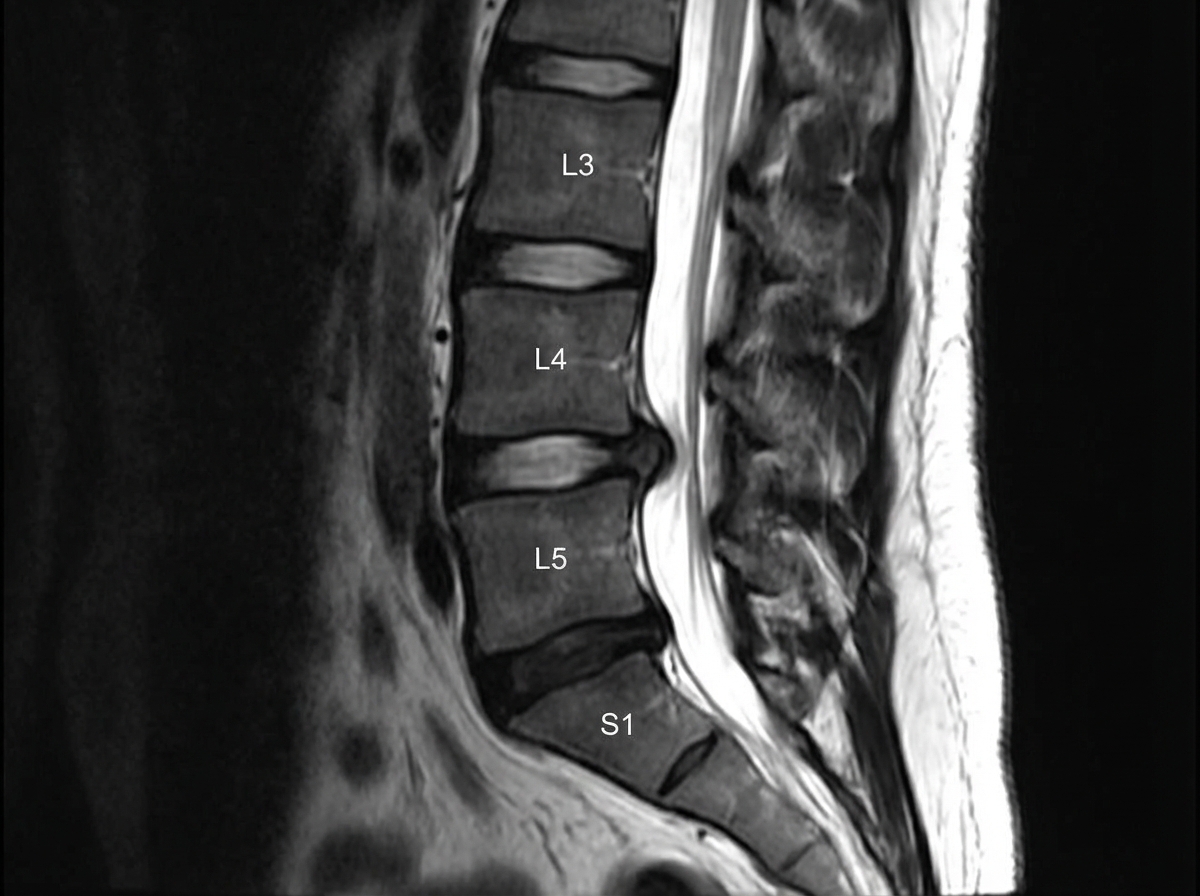
A slipped disc at the level shown in the image would most likely involve which nerve root?
An 11-year-old girl is brought in to her pediatrician by her parents due to developmental concerns. The patient developed normally throughout childhood, but she has not yet menstruated and has noticed that her voice is getting deeper. The patient has no other health issues. On exam, her temperature is 98.6°F (37.0°C), blood pressure is 110/68 mmHg, pulse is 74/min, and respirations are 12/min. The patient is noted to have Tanner stage I breasts and Tanner stage II pubic hair. On pelvic exam, the patient is noted to have a blind vagina with slight clitoromegaly as well as two palpable testes. Through laboratory workup, the patient is found to have 5-alpha-reductase deficiency. Which of the following anatomic structures are correctly matched homologues between male and female genitalia?
Want unlimited practice?
Get full access to all questions, explanations, and performance tracking.
Scan to download app