
Clinical correlations in pelvis/perineum — MCQs

A 33-year-old woman comes to the emergency department because of a 1-hour history of severe pelvic pain and nausea. She was diagnosed with a follicular cyst in the left ovary 3 months ago. The cyst was found incidentally during a fertility evaluation. A pelvic ultrasound with Doppler flow shows an enlarged, edematous left ovary with no blood flow. Laparoscopic evaluation shows necrosis of the left ovary, and a left oophorectomy is performed. During the procedure, blunt dissection of the left infundibulopelvic ligament is performed. Which of the following structures is most at risk of injury during this step of the surgery?
A 67-year-old man comes to the physician because of a 3-month history of difficulty initiating urination. He wakes up at least 3–4 times at night to urinate. Digital rectal examination shows a symmetrically enlarged, nontender prostate with a rubbery consistency. Laboratory studies show a prostate-specific antigen level of 2.1 ng/mL (N < 4). Which of the following is the most likely underlying cause of this patient's symptoms?
A 56-year-old man comes to the clinic complaining of sexual dysfunction. He reports normal sexual function until 4 months ago when his relationship with his wife became stressful due to a death in the family. When asked about the details of his dysfunction, he claims that he is “able to get it up, but just can’t finish the job.” He denies any decrease in libido or erections, endorses morning erections, but an inability to ejaculate. He is an avid cyclist and exercises regularly. His past medical history includes depression and diabetes, for which he takes citalopram and metformin, respectively. A physical examination is unremarkable. What is the most likely explanation for this patient’s symptoms?
A 42-year-old woman, gravida 5, para 5, comes to the physician because of a 6-month history of occasional involuntary urine loss that is exacerbated by coughing, sneezing, and laughing. She has no urgency or dysuria. Physical examination shows normal appearing external genitalia, vagina, and cervix. There is a loss of urine with the Valsalva maneuver. The physician recommends doing Kegel exercises. Which of the following muscles is strengthened by these exercises?
A 76-year-old female with a past medical history of obesity, coronary artery disease status post stent placement, hypertension, hyperlipidemia, and insulin dependent diabetes comes to your outpatient clinic for regular checkup. She has not been very adherent to her diabetes treatment regimen. She has not been checking her sugars regularly and frequently forgets to administer her mealtime insulin. Her Hemoglobin A1c three months ago was 14.1%. As a result of her diabetes, she has developed worsening diabetic retinopathy and neuropathy. Based on her clinical presentation, which of the following is the patient most at risk for developing?
A 42-year-old woman comes to the physician because of right flank pain that started 3 days following a procedure. Her vital signs are within normal limits. Physical examination shows right costovertebral angle tenderness. An intravenous pyelogram shows a dilated renal pelvis and ureter on the right with a lack of contrast proximal to the ureterovesical junction. This patient most likely recently underwent which of the following procedures?
A 60-year-old post-menopausal female presents to her gynecologist with vaginal bleeding. Her last period was over 10 years ago. Dilation and curettage reveals endometrial carcinoma so she is scheduled to undergo a total abdominal hysterectomy and bilateral salpingo-oophorectomy. During surgery, the gynecologist visualizes paired fibrous structures arising from the cervix and attaching to the lateral pelvic walls at the level of the ischial spines. Which of the following vessels is found within each of the paired visualized structure?
A 32-year-old man comes to the physician because of episodic tingling and numbness in his right hand for the past 3 months. His symptoms are worse in the evening. There is no history of trauma. He is employed as a carpenter. He has smoked 1 pack of cigarettes daily for the past 10 years. He drinks a pint of vodka daily. He does not use illicit drugs. His vital signs are within normal limits. Physical examination shows decreased pinch strength in the right hand. Sensations are decreased over the little finger and both the dorsal and palmar surfaces of the medial aspect of the right hand. Which of the following is the most likely site of nerve compression?
A 19-year-old man is brought to the emergency department following a high-speed motor vehicle collision in which he was a restrained passenger. He complains of pelvic pain and urinary retention with overflow incontinence, along with associated lower extremity weakness. Examination shows perineal bruising and there is pain with manual compression of the pelvis. Injury to which of the following structures is most likely responsible for this patient's urinary incontinence?
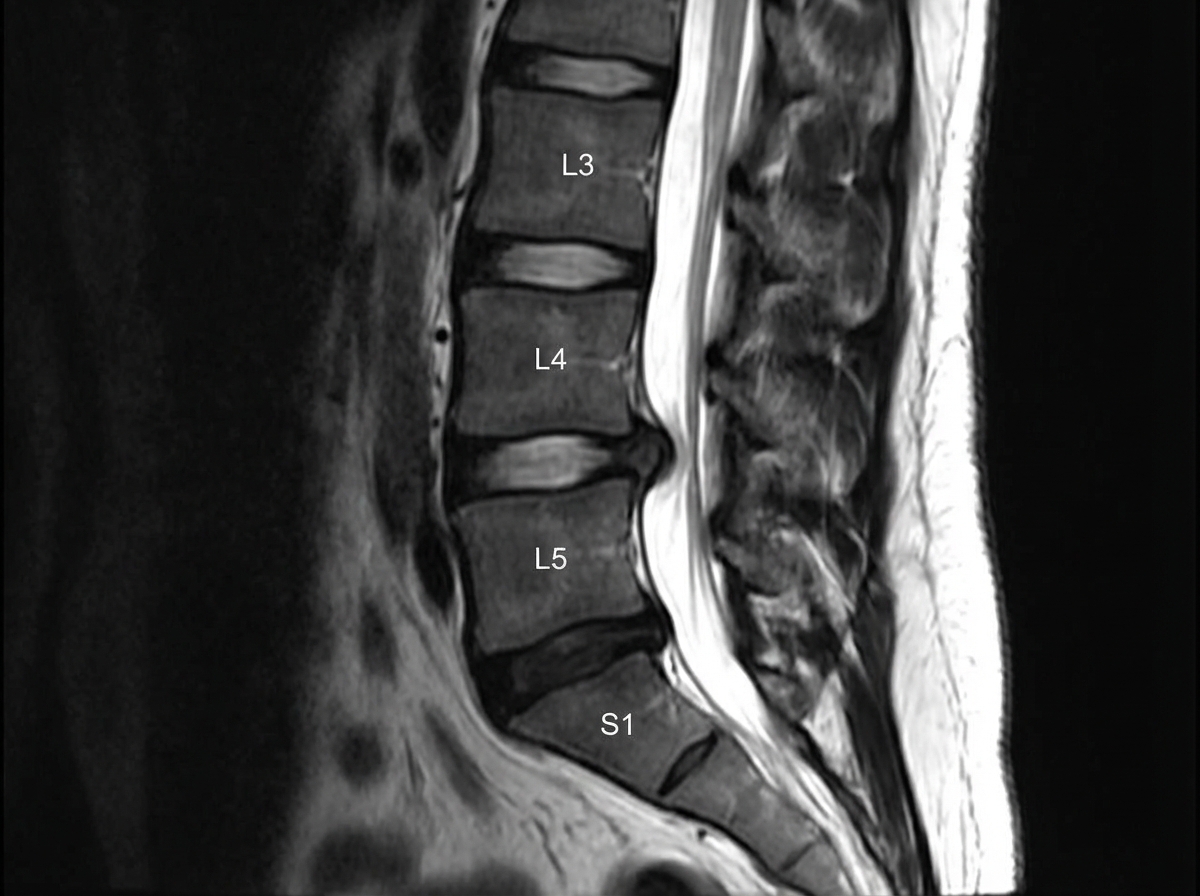
A slipped disc at the level shown in the image would most likely involve which nerve root?
Want unlimited practice?
Get full access to all questions, explanations, and performance tracking.
Scan to download app