
Male reproductive histology — MCQs

A 13-year-old boy is brought to the emergency department by his parents for evaluation of severe groin pain for the past 4 hours. His symptoms began while he was participating in a basketball game. On arrival to the ED, the resident on call notes a swollen, tender, and elevated left testicle with absence of the cremasteric reflex. A urology consult is requested and the patient is scheduled for surgery. An abnormality in which of the following anatomical structures is most likely responsible for this patient’s condition?
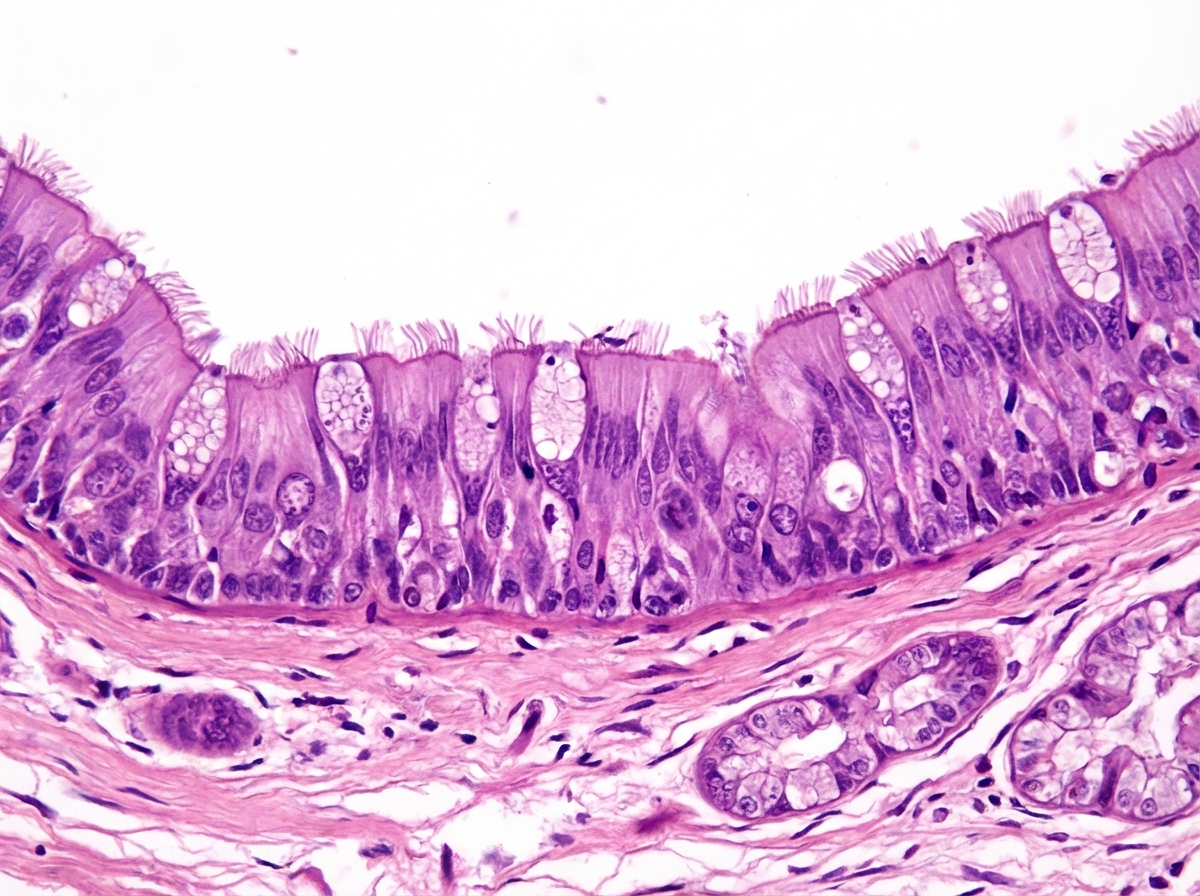
A pathologist examining a tissue sample notes the presence of pseudostratified columnar epithelium with goblet cells and cilia. This tissue was most likely obtained from which of the following locations?
A 34-year-old man comes to the physician because of a 3-week history of left testicular swelling. He has no pain. He underwent a left inguinal hernia repair as a child. He takes no medications. He appears healthy. His vital signs are within normal limits. Examination shows an enlarged, nontender left testicle. When the patient is asked to cough, there is no bulge present in the scrotum. When a light is held behind the scrotum, it does not shine through. There is no inguinal lymphadenopathy. Laboratory studies show: Hemoglobin 14.5 g/dL Leukocyte count 8,800/mm3 Platelet count 345,000/mm3 Serum Glucose 88 mg/dL Creatinine 0.8 mg/dL Total bilirubin 0.7 mg/dL Alkaline phosphatase 35 U/L AST 15 U/L ALT 14 U/L Lactate dehydrogenase 60 U/L β-Human chorionic gonadotropin 80 mIU/mL (N < 5) α-Fetoprotein 6 ng/mL (N < 10) Which of the following is the most likely diagnosis?
A 31-year-old G2P2 female at 40 weeks gestation presents to the hospital following a rush of water that came from her vagina. She is 4 cm dilated and 80% effaced. Fetal heart tracing shows a pulse of 155/min with variable decelerations. About 12 hours after presentation, she gives birth to a 6 lb 15 oz baby boy with APGAR scores of 8 and 9 at 1 and 5 minutes, respectively. Which of the following structures is responsible for inhibition of female internal genitalia?
A 65-year-old African American man presents for follow-up examination with a 6-month history of urinary hesitancy, weak stream, and terminal dribbling, which is refractory to a combination therapy of finasteride and tamsulosin. The patient’s past medical history is otherwise unremarkable. His father and brother were diagnosed with prostate cancer at the age of 55 years. His vital signs are within normal limits. The patient has a normal anal sphincter tone and a bulbocavernosus muscle reflex. Digital rectal exam (DRE) reveals a prostate size equivalent to 2 finger pads with a hard nodule and without fluctuance or tenderness. Serum prostate-specific antigen (PSA) level is 5 ng/mL. Which of the following investigations is most likely to establish a definitive diagnosis?
A research team is studying certain congenital anomalies of the respiratory tract. The method consists of marking a certain germinal layer with an isotope, following its development stages in chicken embryos, and finally analyzing the specimen. A given specimen of tissue is presented in the exhibit. Which of the following germinal structures most likely gave rise to the epithelial lining of this specimen?
A 35-year-old woman comes to the physician because of a 3-month history of facial hair growth, acne, and irregular menses. Her friends have told her that her voice sounds lower than usual. Physical examination shows pustular acne and dark hair growth along the jawline. Serum studies show elevated testosterone levels and normal inhibin levels. An ultrasound of the pelvis shows a left-sided ovarian mass. Microscopic examination of the resected ovarian mass shows pale, testosterone-positive staining cells with cytoplasmic Reinke crystal inclusions. These abnormal cells are homologous to which of the following physiological cell type in females?
A 51-year-old man presents to the emergency department with an episode of syncope. He was at a local farmer's market when he fainted while picking produce. He rapidly returned to his baseline mental status and did not hit his head. The patient has a past medical history of diabetes and hypertension but is not currently taking any medications. His temperature is 97.5°F (36.4°C), blood pressure is 173/101 mmHg, pulse is 82/min, respirations are 14/min, and oxygen saturation is 98% on room air. Physical exam is notable for clear breath sounds and a S4 heart sound. Rectal exam reveals a firm and nodular prostate that is non-tender and a fecal-occult sample that is negative for blood. Which of the following is this patient's presentation most concerning for?
A 55-year-old man comes to the physician because of difficulties achieving an erection for the past year. A medication is prescribed that inhibits cyclic GMP phosphodiesterase type 5. Which of the following is the most likely site of action of the prescribed drug?
A 35-year-old woman presents to a pre-operative evaluation clinic prior to an elective cholecystectomy. She has a 5 pack-year smoking history. The anesthesiologist highly recommends to discontinue smoking for at least 8 weeks prior to the procedure for which she is compliant. What is the most likely histology of her upper respiratory tract's epithelial lining at the time of her surgery?
Want unlimited practice?
Get full access to all questions, explanations, and performance tracking.
Scan to download app