
Liver and gallbladder histology — MCQs

A 34-year-old patient presents with severe pain in the right upper quadrant that radiates to the right shoulder. During laparoscopic cholecystectomy, which of the following anatomical spaces must be carefully identified to prevent bile duct injury?
A 45-year-old man comes to the physician for a routine health maintenance examination. He feels well. He has type 2 diabetes mellitus. There is no family history of serious illness. He works as an engineer at a local company. He does not smoke. He drinks one glass of red wine every other day. He does not use illicit drugs. His only medication is metformin. He is 180 cm (5 ft 11 in) tall and weighs 100 kg (220 lb); BMI is 31 kg/m2. His vital signs are within normal limits. Examination shows a soft, nontender abdomen. The liver is palpated 2 to 3 cm below the right costal margin. Laboratory studies show an aspartate aminotransferase concentration of 100 U/L and an alanine aminotransferase concentration of 130 U/L. Liver biopsy shows hepatocyte ballooning degeneration, as well as inflammatory infiltrates with scattered lymphocytes, neutrophils, and Kupffer cells. Which of the following is the most likely diagnosis?
A 57-year-old man presents with fever and yellow discoloration of the skin for the past 4 days. He denies any recent weight loss or changes in urine or stool color. His past medical history is unremarkable. He admits to drinking about 130 g/day of alcohol and says he has been doing so for the past 25 years. His wife who is accompanying him during this visit adds that once her husband drank 15 cans of beer at a funeral. The patient also reports a 10-pack-year smoking history. His vital signs include: pulse 98/min, respiratory rate 13/min, temperature 38.2°C (100.8°F) and blood pressure 120/90 mm Hg. On physical examination, the patient appears jaundiced and is ill-appearing. Sclera is icteric. Abdominal examination reveals tenderness to palpation in the right upper quadrant with no rebound or guarding. Percussion reveals significant hepatomegaly extending 3 cm below the right costal margin. Laboratory studies are significant for the following: Sodium 135 mEq/L Potassium 3.5 mEq/L ALT 240 U/L AST 500 U/L A liver biopsy is obtained but the results are pending. Which of the following would most likely be seen in this patient's biopsy?
A 49-year-old woman presents to the primary care physician with complaints of recurrent episodes of right upper abdominal pain for the past 2 years. She is currently symptom-free. She mentions that the pain often occurs after a heavy fatty meal and radiates to her right shoulder. On examination, the patient has no tenderness in the abdomen and all other systemic examination is normal. Blood work shows: Leukocyte count 8,000/mm³ Total bilirubin 1.2 mg/dL Prothrombin time 12 s Aspartate transaminase 58 IU/L Alanine transaminase 61 IU/L Serum albumin 4.1 g/dL Stool occult blood negative Ultrasonography of the abdomen shows a thickened gallbladder wall with few gallstones. A hydroxy iminodiacetic acid (HIDA) scan was done which demonstrated non-filling of the gallbladder and a minimal amount of tracer in the common bile duct. Which of the following best describes a histopathological feature in the gallbladder described in this case?
A 40-year-old man presents to his primary care provider complaining of abdominal pain. The patient reports a dull pain that has been present for 4 weeks now. The patient states that the pain is located to his right upper quadrant and does not change with eating. The patient denies any alcohol or illicit substance use, stating that he is meticulous about eating healthy since he is a professional bodybuilder. The patient reports no history of malignancy. On exam, the patient's temperature is 98.2°F (36.8°C), blood pressure is 130/86 mmHg, pulse is 60/min, and respirations are 12/min. The patient has an athletic build, and his exam is unremarkable for any palpable mass or abdominal tenderness. On further questioning, the patient does endorse a 5-year history of using anabolic steroids for bodybuilding. Imaging demonstrates an enhancing liver nodule. Which of the following is the most likely histopathologic finding of this patient’s disease?
A previously healthy 75-year-old woman comes to the physician because of fatigue and decreasing exercise tolerance over the past 6 weeks. She also has intermittent episodes of dizziness. She has never smoked and does not drink alcohol. She takes a daily multivitamin. She appears pale. Physical examination shows a smooth liver that is palpable 1 cm below the costal margin. The spleen is not palpable. Laboratory studies show: Hemoglobin 9.8 g/dL MCV 104 fL Reticulocyte count 0.2 % Folate 21 ng/mL (N = 2–20) Vitamin B12 789 pg/mL (N = 200–900) A peripheral blood smear shows anisocytosis and bone marrow aspirate shows ringed sideroblasts. This patient is most likely to develop which of the following?
A 28-year-old male presents to his primary care physician with complaints of intermittent abdominal pain and alternating bouts of constipation and diarrhea. His medical chart is not significant for any past medical problems or prior surgeries. He is not prescribed any current medications. Which of the following questions would be the most useful next question in eliciting further history from this patient?
Two weeks after returning from vacation in Mexico, a 21-year-old man comes to the emergency department because of malaise, nausea, vomiting, fever, and abdominal pain. He has no history of serious illness and takes no medications. Physical examination shows scleral icterus and right upper quadrant tenderness. The liver is palpated 1.5 cm below the right costal margin. A biopsy specimen of this patient's liver would most likely show which of the following findings?
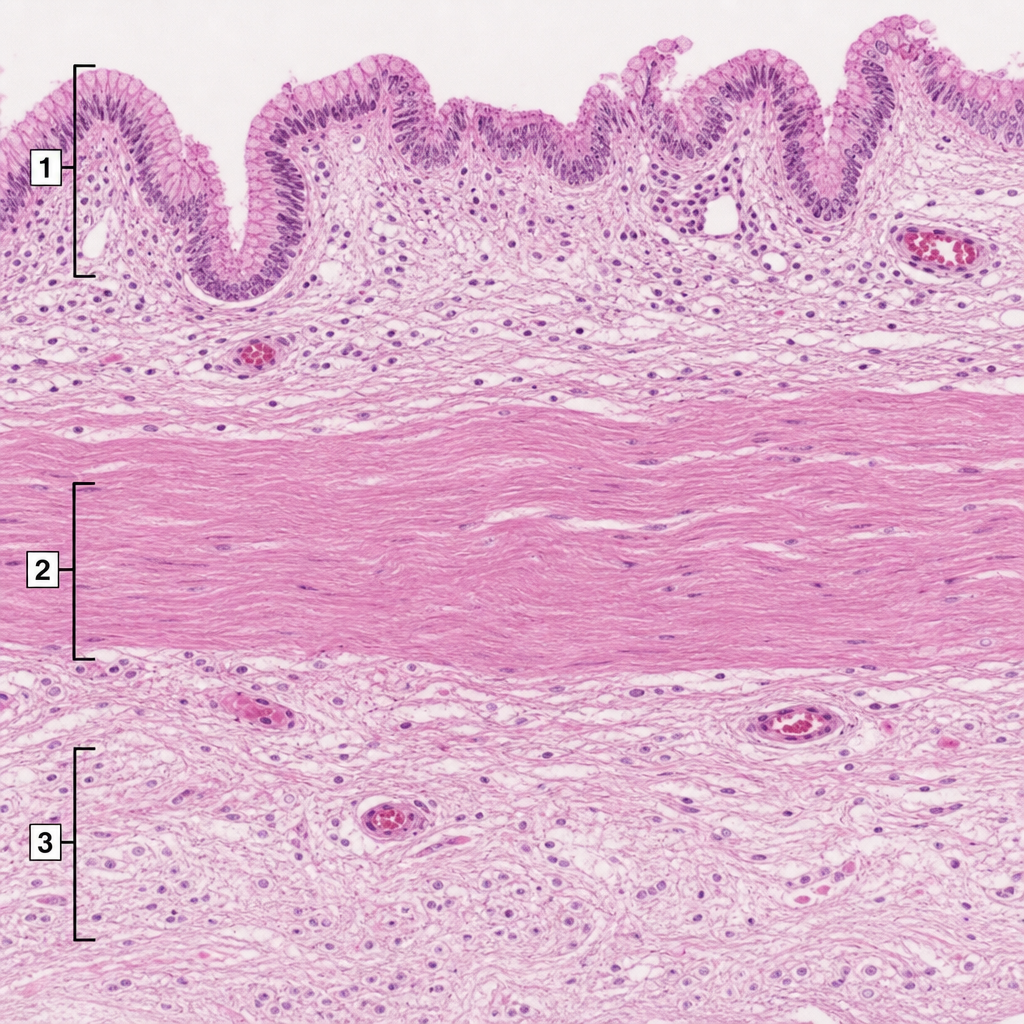
A 36-year-old man undergoes surgical intervention due to a right upper quadrant stab wound. His gallbladder was found to be lacerated and is removed. It is sent for histological evaluation. The pathologist examines the slide shown in the exhibit and identifies several structures numbered the image. Which of the following statements is correct?
A 32-year-old woman presents with amenorrhea and galactorrhea. MRI shows a pituitary adenoma. Histological examination of the surgical specimen shows cells arranged in cords and nests with sinusoidal capillaries. Special staining reveals three distinct cell types: chromophobes (50%), acidophils (40%), and basophils (10%). Immunohistochemistry shows the tumor cells staining strongly for prolactin. Evaluate the relationship between normal pituitary architecture and tumor development to determine which cell type most likely gave rise to this neoplasm.
Want unlimited practice?
Get full access to all questions, explanations, and performance tracking.
Scan to download app