
Central and peripheral nervous system histology — MCQs

A 32-year-old woman presents with a 3-month history of intermittent blurred vision and problems walking. The patient states that she often feels “pins and needles” in her legs that cause her problems when she’s walking. The patient is afebrile, and her vital signs are within normal limits. An autoimmune disorder is suspected. Which of the following findings would most likely be present in this patient?
Which receptor type mediates the slow phase of synaptic transmission in autonomic ganglia?
An investigator is studying cellular repair mechanisms in various tissues. One of the samples being reviewed is from the anterior horn of the spinal cord of a patient who was involved in a snowboard accident. Pathologic examination of the biopsy specimen shows dispersion of the Nissl bodies, swelling of the neuronal body, and a displacement of the nucleus to the periphery in numerous cells. Which of the following is the most likely explanation for the observed findings?
A 57-year-old man is brought to the emergency department by his wife 20 minutes after having had a seizure. He has had recurrent headaches and dizziness for the past 2 weeks. An MRI of the brain shows multiple, round, well-demarcated lesions in the brain parenchyma at the junction between gray and white matter. This patient's brain lesions are most likely comprised of cells that originate from which of the following organs?
A researcher is studying the brains of patients who recently died from stroke-related causes. One specimen has a large thrombus in an area of the brain that is important in relaying many modalities of sensory information from the periphery to the sensory cortex. Which of the following embryologic structures gave rise to the part of the brain in question?
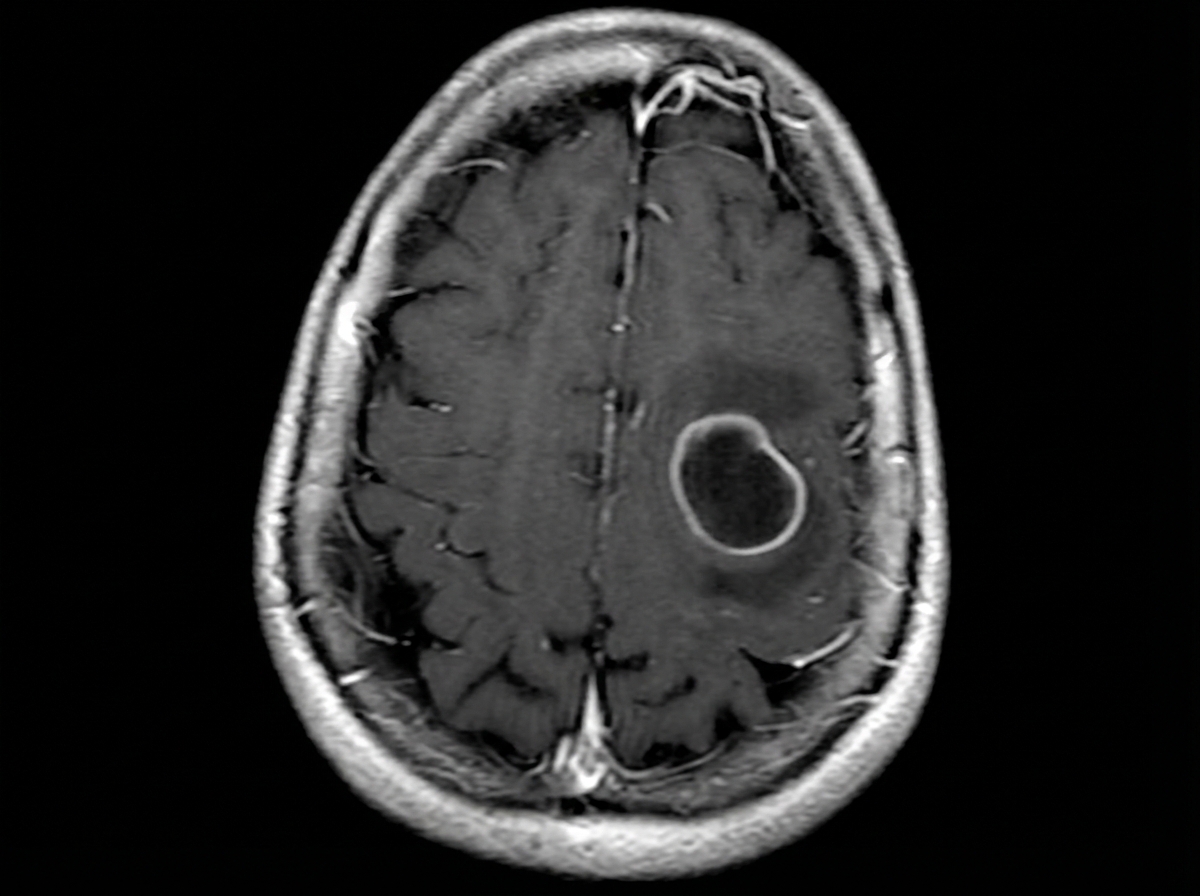
A 61-year-old woman visits the clinic with a complaint of new-onset episodic abnormal body movements. She says her husband noticed it twice in the past week. There were jerky movements for roughly 15 seconds during her last episode. She denies any recent trauma or fever. Her vital signs include: blood pressure 114/74 mm Hg, pulse 81/min, temperature 36.7°C (98.1°F) and respiratory rate 10/min. On physical examination, there is no evidence of focal neurological deficits. A basic metabolic panel is ordered which shows: Sodium 141 mEq/L Potassium 5.1 mEq/L Chloride 101 mEq/L Bicarbonate 24 mEq/L Albumin 4.3 mg/dL Urea nitrogen 11 mg/dL Creatinine 1.0 mg/dL Uric Acid 6.8 mg/dL Calcium 8.9 mg/dL Glucose 111 mg/dL A contrast magnetic resonance imaging (MRI) of the head is shown in the provided image. Which of the following cells is the origin of the lesion seen in this patient’s MRI?
A 26-year-old man presents to his primary doctor with one week of increasing weakness. He reports that he first noticed difficulty walking while attending his sister's graduation last week, and yesterday he had difficulty taking his coffee cup out of the microwave. He remembers having nausea and vomiting a few weeks prior, but other than that has no significant medical history. On exam, he has decreased reflexes in his bilateral upper and lower extremities, with intact sensation. If a lumbar puncture is performed, which of the following results are most likely?
A 26-year-old woman presents to the obstetrics ward to deliver her baby. The obstetrician establishes a pudendal nerve block via intravaginal injection of lidocaine near the tip of the ischial spine. From which of the following nerve roots does the pudendal nerve originate?
A 21-year-old G3P2 woman presents to her obstetrician at 6 weeks gestation for routine prenatal care. Her past medical history includes obesity and gestational diabetes. She has had two spontaneous vaginal deliveries at term. One infant was macrosomic with hypoglycemia, but otherwise, she has had no complications. Her physician informs her that she must start taking a multivitamin with folic acid daily. The defect that folic acid supplementation protects against arises in tissue that is derived from which germ cell layer?
A 33-year-old man is brought to the emergency department 20 minutes after he fell from the roof of his house. On arrival, he is unresponsive to verbal and painful stimuli. His pulse is 72/min and blood pressure is 132/86 mm Hg. A CT scan of the head shows a fracture in the anterior cranial fossa and a 1-cm laceration in the left anterior orbital gyrus. If the patient survives, which of the following would ultimately be the most common cell type at the injured region of the frontal lobe?
Want unlimited practice?
Get full access to all questions, explanations, and performance tracking.
Scan to download app