
Limbic system — MCQs

A 78-year-old woman is brought to the physician by her son because of progressive memory loss for the past year. She feels tired and can no longer concentrate on her morning crossword puzzles. She has gained 11.3 kg (25 lb) in the last year. Her father died from complications of Alzheimer disease. She has a history of drinking alcohol excessively but has not consumed alcohol for the past 10 years. Vital signs are within normal limits. She is oriented but has short-term memory deficits. Examination shows a normal gait and delayed relaxation of the achilles reflex bilaterally. Her skin is dry and she has brittle nails. Which of the following is the most likely underlying etiology of this woman’s memory loss?
A 62-year-old man is brought to the emergency department because of headache, blurring of vision, and numbness of the right leg for the past 2 hours. He has hypertension and type 2 diabetes mellitus. Current medications include enalapril and metformin. He is oriented only to person. His temperature is 37.3°C (99.1°F), pulse is 99/min and blood pressure is 158/94 mm Hg. Examination shows equal pupils that are reactive to light. Muscle strength is normal in all extremities. Deep tendon reflexes are 2+ bilaterally. Sensation to fine touch and position is decreased over the right lower extremity. The confrontation test shows loss of the nasal field in the left eye and the temporal field in the right eye with macular sparing. He is unable to read phrases shown to him but can write them when they are dictated to him. He has short-term memory deficits. Which of the following is the most likely cause for this patient's symptoms?
A 52-year-man is brought to the physician because of a 2-week history of memory loss. Three weeks ago, he had a cardiac arrest that required cardiopulmonary resuscitation and intravenous epinephrine. On mental status examination, he cannot recall objects shown to him 20 minutes earlier but vividly recalls memories from before the incident. The remainder of the examination shows no abnormalities. Which of the following structures of the brain is most likely affected?
A neurology resident sees a stroke patient on the wards. This 57-year-old man presented to the emergency department after sudden paralysis of his right side. He was started on tissue plasminogen activator within 4 hours, as his wife noticed the symptoms and immediately called 911. When the resident asks the patient how he is doing, he replies by saying that his apartment is on Main St. He does not seem to appropriately answer the questions being asked, but rather speaks off topic. He is able to repeat the word "fan." His consciousness is intact, and his muscle tone and reflexes are normal. Upon striking the lateral part of his sole, his big toe extends upward and the other toes fan out. Which of the following is the area most likely affected in his condition?
A 58-year-old right-handed man is brought to the emergency department after he was found unconscious in his living room by his wife. She reports that he has never had a similar episode before. The patient has hypertension and consumes multiple alcoholic drinks per day. On arrival, he is confused and oriented only to person. He cannot recall what happened. He has difficulty speaking and his words are slurred. He reports a diffuse headache and muscle pain and appears fatigued. His temperature is 37°C (98.6°F), pulse is 85/min, respirations are 14/min, and blood pressure is 135/70 mm Hg. Examination shows a 2-cm bruise on his right shoulder. Strength is 5/5 throughout, except for 1/5 in the left arm. The remainder of the physical examination shows no abnormalities. An ECG shows left ventricular hypertrophy. A CT scan of the head without contrast shows no abnormalities. Which of the following is the most likely underlying cause of this patient's symptoms?
A 46-year-old homeless man was found wandering aimlessly in the supermarket. On examination, he is confused and said that the President appointed men to kill him because he is disclosing state secrets to extraterrestrial organisms. The man also has horizontal nystagmus and an ataxic gait. What is the most likely cause of the clinical presentation?
A man appearing to be in his mid-50s is brought in by ambulance after he was seen walking on railroad tracks. On further questioning, the patient does not recall being on railroad tracks and is only able to provide his name. Later on, he states that he is a railroad worker, but this is known to be false. On exam, his temperature is 99.9°F (37.7°C), blood pressure is 128/86 mmHg, pulse is 82/min, and respirations are 14/min. He appears disheveled, and his clothes smell of alcohol. The patient is alert, is only oriented to person, and is found to have abnormal eye movements and imbalanced gait when attempting to walk. Which of the following structures in the brain likely has the greatest reduction in the number of neurons?
A 54-year-old man is brought to the emergency department 30 minutes after being hit by a car while crossing the street. He had a left-sided tonic-clonic seizure and one episode of vomiting while being transported to the hospital. On arrival, he is not oriented to person, place, or time. Physical examination shows flaccid paralysis of all extremities. A CT scan of the head is shown. This patient's symptoms are most likely the result of a hemorrhage in which of the following structures?
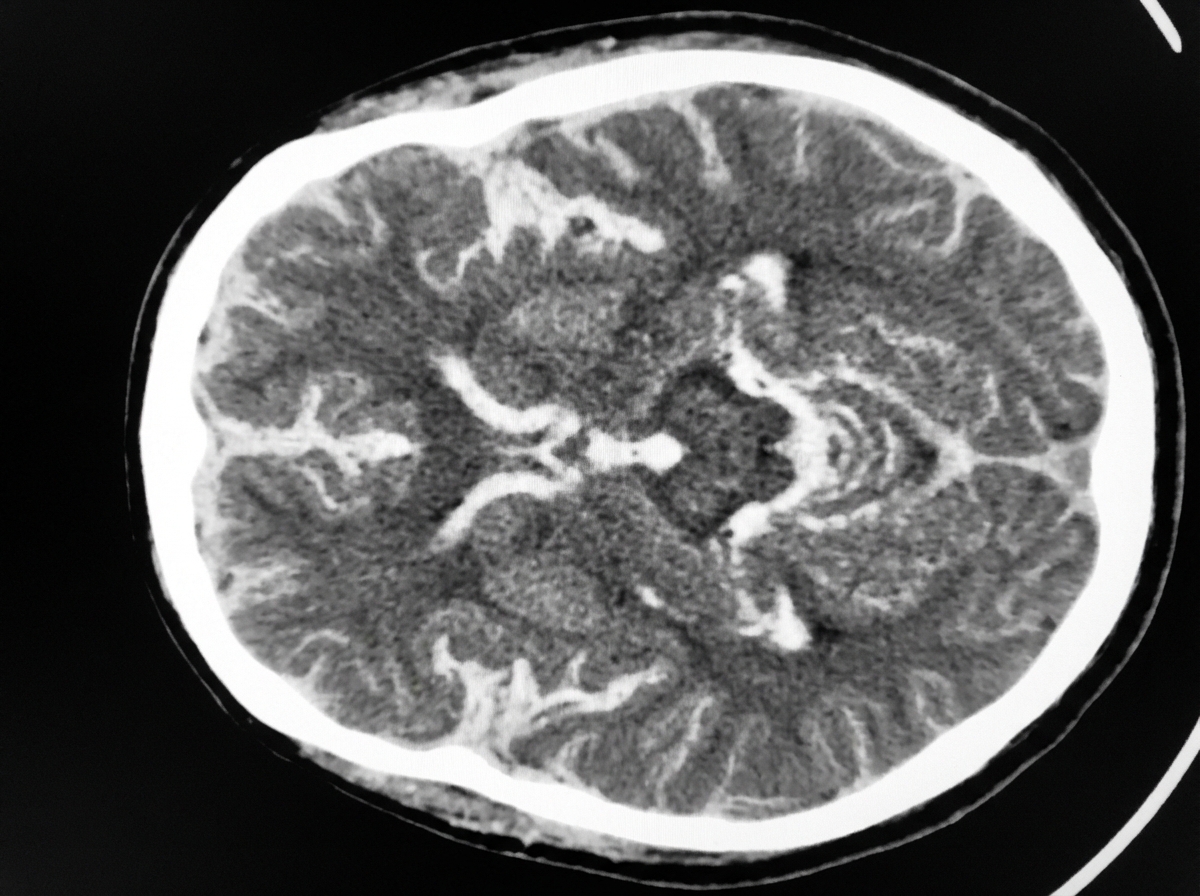
A 67-year-old man is brought to the physician by his daughter because he frequently misplaces his personal belongings and becomes easily confused. His daughter mentions that his symptoms have progressively worsened for the past one year. On mental status examination, he is oriented to person, place, and time. He vividly recalls memories from his childhood but can only recall one of three objects presented to him after 5 minutes. His affect is normal. This patients' symptoms are most likely caused by damage to which of the following?
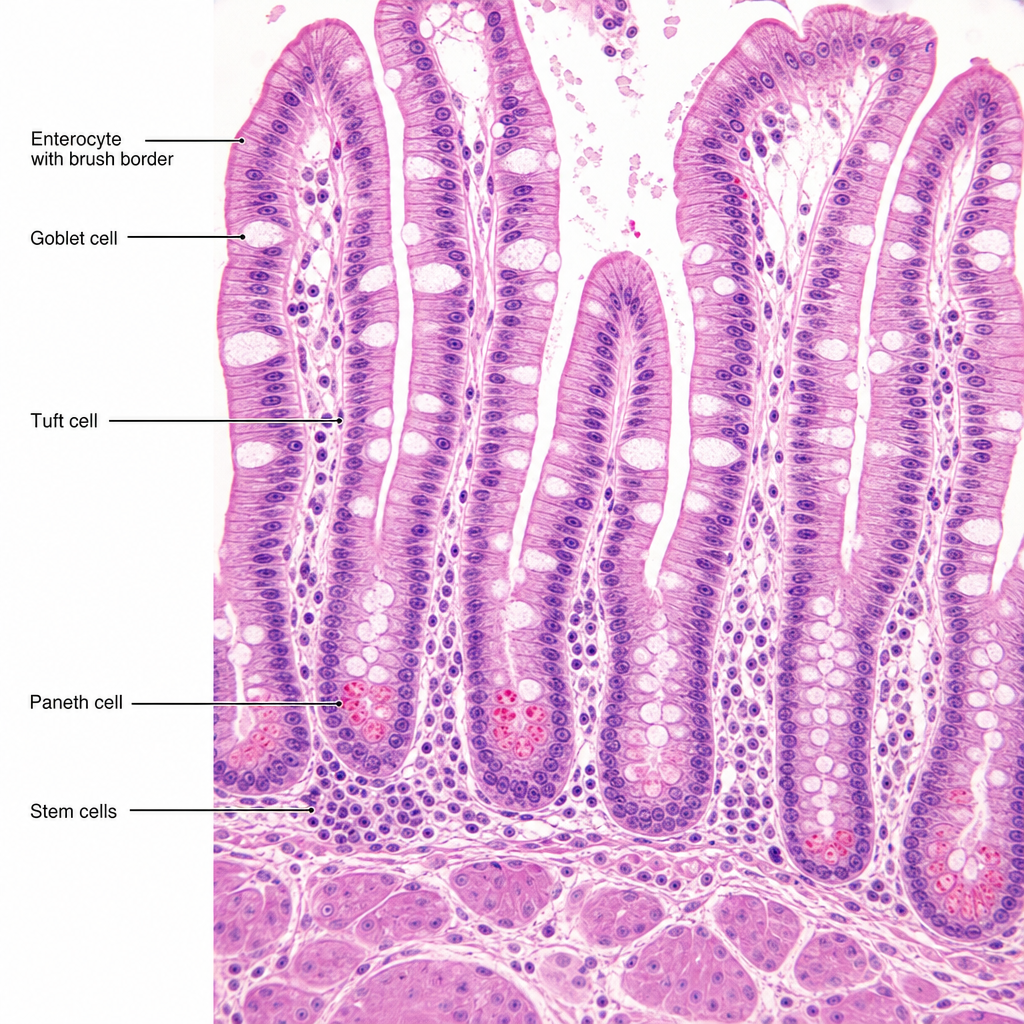
A histology slide from a surgical biopsy of the small intestine reveals tall columnar cells with a prominent brush border, interspersed with flask-shaped cells containing apical mucin granules, and occasional triangular cells wedged at the base of the crypts with eosinophilic granules. A separate population of undifferentiated cells is clustered at the base of the crypts. Based on this architecture, which cell type is responsible for the eosinophilic granules and what is its primary functional role?
Want unlimited practice?
Get full access to all questions, explanations, and performance tracking.
Scan to download app