
Cerebral cortex and lobes — MCQs

A 52-year-man is brought to the physician because of a 2-week history of memory loss. Three weeks ago, he had a cardiac arrest that required cardiopulmonary resuscitation and intravenous epinephrine. On mental status examination, he cannot recall objects shown to him 20 minutes earlier but vividly recalls memories from before the incident. The remainder of the examination shows no abnormalities. Which of the following structures of the brain is most likely affected?
A 61-year-old man is brought to the emergency room with slurred speech. According to the patient's wife, they were watching a movie together when he developed a minor headache. He soon developed difficulty speaking in complete sentences, at which point she decided to take him to the emergency room. His past medical history is notable for hypertension and hyperlipidemia. He takes aspirin, lisinopril, rosuvastatin. The patient is a retired lawyer. He has a 25-pack-year smoking history and drinks 4-5 beers per day. His father died of a myocardial infarction, and his mother died of breast cancer. His temperature is 98.6°F (37°C), blood pressure is 143/81 mmHg, pulse is 88/min, and respirations are 21/min. On exam, he can understand everything that is being said to him and is able to repeat statements without difficulty. However, when asked to speak freely, he hesitates with every word and takes 30 seconds to finish a short sentence. This patient most likely has an infarct in which of the following vascular distributions?
A 60-year-old man is brought to the emergency department by police officers because he was acting strangely in public. The patient was found talking nonsensically to characters on cereal boxes in the store. Past medical history is significant for multiple hospitalizations for alcohol-related injuries and seizures. The patient’s vital signs are within normal limits. Physical examination shows a disheveled male who is oriented to person, but not time or place. Neurologic examination shows nystagmus and severe gait ataxia. A T1/T2 MRI is performed and demonstrates evidence of damage to the mammillary bodies. The patient is given the appropriate treatment for recovering most of his cognitive functions. However, significant short-term memory deficits persist. The patient remembers events from his past such as the school and college he attended, his current job, and the names of family members quite well. Which of the following is the most likely diagnosis in this patient?
A 67-year-old female patient is brought to the emergency department after her daughter noticed she has been having meaningless speech. When assessing the patient, she calls the chair a table, and at times would make up new words. She does not appear to be aware of her deficit, and is carrying on an empty conversation. Her speech is fluent, but with paraphasic errors. Her repetition is impaired. On physical examination, a right upper quadrant field-cut is appreciated, with impairment in comprehension and repetition. Which of the following structures is most likely involved in this patient’s presentation?
A 67-year-old man is brought to the physician by his daughter because he frequently misplaces his personal belongings and becomes easily confused. His daughter mentions that his symptoms have progressively worsened for the past one year. On mental status examination, he is oriented to person, place, and time. He vividly recalls memories from his childhood but can only recall one of three objects presented to him after 5 minutes. His affect is normal. This patients' symptoms are most likely caused by damage to which of the following?
A 54-year-old man with hypertension and congenital blindness comes to the physician because he is unable to recognize objects by touch with his right hand. The symptoms started about 2 hours ago. When given a house key, he can feel the object in his right hand but is not able to identify what it is. This patient's condition is most likely caused by a lesion in which of the following locations?
A 75-year-old woman presents with sudden loss of vision. She says that she was reading when suddenly she was not able to see the print on half of the page. Her symptoms started 4 hours ago and are accompanied by a severe posterior headache. Vital signs reveal the following: blood pressure 119/76 mm Hg, pulse 89/min, SpO2 98% on room air. The patient was unable to recognize her niece when she arrived to see her. A noncontrast CT of the head shows no evidence of hemorrhagic stroke. What is the most likely diagnosis in this patient?
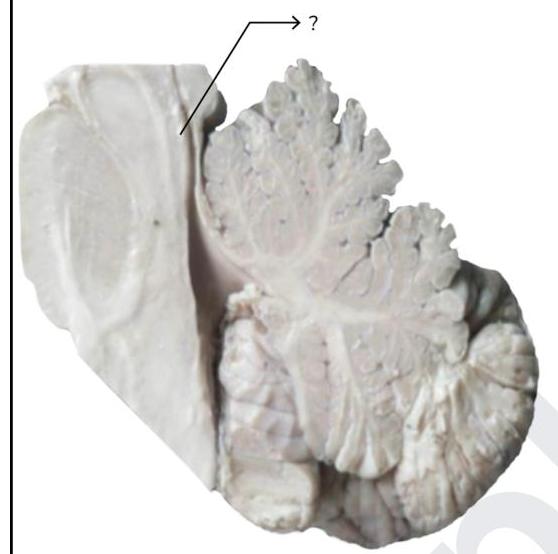
Fibers from the marked structure terminate at which of the following?
A 75-year-old woman is brought to the physician by her daughter for a 4-month history of increasing difficulty recognizing her friends and family. She has had to rely on recognizing haircuts, gait, and voices because she cannot remember their faces. Neurologic examination shows that she is able to recognize objects and name facial features such as the eyes and nose. On mental status examination, she is alert and has no deficits in cognition or short-term memory. An MRI of her head shows an inhomogeneous 2-cm mass with perifocal edema in her brain. Which of the following brain regions is most likely affected?
A 68-year-old man is brought to the emergency department by ambulance after he was found to be altered at home. Specifically, his wife says that he fell and was unable to get back up while walking to bed. When she approached him, she found that he was unable to move his left leg. His past medical history is significant for hypertension, atrial fibrillation, and diabetes. In addition, he has a 20-pack-year smoking history. On presentation, he is found to still have difficulty moving his left leg though motor function in his left arm is completely intact. The cause of this patient's symptoms most likely occurred in an artery supplying which of the following brain regions?
Want unlimited practice?
Get full access to all questions, explanations, and performance tracking.
Scan to download app