
Cell and tissue identification keys — MCQs

A 13-year-old girl is referred to an oral surgeon after complaining of tooth pain, especially in the upper jaw. A review of her medical history reveals status post-surgical repair of a patent ductus arteriosus when she was 6 years old. At the clinic, her temperature is 37.0ºC (98.6°F), pulse is 90/min, respirations are 18/min, and blood pressure is 110/78 mm Hg. On physical examination, her height is 157.5 cm (5 ft 2 in), her weight is 50 kg (110 lb) and her arms seem disproportionately long for her trunk. She also has arachnodactyly and moderate joint laxity. Intraoral examination reveals crowded teeth and a high arched palate. Which of the following protein is most likely defective in this condition?
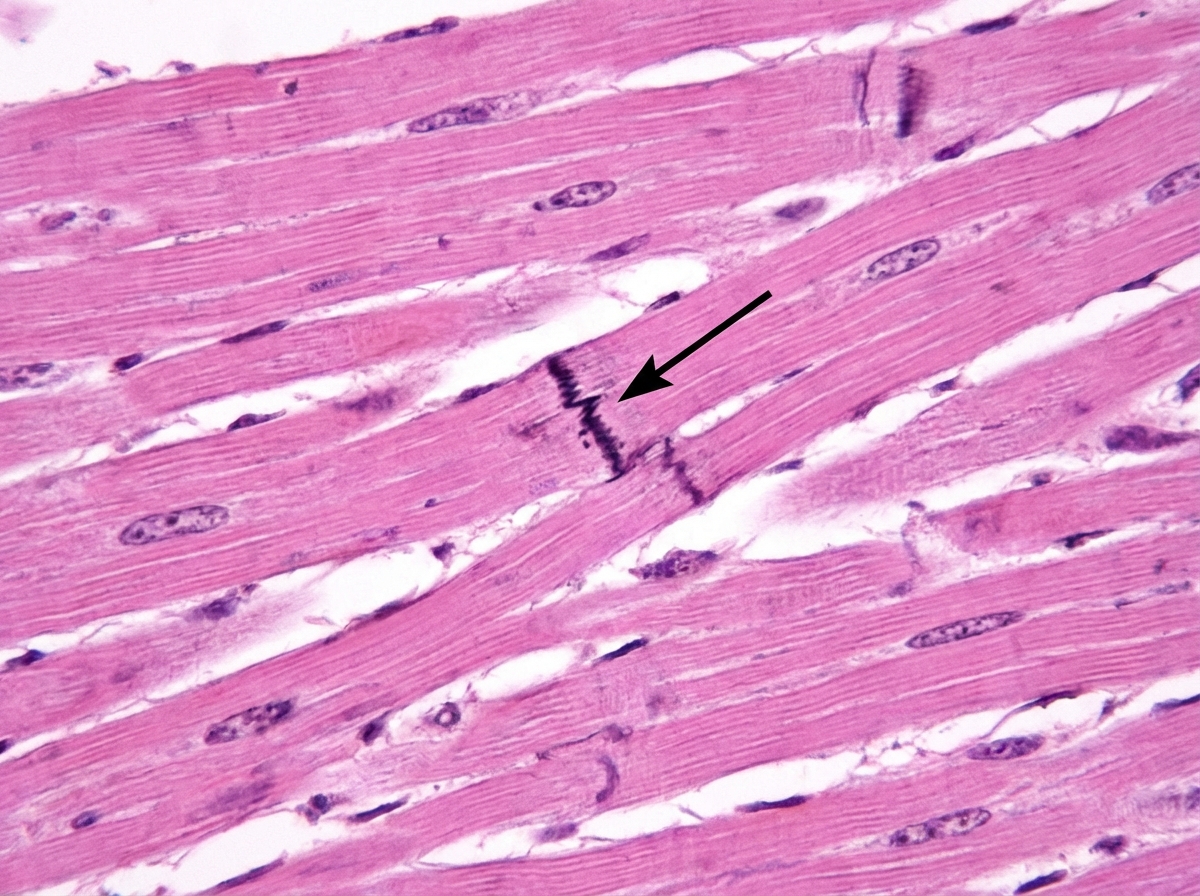
Cardiac muscle serves many necessary functions, leading to a specific structure that serves these functions. The structure highlighted is an important histology component of cardiac muscle. What would be the outcome if this structure diffusely failed to function?
An investigator is studying cellular repair mechanisms in various tissues. One of the samples being reviewed is from the anterior horn of the spinal cord of a patient who was involved in a snowboard accident. Pathologic examination of the biopsy specimen shows dispersion of the Nissl bodies, swelling of the neuronal body, and a displacement of the nucleus to the periphery in numerous cells. Which of the following is the most likely explanation for the observed findings?
A 57-year-old man is brought to the emergency department by his wife 20 minutes after having had a seizure. He has had recurrent headaches and dizziness for the past 2 weeks. An MRI of the brain shows multiple, round, well-demarcated lesions in the brain parenchyma at the junction between gray and white matter. This patient's brain lesions are most likely comprised of cells that originate from which of the following organs?
A healthy 22-year-old male participates in a research study you are leading to compare the properties of skeletal and cardiac muscle. You conduct a 3-phased experiment with the participant. In the first phase, you get him to lift up a 2.3 kg (5 lb) weight off a table with his left hand. In the second phase, you get him to do 20 burpees, taking his heart rate to 150/min. In the third phase, you electrically stimulate his gastrocnemius with a frequency of 50 Hz. You are interested in the tension and electrical activity of specific muscles as follows: Biceps in phase 1, cardiac muscle in phase 2, and gastrocnemius in phase 3. What would you expect to be happening in the phases and the respective muscles of interest?
A 57-year-old man comes to the physician for a follow-up evaluation of chronic, retrosternal chest pain. The pain is worse at night and after heavy meals. He has taken oral pantoprazole for several months without any relief of his symptoms. Esophagogastroduodenoscopy shows ulcerations in the distal esophagus and a proximally dislocated Z-line. A biopsy of the distal esophagus shows columnar epithelium with goblet cells. Which of the following microscopic findings underlie the same pathomechanism as the cellular changes seen in this patient?
A 65-year-old man with a 40-pack-year smoking history presents with hemoptysis and a persistent cough. Chest CT shows a 3.5 cm centrally located mass in the right main bronchus. Positron emission tomography confirms a malignant nodule. Bronchoscopy with transbronchial biopsy is performed and a specimen sample of the nodule is sent for frozen section analysis. The tissue sample is most likely to show which of the following tumor types?
Collagen is a very critical structural protein in many of our connective tissues. Defects in collagen produce diseases such as Ehlers-Danlos syndrome, where there is a defective lysyl hydroxylase gene, or osteogenesis imperfecta, where there is a defect in the production of type I collagen. Which of the following represents the basic repeating tripeptide of collagen?
A 52-year-old man presents to his primary care physician complaining of an ongoing cough. He reports that the cough started 1 year ago after a "bad cold" and then never resolved. He feels the cough is getting worse, sometimes the cough is dry, but often the cough will bring up a clear to white mucus, especially in the morning. The patient has hypertension and peripheral artery disease. He takes aspirin and lisinopril. He started smoking at age 16, and now smokes 2 packs of cigarettes a day. He has 1-2 beers a couple nights of the week with dinner. He denies illicit drug use. Which of the following cell types within the lung is most likely to undergo metaplasia caused by smoking?
Research is being conducted on embryoblasts. The exact date of fertilization is unknown. There is the presence of a cytotrophoblast and syncytiotrophoblast, marking the time when implantation into the uterus would normally occur. Within the embryoblast, columnar and cuboidal cells are separated by a membrane. Which of these cell layers begins to line the yolk sac cavity?
Want unlimited practice?
Get full access to all questions, explanations, and performance tracking.
Scan to download app