
Outflow tract septation — MCQs

A 36-year-old man comes to the physician for a follow-up examination. Two weeks ago, he was diagnosed with an ischemic stroke of the right middle cerebral artery. He was treated with thrombolytics and does not have any residual symptoms. His pulse is 82/min and regular. Cardiovascular examination shows no abnormalities. Echocardiography shows a reproducible, transient, low-volume, right-to-left shunt through the atrial septum during coughing. Which of the following conditions is caused by failure of an embryologic process similar to that responsible for this patient's heart condition?
A 4-year-old male is brought into your office because his mother states he has been fatigued. He has not been acting like himself and has been getting tired easily while running around and playing with other children. As of last week, he has also been complaining of being short of breath. His vitals are temperature 98.6 deg F (37.2 deg C), blood pressure 100/75 mmHg, pulse 98/min, and respirations 22/min. On exam, the patient is short of breath, and there is a holosystolic murmur with an appreciable thrill along the left sternal border. There are no other noticeable abnormalities, and the mother states that the child's prenatal course along with genetic testing was normal. What is the most likely diagnosis?
A 4-year-old Caucasian male suffers from cyanosis and dyspnea relieved by squatting. Which of the following abnormalities is most likely present?
A newborn male is evaluated 30 minutes after birth. He was born at 38 weeks gestation to a 39-year-old gravida 3 via vaginal delivery. The pregnancy was complicated by gestational diabetes, and the patient’s mother received routine prenatal care. The family declined all prenatal testing, including an anatomy ultrasound. The patient’s two older siblings are both healthy. Upon delivery, the patient appeared well and had good respiratory effort. He was noted to have acrocyanosis, and his Apgar scores were 8 and 9 at one and five minutes of life, respectively. The patient’s birth weight is 3840 g (8 lb 7 oz). His temperature is 98.7°F (37.1°C), blood pressure is 66/37 mmHg, pulse is 142/min, and respirations are 34/min. On physical exam, the patient has low-set ears, upslanting palpebral fissures, and a hypoplastic fifth finger. Which of the following is most likely to be found in this patient?
Shortly after delivery, a female newborn develops bluish discoloration of the lips, fingers, and toes. She was born at term to a 38-year-old primigravid woman. Pregnancy was complicated by maternal diabetes mellitus. Pulse oximetry on room air shows an oxygen saturation of 81%. Echocardiography shows immediate bifurcation of the vessel arising from the left ventricle; the vessel emerging from the right ventricle gives out coronary, head, and neck vessels. An abnormality in which of the following developmental processes most likely accounts for this patient's condition?
A 5-day-old boy is brought to the emergency department by his mother because of a 2-day history of difficulty feeding and multiple episodes of his lips turning blue. He was born at home via spontaneous vaginal delivery and Apgar scores were 7 and 8 at 1 and 5 minutes, respectively. Physical examination shows grunting and moderate intercostal and subcostal retractions. Echocardiography shows a single vessel exiting from the heart. Which of the following is the most likely underlying cause of this patient's condition?
A 26-year-old G1P0 woman at 32-weeks gestation presents for follow-up ultrasound. She was diagnosed with gestational diabetes during her second trimester, but admits to poor glucose control and non-adherence to insulin therapy. Fetal ultrasound reveals an asymmetric, enlarged interventricular septum, left ventricular outflow tract obstruction, and significantly reduced ejection fraction. Which of the following is the most appropriate step in management after delivery?
A 52-year-old woman sees you in your office with a complaint of new-onset headaches over the past few weeks. On exam, you find a 2 x 2 cm dark, irregularly shaped, pigmented lesion on her back. She is concerned because her father recently passed away from skin cancer. What tissue type most directly gives rise to the lesion this patient is experiencing?
A newborn is rushed to the neonatal ICU after becoming cyanotic shortly after birth. An ultrasound is performed which shows the aorta coming off the right ventricle and lying anterior to the pulmonary artery. The newborn is given prostaglandin E1 and surgery is planned to correct the anatomic defect. Which of the following developmental processes failed to occur in the newborn?
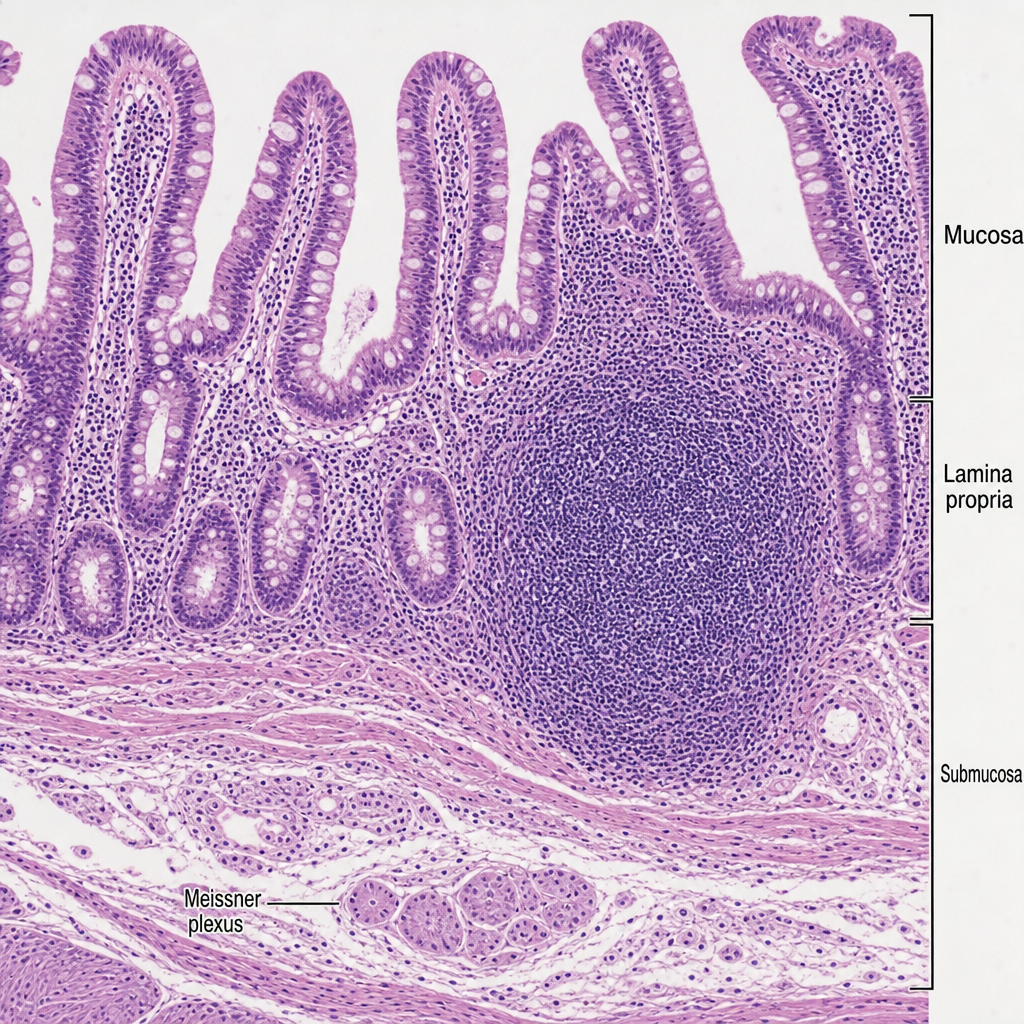
A histology slide from a surgical specimen is shown. The image reveals a tubular structure lined by simple columnar epithelium with prominent brush border microvilli, interspersed goblet cells, and a lamina propria containing numerous plasma cells. The submucosa shows a well-developed Meissner plexus and prominent lymphoid aggregates extending into the mucosa; villi are definitively present and the lumen is not obliterated by circumferential lymphoid tissue. Crypts of Lieberkühn are visible but villi are short and broad. Which segment of the gastrointestinal tract does this specimen most likely represent?
Want unlimited practice?
Get full access to all questions, explanations, and performance tracking.
Scan to download app