
Orbital structures — MCQs

During an examination of the cranial nerves, a patient shows inability to move their eye laterally past the midline. Which of the following structures in the cavernous sinus is most likely affected?
A 45-year-old man is brought to the emergency department after being found down in the middle of the street. Bystanders reported to the police that they had seen the man as he exited a local bar, where he was subsequently assaulted. He sustained severe facial trauma, including multiple lacerations and facial bone fractures. The man is taken to the operating room by the ENT team, who attempted to reconstruct his facial bones with multiple plates and screws. Several days later, he complains of the inability to open his mouth wide or to completely chew his food, both of which he seemed able to do prior to the surgery. Where does the affected nerve exit the skull?
A 26-year-old man is brought to the emergency department by ambulance after being involved in a motor vehicle collision. He does not open his eyes on command or respond to verbal cues. A CT scan of the head shows a hyperdense fluid collection in the right medial temporal lobe with medial displacement of the uncus and parahippocampal gyrus of the temporal lobe. Which of the following cranial nerves is most likely to be injured as a result of this patient's lesion?
A 24-year-old man is brought to the emergency department 30 minutes after being involved in a high-speed motor vehicle collision in which he was a restrained driver. On arrival, he is alert and oriented. His pulse is 112/min, respirations are 29/min, and blood pressure is 100/60 mm Hg. The pupils are equal and reactive to light. There is a 3-cm laceration over the forehead and multiple bruises over the trunk. The lungs are clear to auscultation. Cardiac examination shows no abnormalities. The abdomen is soft and nontender. The right knee is swollen and tender; range of motion is limited by pain. Infusion of 0.9% saline is begun and intravenous acetaminophen is administered. Two hours later, blood-tinged fluid spontaneously drains from both nostrils, and is made worse by leaning forward. On a piece of gauze, it shows up as a rapidly-expanding clear ring of fluid surrounding blood. Further evaluation of this patient is most likely to show which of the following?
A 36-year-old man was sent to the Emergency Department after a stray baseball hit him in the left eye during a game. Paramedics on sight could not perform the necessary testing and encouraged the patient to visit an ED for further testing and imaging. At the Emergency Department, the patient complains of slight pain in the orbital region and minimal diplopia that mildly increases with upward gaze. The patient’s blood pressure is 110/60 mm Hg, heart rate is 53/min, respiratory rate is 13/min, and temperature 36.6℃ (97.9℉). On physical examination, the patient is alert and responsive. There is an ecchymosis involving the lower lid and infraorbital area on the left side, with a slight downward deviation of the left globe, and conjunctival injection of the left eye. An upward gaze is limited on the left side. The visual acuity is 5/20 bilaterally. A head and neck CT shows a small (0.4 cm), nondisplaced, linear fracture of the left orbital floor. Which of the following statements about the condition the patient presents with is the most accurate?
A 71-year-old woman presents to the emergency department with a headache for the past 30 minutes. She says that this is the worst headache of her life and that it came on suddenly after she hit her head. She says that she has also been experiencing visual problems with double vision when she looks to the left or the right. Visual examination reveals that her right eye cannot move right past the midline and her left eye cannot move left past the midline. Which of the following is most likely responsible for this patient's visual defects?
A 33-year-old man comes to the otolaryngologist for the evaluation of a 6-month history of difficulty breathing through his nose and clear nasal discharge. He has a history of seasonal atopic rhinosinusitis. Anterior rhinoscopy shows a nasal polyp obstructing the superior nasal meatus. A CT scan of the head is most likely to show opacification of which of the following structures?
A 47-year-old woman presents to the emergency department with a fever and a headache. Her symptoms started yesterday and have rapidly progressed. Initially, she was experiencing just a fever and a headache which she was treating with acetaminophen. It rapidly progressed to blurry vision, chills, nausea, and vomiting. The patient has a past medical history of diabetes and hypertension and she is currently taking insulin, metformin, lisinopril, and oral contraceptive pills. Her temperature is 104°F (40.0°C), blood pressure is 157/93 mmHg, pulse is 120/min, respirations are 15/min, and oxygen saturation is 98% on room air. Upon further inspection, the patient also demonstrates exophthalmos in the affected eye. The patient's extraocular movements are notably decreased in the affected eye with reduced vertical and horizontal gaze. The patient also demonstrates decreased sensation near the affected eye in the distribution of V1 and V2. While the patient is in the department waiting for a CT scan, she becomes lethargic and acutely altered. Which of the following is the most likely diagnosis?
A 54-year-old woman comes to the physician because of a 1-day history of fever, chills, and double vision. She also has a 2-week history of headache and foul-smelling nasal discharge. Her temperature is 39.4°C (103°F). Examination shows mild swelling around the left eye. Her left eye does not move past midline on far left gaze but moves normally when looking to the right. Without treatment, which of the following findings is most likely to occur in this patient?
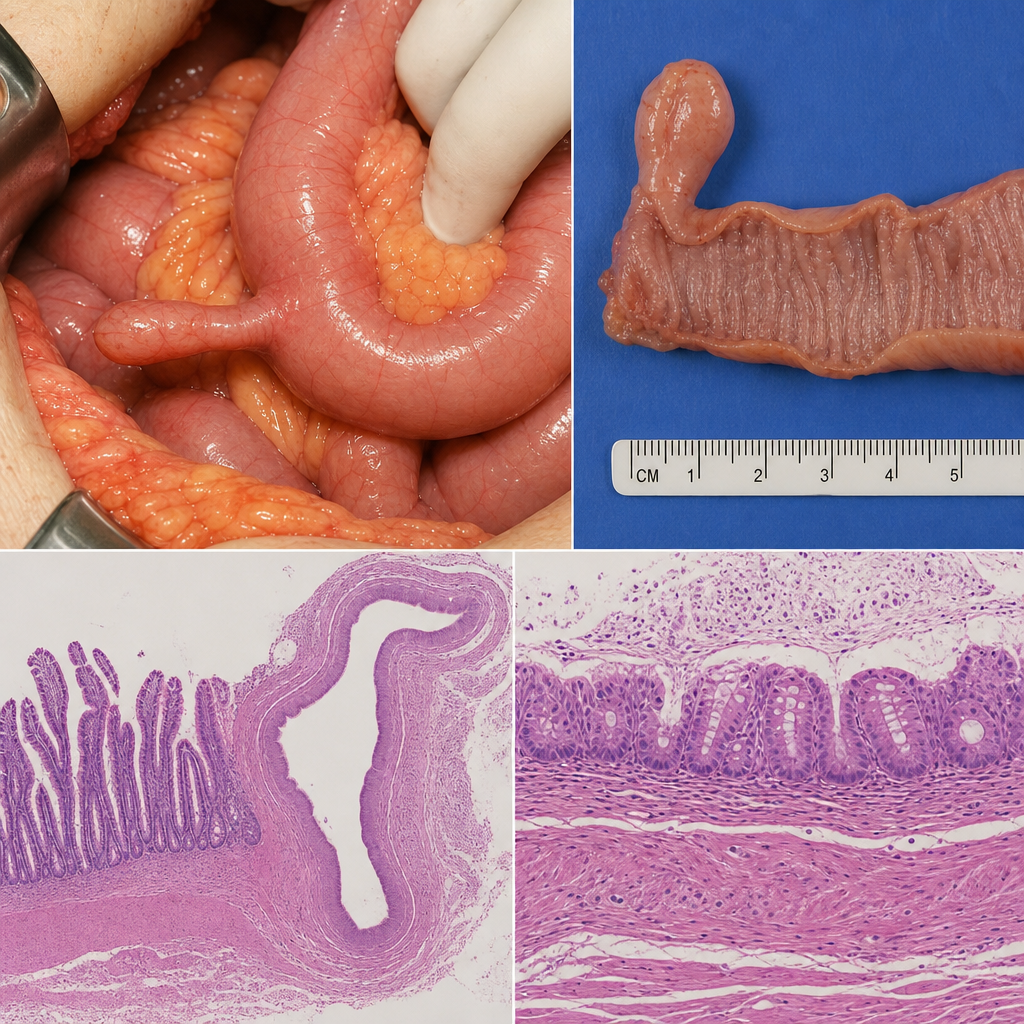
During a routine appendectomy in a 19-year-old man, the surgeon identifies a 5 cm blind-ended diverticulum on the antimesenteric border of the ileum, approximately 60 cm proximal to the ileocecal valve. Histological examination of the resected specimen reveals heterotopic gastric mucosa within the diverticulum wall alongside normal ileal mucosa and a well-defined muscularis propria continuous with the bowel wall. Which developmental structure failed to obliterate to produce this anomaly?
Want unlimited practice?
Get full access to all questions, explanations, and performance tracking.
Scan to download app