
Urinary system overview — MCQs

A 29-year-old man presents to his primary care provider complaining of testicular pain. He reports a four-day history of dull chronic pain in his left testicle that is worse with standing. His past medical history is notable for asthma and major depressive disorder. He takes inhaled albuterol as needed and sertraline. He is sexually active with a single female partner and always uses barrier protection. His temperature is 99.2°F (37.3°C), blood pressure is 125/75 mmHg, pulse is 85/min, and respirations are 17/min. Physical examination reveals a non-tender twisted mass along the left spermatic cord that disappears when the patient lies supine. This patient’s condition most likely stems from decreased laminar flow at which of the following vascular junctions?
A healthy 30-year-old female has a measured creatinine clearance of 100 mL/min. She has a filtration fraction (FF) of 25%. Serum analysis reveals a creatinine level of 0.9 mg/dL and an elevated hematocrit of 0.6. Which of the following is the best estimate of this patient’s renal blood flow?
A 46-year-old woman presents to the clinic complaining that she “wets herself.” She states that over the past year she has noticed increased urinary leakage. At first it occurred only during her job, which involves restocking shelves with heavy appliances. Now she reports that she has to wear pads daily because leakage of urine will occur with simply coughing or sneezing. She denies fever, chills, dysuria, hematuria, or flank pain. She has no significant medical or surgical history, and takes no medications. Her last menstrual period was 8 months ago. She has 3 healthy daughters that were born by vaginal delivery. Which of the following tests, if performed, would most likely identify the patient’s diagnosis?
On cardiology service rounds, your team sees a patient admitted with an acute congestive heart failure exacerbation. In congestive heart failure, decreased cardiac function leads to decreased renal perfusion, which eventually leads to excess volume retention. To test your knowledge of physiology, your attending asks you which segment of the nephron is responsible for the majority of water absorption. Which of the following is a correct pairing of the segment of the nephron that reabsorbs the majority of all filtered water with the means by which that segment absorbs water?
A 22-year-old male college student volunteers for a research study involving renal function. He undergoes several laboratory tests, the results of which are below: Urine Serum Glucose 0 mg/dL 93 mg/dL Inulin 100 mg/dL 1.0 mg/dL Para-aminohippurate (PAH) 150 mg/dL 0.2 mg/dL Hematocrit 50% Urine flow rate 1 mL/min What is the estimated renal blood flow?
A 75-year-old male presents to the emergency room complaining of severe lower abdominal pain and an inability to urinate. He reports that he last urinated approximately nine hours ago. When asked to urinate, only a few drops dribble from the tip of his penis. Further questioning reveals that the patient has experienced progressively worsening difficulty with urinating over the past two years. He has lived alone for five years since his wife passed away. He has not seen a doctor in that time. His temperature is 98.8°F (37.1°C), blood pressure is 145/90 mmHg, pulse is 115/min, and respirations are 22/min. He appears to be in severe pain. Physical examination reveals a distended bladder and significant tenderness to palpation over the inferior aspect of his abdomen. Which of the following sets of lab values would most likely be found in a urinalysis of this patient?
A 66-year-old G3P3 presents with an 8-year-history of back pain, perineal discomfort, difficulty urinating, recurrent malaise, and low-grade fevers. These symptoms have recurred regularly for the past 5–6 years. She also says that there are times when she experiences a feeling of having a foreign body in her vagina. With the onset of symptoms, she was evaluated by a physician who prescribed her medications after a thorough examination and recommended a vaginal pessary, but she was non-compliant. She had 3 vaginal deliveries She has been menopausal since 51 years of age. She does not have a history of malignancies or cardiovascular disease. She has type 2 diabetes mellitus that is controlled with diet and metformin. Her vital signs include: blood pressure 110/60 mm Hg, heart rate 91/min, respiratory rate 13/min, and temperature 37.4℃ (99.3℉). On physical examination, there is bilateral costovertebral angle tenderness. The urinary bladder is non-palpable. The gynecologic examination reveals descent of the cervix to the level of the introitus. A Valsalva maneuver elicits uterine procidentia. Which pathology is most likely to be revealed by imaging in this patient?
An investigator is studying physiologic renal responses to common medical conditions. She measures urine osmolalities in different parts of the nephron of a human subject in the emergency department. The following values are obtained: Portion of nephron Osmolality (mOsmol/kg) Proximal convoluted tubule 300 Loop of Henle, descending limb 1200 Loop of Henle, ascending limb 250 Distal convoluted tubule 100 Collecting duct 1200 These values were most likely obtained from an individual with which of the following condition?
A 40-year-old sailor is brought to a military treatment facility 20 minutes after being involved in a navy ship collision. He appears ill. He reports a sensation that he needs to urinate but is unable to void. His pulse is 140/min, respirations are 28/min, and blood pressure is 104/70 mm Hg. Pelvic examination shows ecchymoses over the scrotum and perineum. There is tenderness over the suprapubic region and blood at the urethral meatus. Digital rectal examination shows a high-riding prostate. Abdominal ultrasound shows a moderately distended bladder. X-rays of the pelvis show fractures of all four pubic rami. Which of the following is the most likely cause of this patient's symptoms?
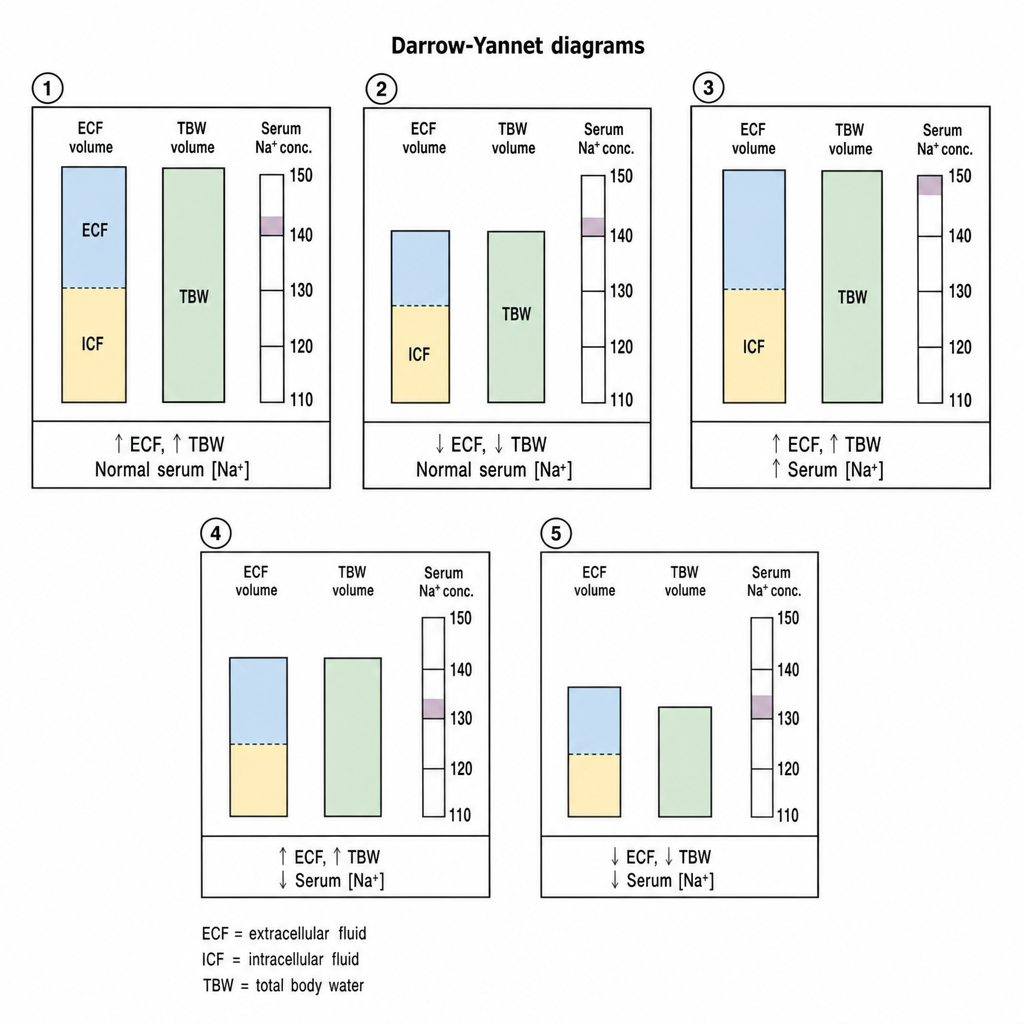
A 28-year-old man presents to his physician with a history of excessive thirst and excessive urination over the last 3 weeks. He mentions that he has to wake up multiple times at night to urinate. A detailed history reveals that he has a known case of bipolar mood disorder and has been taking lithium carbonate for 5 years. His urinary specific gravity is 1.003, and his urinary osmolality is 150 mOsm/kg H2O. Which of the following Darrow-Yannet diagrams best describes the status of volumes and osmolality of this man’s body fluids?
Want unlimited practice?
Get full access to all questions, explanations, and performance tracking.
Scan to download app