
Anatomical variations and clinical significance — MCQs

A 39-year-old male is rushed to the emergency department after he developed a sudden-onset severe headache with ensuing nausea, vomiting, vision changes, and loss of consciousness. Past medical history is unattainable. He reports that the headache is worse than any he has experienced before. Noncontrast CT of the head is significant for an intracranial hemorrhage. Follow-up cerebral angiography is performed and shows a ruptured anterior communicating artery aneurysm. Which of the following has the strongest association with this patient's current presentation?
A 27-year-old man is brought to the emergency department after a motorcycle accident 30 minutes ago. He was found at the scene of the accident with a major injury to the anterior chest by a metallic object that was not removed during transport to the hospital. The medical history could not be obtained. His blood pressure is 80/50 mm Hg, pulse is 130/min, and respiratory rate is 40/min. Evaluation upon arrival to the emergency department reveals a sharp metal object penetrating through the anterior chest to the right of the sternum at the 4th intercostal space. The patient is taken to the operating room immediately, where it is shown the heart has sustained a major injury. Which of the following arteries supplies the part of the heart most likely injured in this patient?
A 6-year-old girl is brought to the physician by her parents because of concern that she is the shortest in her class. She has always been short for her age, but she is upset now that her classmates have begun teasing her for her height. She has no history of serious illness and takes no medications. She is 109 cm (3 ft 7 in) tall (10th percentile) and weighs 20 kg (45 lb) (50th percentile). Her blood pressure is 140/80 mm Hg. Vital signs are otherwise within normal limits. Physical examination shows a low-set hairline and a high-arched palate. Breast development is Tanner stage 1 and the nipples are widely spaced. Extremities are well perfused with strong peripheral pulses. Her hands are moderately edematous. This patient is at increased risk of developing which of the following complications?
A 14-year-old boy is brought to the emergency department because of acute left-sided chest pain and dyspnea following a motor vehicle accident. His pulse is 122/min and blood pressure is 85/45 mm Hg. Physical examination shows distended neck veins and tracheal displacement to the right side. The left chest is hyperresonant to percussion and there are decreased breath sounds. This patient would most benefit from needle insertion at which of the following anatomical sites?
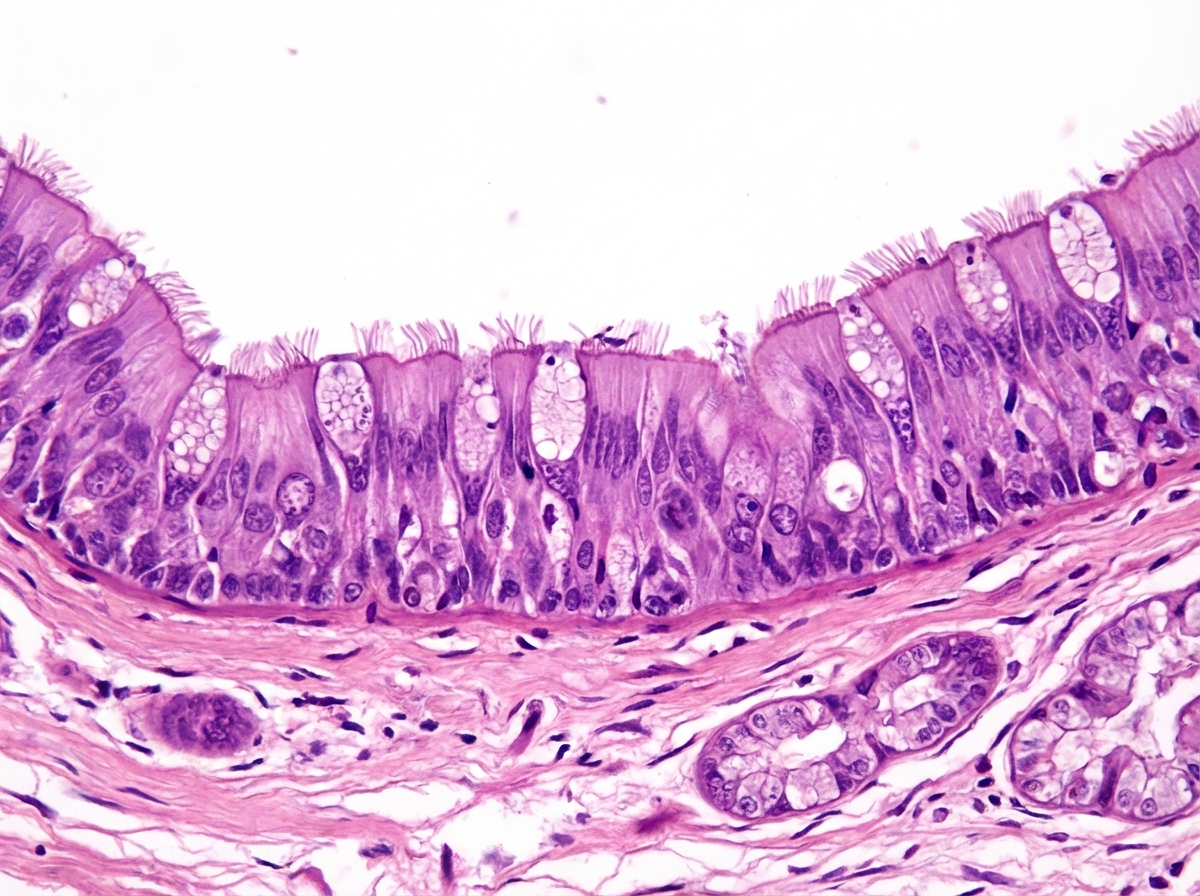
A research team is studying certain congenital anomalies of the respiratory tract. The method consists of marking a certain germinal layer with an isotope, following its development stages in chicken embryos, and finally analyzing the specimen. A given specimen of tissue is presented in the exhibit. Which of the following germinal structures most likely gave rise to the epithelial lining of this specimen?
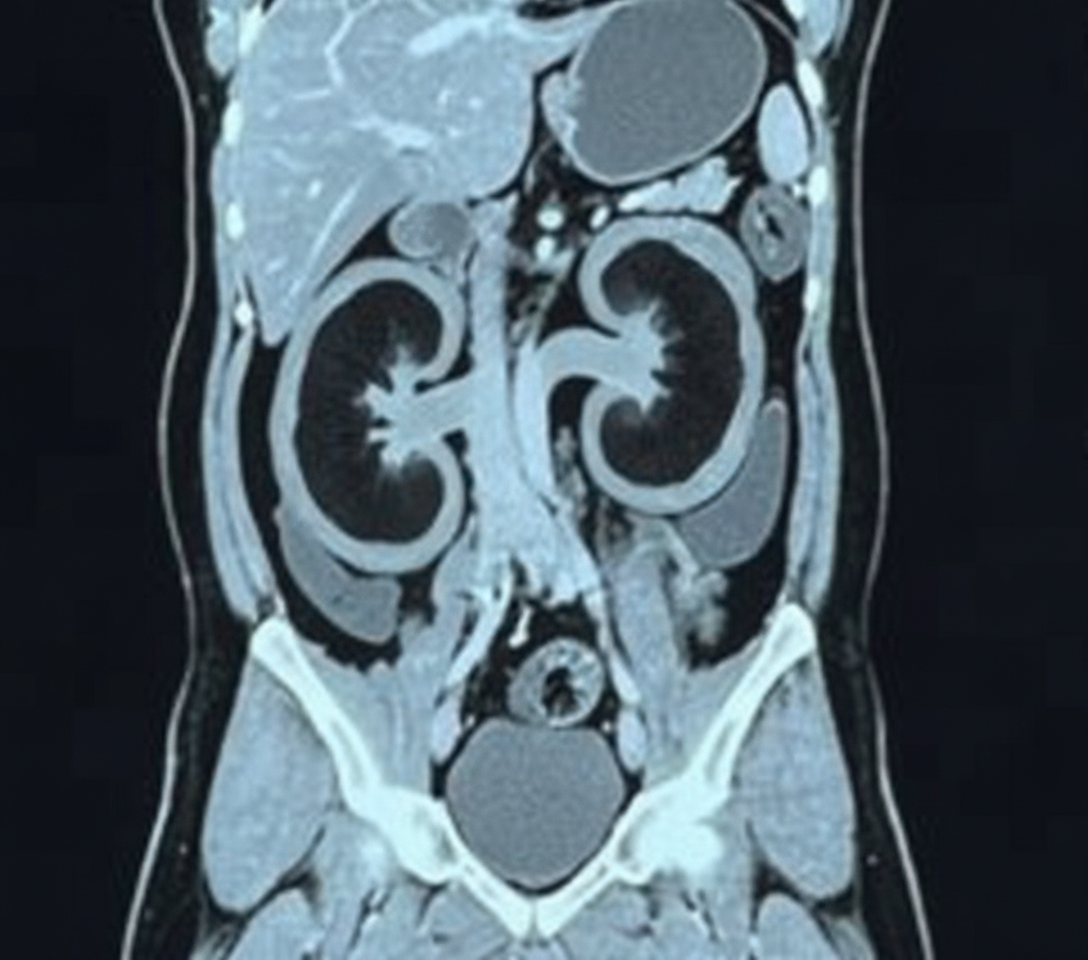
An 11-year-old girl is brought to the office by her mother due to complaint of intermittent and severe periumbilical pain for 1 day. She does not have any significant past medical history. She provides a history of a recent school trip to the suburbs. On physical examination, there is a mild tenderness around the umbilicus without any distension or discharge. There is no rebound tenderness. Bowel sounds are normal. An abdominal imaging shows enlarged mesenteric lymph nodes, and she is diagnosed with mesenteric lymphadenitis. However, incidentally, a mass of tissue was seen joining the inferior pole of both kidneys as shown in the image. Which of the following best describes this renal anomaly?
A female infant is born with a mutation in PKD1 on chromosome 16. An abdominal ultrasound performed shortly after birth would most likely reveal which of the following?
A 35-year-old Caucasian female with a history of rheumatoid arthritis presents to your clinic with pleuritic chest pain that improves while leaning forward. Which of the following additional findings would you expect to observe in this patient?
A researcher is investigating the blood supply of the adrenal gland. While performing an autopsy on a patient who died from unrelated causes, he identifies a vessel that supplies oxygenated blood to the inferior aspect of the right adrenal gland. Which of the following vessels most likely gave rise to the vessel in question?
A 24-year-old woman comes to the emergency department because of abdominal pain, fever, nausea, and vomiting for 12 hours. Her abdominal pain was initially dull and diffuse but has progressed to a sharp pain on the lower right side. Two years ago she had to undergo right salpingo-oophorectomy after an ectopic pregnancy. Her temperature is 38.7°C (101.7°F). Physical examination shows severe right lower quadrant tenderness with rebound tenderness; bowel sounds are decreased. Laboratory studies show leukocytosis with left shift. An abdominal CT scan shows a distended, edematous appendix. The patient is taken to the operating room for an appendectomy. During the surgery, the adhesions from the patient's previous surgery make it difficult for the resident physician to identify the appendix. Her attending mentions that she should use a certain structure for guidance to locate the appendix. The attending is most likely referring to which of the following structures?
Want unlimited practice?
Get full access to all questions, explanations, and performance tracking.
Scan to download app