
Liver and biliary system development — MCQs

A 34-year-old woman comes to the emergency department because of a 2-hour history of abdominal pain, nausea, and vomiting that began an hour after she finished lunch. Examination shows abdominal guarding and rigidity; bowel sounds are reduced. Magnetic resonance cholangiopancreatography shows the dorsal pancreatic duct draining into the minor papilla and a separate smaller duct draining into the major papilla. The spleen is located anterior to the left kidney. A disruption of which of the following embryological processes is the most likely cause of this patient's imaging findings?
A 25-year-old female comes to her obstetrician’s office for a prenatal visit. She has a transvaginal ultrasound that correlates with her last menstrual period and dates her pregnancy at 4 weeks. She has no complaints except some nausea during the morning that is improving. She comments that she has had some strange food cravings, but has no issues with eating a balanced diet. Her BMI is 23 kg/m^2 and she has gained 1 pound since the start of her pregnancy. She is curious about her pregnancy and asks the physician what her child is now able to do. Which of the following developments is expected of the fetus during this embryological phase?
A newborn is rushed to the neonatal ICU after becoming cyanotic shortly after birth. An ultrasound is performed which shows the aorta coming off the right ventricle and lying anterior to the pulmonary artery. The newborn is given prostaglandin E1 and surgery is planned to correct the anatomic defect. Which of the following developmental processes failed to occur in the newborn?
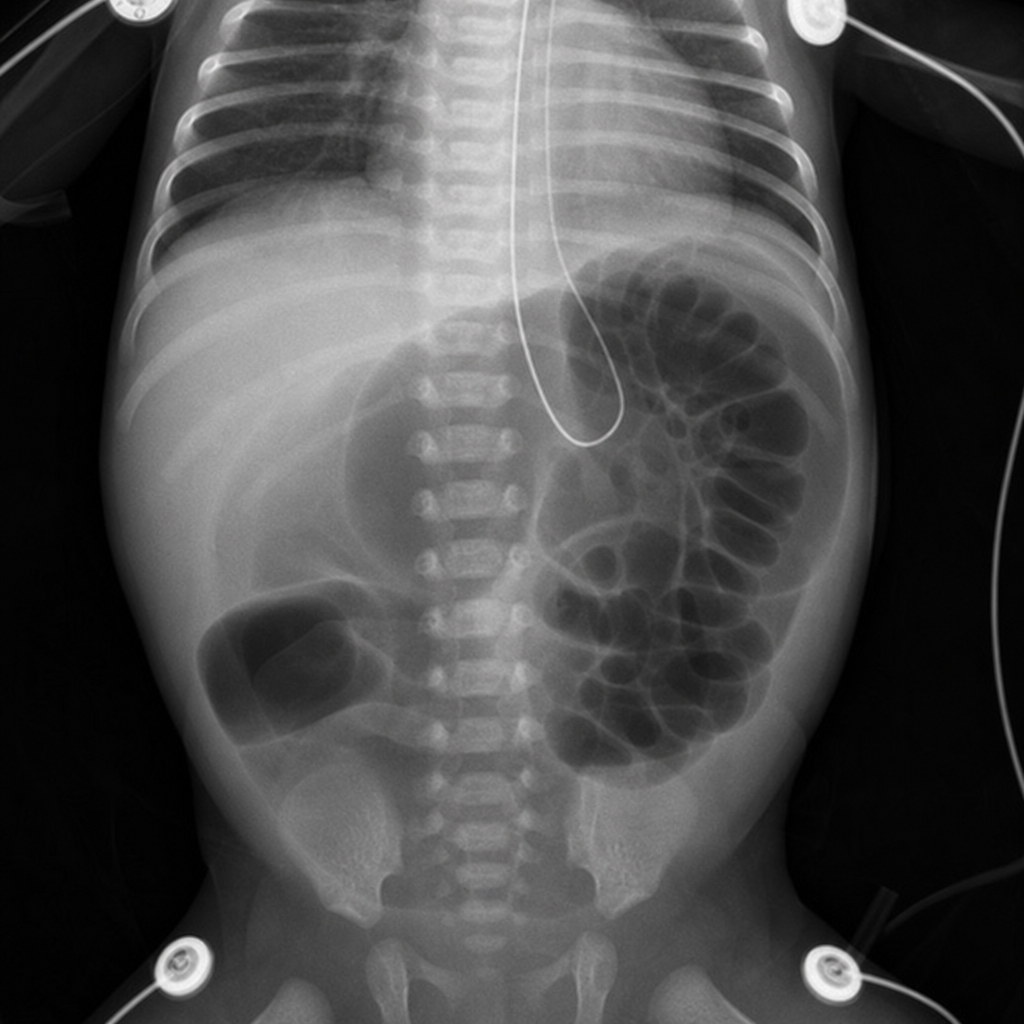
One week after delivery, a 3550-g (7-lb 13-oz) newborn has multiple episodes of bilious vomiting and abdominal distention. He passed urine 14 hours after delivery and had his first bowel movement 3 days after delivery. He was born at term to a 31-year-old woman. Pregnancy was uncomplicated and the mother received adequate prenatal care. His temperature is 37.1°C (98.8°F), pulse is 132/min, and respirations are 50/min. Examination shows a distended abdomen. Bowel sounds are hypoactive. Digital rectal examination shows a patent anus and an empty rectum. The remainder of the examination shows no abnormalities. An x-ray of the abdomen is shown. Which of the following is the underlying cause of these findings?
A 2-day-old infant dies of severe respiratory distress following a gestation complicated by persistent oligohydramnios. Upon examination at autopsy, the left kidney is noted to selectively lack cortical and medullary collecting ducts. From which of the following embryological structures do the cortical and medullary collecting ducts arise?
A child is in the nursery one day after birth. A nurse notices a urine-like discharge being expressed through the umbilical stump. What two structures in the embryo are connected by the structure that failed to obliterate during the embryologic development of this child?
A previously healthy 2-year-old girl is brought to the physician because of a 1-week history of yellow discoloration of her skin, loss of appetite, and 3 episodes of vomiting. Her parents also report darkening of her urine and light stools. During the last 2 days, the girl has been scratching her abdomen and arms and has been crying excessively. She was born at 38 weeks' gestation after an uncomplicated pregnancy and delivery. Her family emigrated from Japan 8 years ago. Immunizations are up-to-date. Her vital signs are within normal limits. Examination shows jaundice of her skin and sclerae. Abdominal examination shows a mass in the right upper abdomen. Serum studies show: Bilirubin (total) 5 mg/dL Direct 4.2 mg/dL Aspartate aminotransferase (AST) 20 U/L Alanine aminotransferase (ALT) 40 U/L γ-Glutamyltransferase (GGT) 110 U/L Abdominal ultrasonography shows dilation of the gall bladder and a fusiform dilation of the extrahepatic bile duct. Which of the following is the most likely diagnosis?
A newborn boy born vaginally to a healthy 37-year-old G3P1 from a pregnancy complicated by hydramnios fails to pass meconium after 24 hours of life. The vital signs are within normal limits for his age. The abdomen is distended, the anus is patent, and the rectal examination reveals pale mucous with non-pigmented meconium. Based on a barium enema, the boy is diagnosed with sigmoid colonic atresia. Disruption of which structure during fetal development could lead to this anomaly?
During the third week of development, the blastocyst undergoes a variety of differentiation processes responsible for the formation of the gastrula and, eventually, the embryo. This differentiation creates cell lineages that eventually become a variety of body systems. What cell lineage, present at this date, is responsible for the formation of the liver?
A 3175-g (7-lb) male newborn is delivered at 39 weeks' gestation to a 29-year-old primigravid woman following a spontaneous vaginal delivery. Apgar scores are 8 and 9 at 1 and 5 minutes, respectively. Cardiac examination in the delivery room shows a continuous machine-like murmur. An echocardiogram shows a structure with blood flow between the pulmonary artery and the aorta. This structure is most likely a derivate of which of the following?
Want unlimited practice?
Get full access to all questions, explanations, and performance tracking.
Scan to download app