
Hindgut development — MCQs

A 5-year-old boy with Down syndrome presents with his mother. The patient’s mother says that he isn’t playing or eating as much as he used to and seems lethargic. Expected developmental delays are present and stable. Physical examination reveals dry mucous membranes and abdominal distention with no tenderness to palpation. An abdominal radiograph is shown in the image below. Which of the following is the most likely diagnosis in this patient?
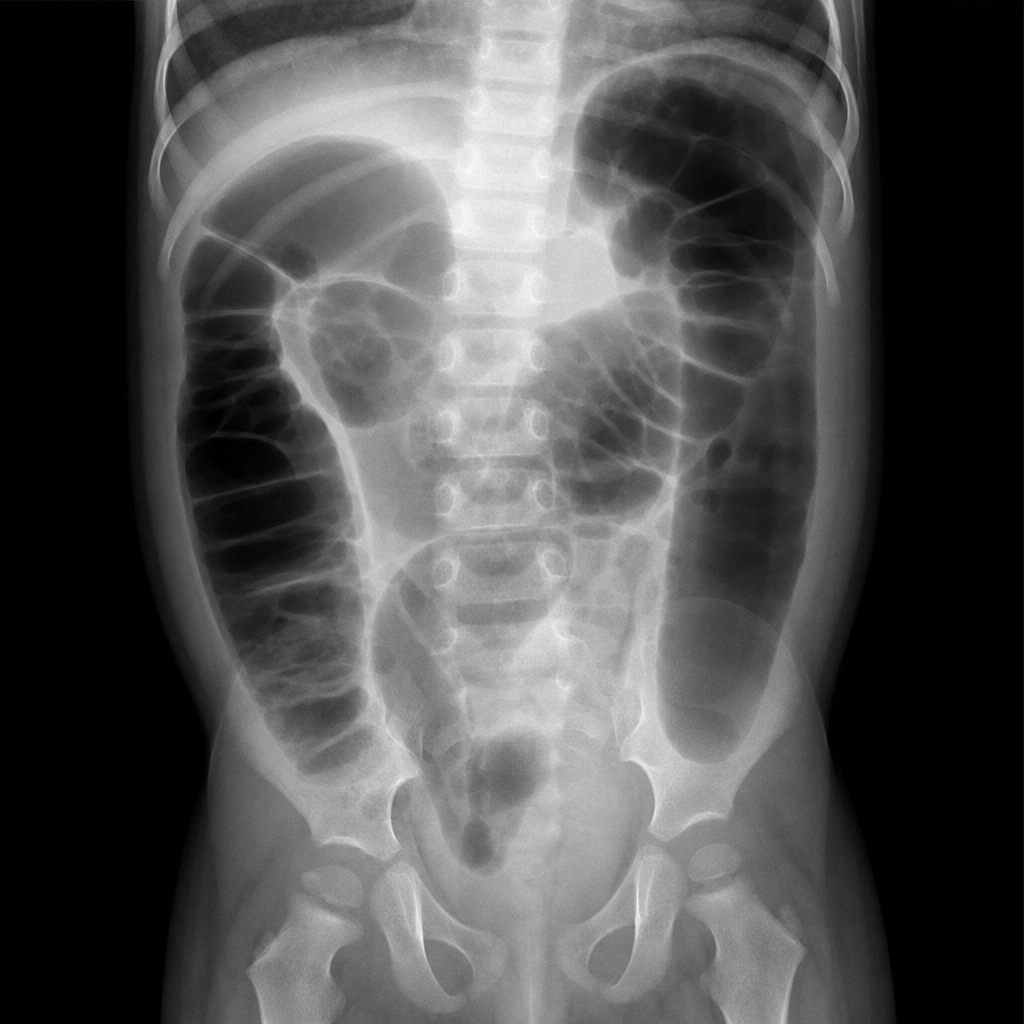
During a surgical procedure to repair an abdominal aortic aneurysm, the surgeon must be careful to avoid injury to which of the following arterial structures that originates near the level of the renal vessels?
A 2-year-old boy is brought in to his pediatrician for a routine checkup. The parents mention that the child has been developing appropriately, although they have been noticing that the child appears to have chronic constipation. The parents report that their child does not routinely have daily bowel movements, and they have noticed that his abdomen has become more distended recently. In the past, they report that the patient was also delayed in passing meconium, but this was not further worked up. On exam, his temperature is 98.6°F (37.0°C), blood pressure is 110/68 mmHg, pulse is 74/min, and respirations are 14/min. The patient is noted to have a slightly distended abdomen that is nontender. Eventually, this patient undergoes a biopsy. Which of the following layers most likely reveals the causative pathologic finding of this disease?
During embryological development, failure of the urorectal septum to completely separate the cloaca results in which of the following congenital anomalies?
Two days following the home birth of her son, a mother brings the infant to the pediatric emergency room because of bilious vomiting. He is unable to pass meconium and his abdomen is distended. Endoscopic biopsy of the distal rectum demonstrates an absence of Meissner's and Auerbach's plexi in the bowel wall. Which of the following is the most likely diagnosis?
A 62-year-old female presents to her primary care physician complaining of bloody stool. She reports several episodes of bloody stools over the past two months as well as a feeling of a mass near her anus. She has one to two non-painful bowel movements per day. She has a history of alcohol abuse and hypertension. Anoscopy reveals engorged vessels. Which of the following vessels most likely drains blood from the affected region?
A 2-day-old newborn boy has failed to pass meconium after 48 hours. There is an absence of stool in the rectal vault. Family history is significant for MEN2A syndrome. Which of the following confirms the diagnosis?
A newborn boy born vaginally to a healthy 37-year-old G3P1 from a pregnancy complicated by hydramnios fails to pass meconium after 24 hours of life. The vital signs are within normal limits for his age. The abdomen is distended, the anus is patent, and the rectal examination reveals pale mucous with non-pigmented meconium. Based on a barium enema, the boy is diagnosed with sigmoid colonic atresia. Disruption of which structure during fetal development could lead to this anomaly?
A 60-year-old gentleman passes away after a car accident. On routine autopsy it is incidentally noted that he has both a ventral and dorsal pancreatic duct. This incidental finding observed by the pathologist is generated due to failure of which of the following embryological processes?
A 4-year-old girl is brought to the physician because her mother is concerned that she has been talking to an imaginary friend for 2 months. The child calls her friend 'Lucy' and says “Lucy is my best friend”. The child has multiple conversation and plays with the 'Lucy' throughout the day. The girl attends preschool regularly. She can copy a circle, tells stories, and can hop on one foot. Her maternal uncle has schizophrenia. Her parents are currently divorcing. The child's father has a history of illicit drug use. Physical examination shows no abnormalities. The mother is concerned about whether the child is acting out because of the divorce. Which of the following is the most appropriate next best step in management?
Want unlimited practice?
Get full access to all questions, explanations, and performance tracking.
Scan to download app