
Dense connective tissue — MCQs

A 40-year-old man comes to his doctor because of 2 weeks of progressively worsening pain on the outer side of his right elbow. He does not recall any trauma to the area. The patient plays tennis recreationally and has recently gone from playing weekly to playing daily in preparation for a local tournament. He has had some pain relief with ibuprofen. On physical examination, there is tenderness over the lateral surface of the right distal humerus. The pain is reproduced by supinating the forearm against resistance. Which of the following is the most likely underlying cause of this patient's condition?
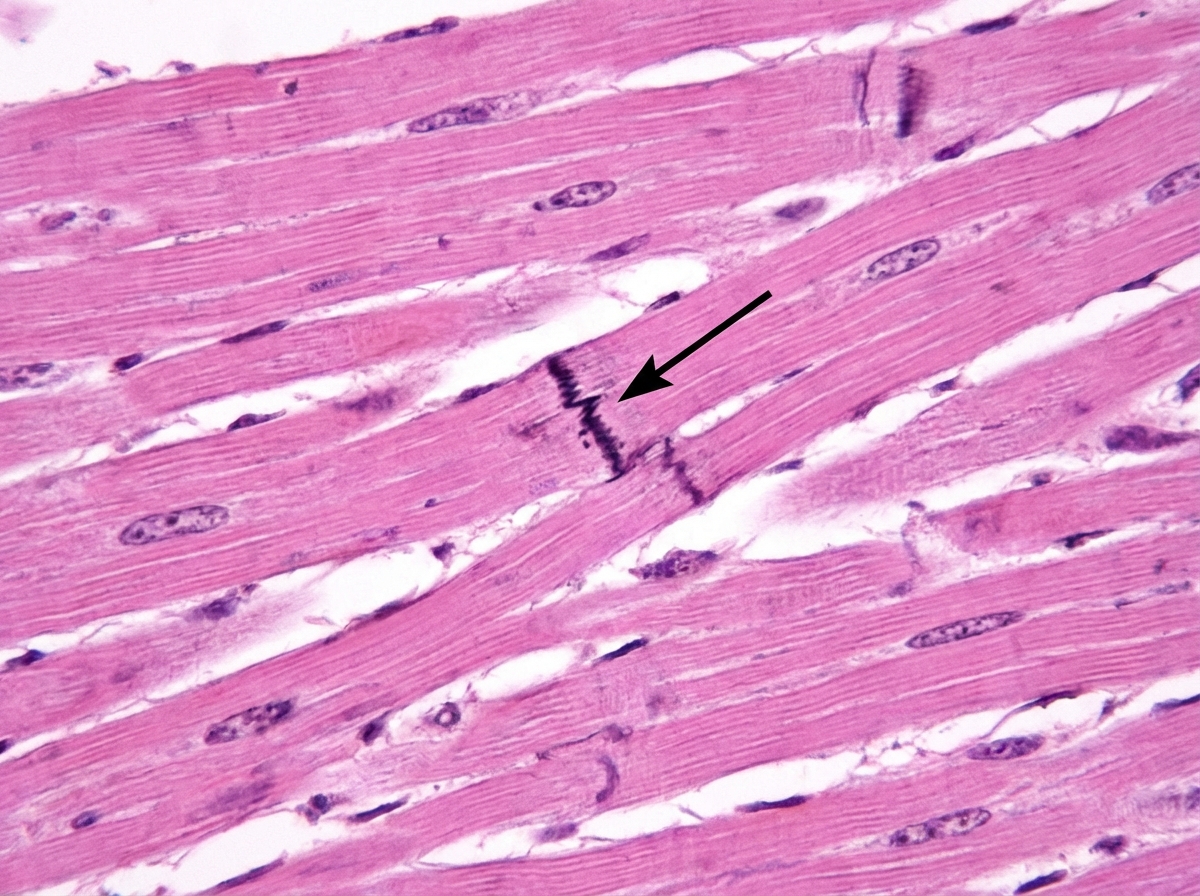
Cardiac muscle serves many necessary functions, leading to a specific structure that serves these functions. The structure highlighted is an important histology component of cardiac muscle. What would be the outcome if this structure diffusely failed to function?
A 30-year-old man comes to the physician for a follow-up examination 1 month after sustaining a chemical burn over the dorsum of his right hand and forearm. Physical examination shows hyperextension of the hand at the wrist. The skin over the dorsum of the wrist is tense and there is a thick, epithelialized scar. Range of motion of the right wrist is restricted. This patient's contracture is most likely due to activity of which of the following cells?
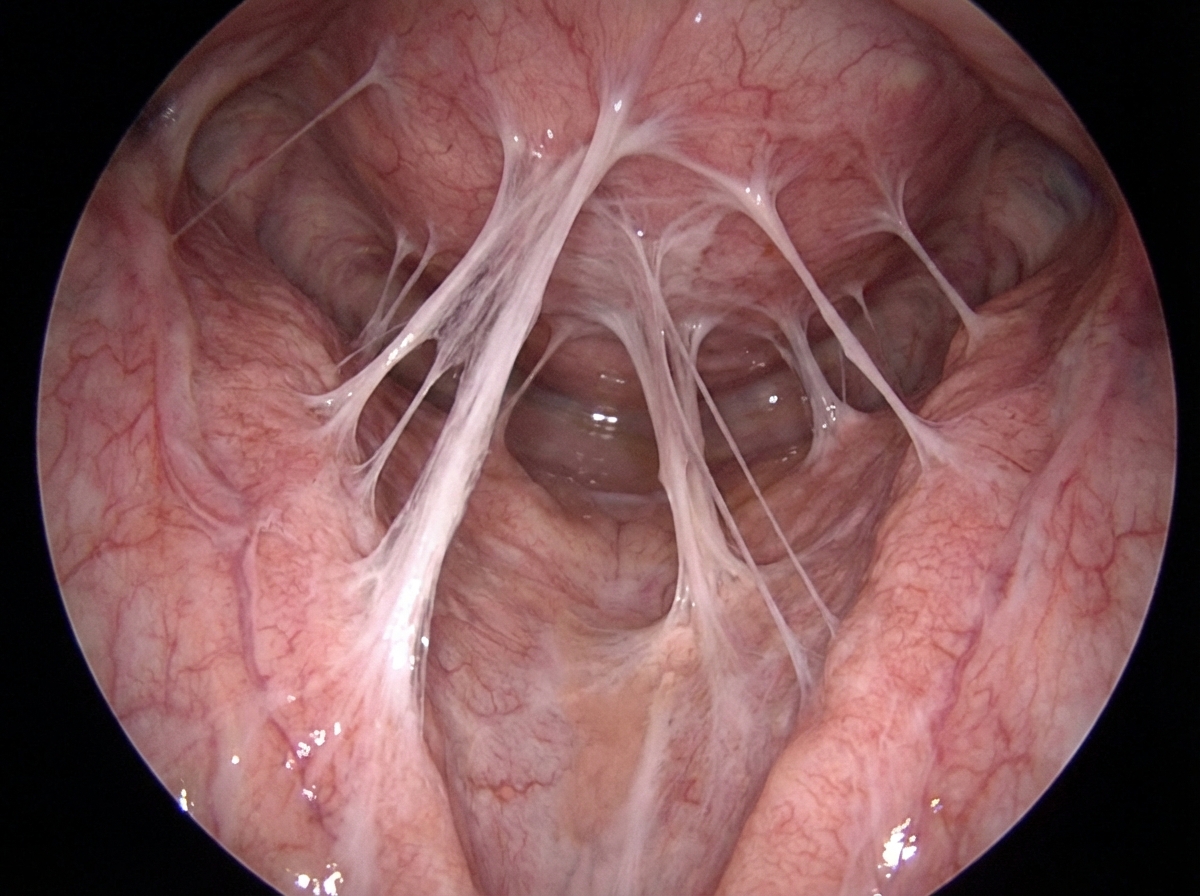
A 28-year-old woman and her husband are admitted to the office due to difficulties conceiving a child for the past year. Her menarche was at the age of 15 years, and her periods have been regular since then. Her medical history is positive for an abortion with curettage 5 years ago. A spermogram on the partner is performed, and it shows motile sperm cells. An ultrasound is performed on the patient and it is unremarkable. The laboratory results show that the FSH, LH, TSH, and prolactin levels are within normal ranges. A hysteroscopy is additionally performed and multiple adhesions are found in the uterus (refer to the image). Which of the following is the most likely composition of the scar tissue present in the uterus?
A 5-year-old girl accompanied by her mother presents to the emergency department after suffering a fall on the elementary school playground. Her mother reports that a child on the playground pushed her daughter who fell on her right side, after which she screamed and was found clutching her right leg. The girl's past medical history is significant for a fracture of the left femur and right radius over the past 2 years and an auditory deficit requiring hearing aid use starting 6 months ago. Inspection reveals a relatively short girl in moderate distress. She has brown opalescent teeth. She refuses to bear weight on her right lower extremity. Radiography of the right lower extremity reveals a femoral midshaft fracture. Which of the following is the most likely etiology of the patient's condition?
During the examination of a gunshot wound, the forensic pathologist notes an entrance wound with abrasion collar and soot deposition. The wound shows a stellate-shaped pattern with irregular margins. This pattern most likely indicates which of the following?
A 5-year-old boy is brought to the emergency room by his parents after slipping on a rug at home and experiencing exquisite pain and swelling of his arms. Radiographs reveal a new supracondylar fracture of the humerus, as well as indications of multiple, old fractures that have healed. His parents note that an inherited disorder is present in their family history. A comprehensive physical exam also reveals blue-tinted sclera and yellow-brown, discolored teeth. What is the etiology of the patient’s disorder?
A 62-year-old man with prostate cancer comes to the physician because of low back pain for 2 weeks and a 4.5-kg (10-lb) weight loss. Physical examination shows localized tenderness over the lumbar spine. An x-ray of the lumbar spine shows several osteoblastic lesions at the level of L2 and L4 vertebrae. Microscopic examination of a bone biopsy specimen from the L4 vertebra shows irregular bone trabeculae and star-shaped cells with long, cytoplasmic processes located deep within the lacunae. Exchange of nutrients and waste products between these cells most likely occurs through which of the following structures?
A 4-year-old boy is brought to the physician for a well-child examination. He started walking at 20 months of age. He can use a cup to drink but cannot use silverware. He speaks in 2-word sentences and can build a tower of 4 blocks. He can scribble but cannot draw a circle. He is above the 99th percentile for height and at the 15th percentile for weight. Vital signs are within normal limits. Examination shows bilateral inferior lens dislocation. His fingers are long and slender. He has a high-arched palate. The thumb and 5th finger overlap when he grips a wrist with the opposite hand. The skin over the neck can be extended and stretched easily. Which of the following is the most likely cause of these findings?
A 25-year-old man presents to the emergency department with sudden-onset severe pain in the right shoulder that occurred when he threw a bowling ball 2 hours ago. He has a history of dislocations in both shoulders and subluxation of the right knee and left wrist. There is no history of fractures. On physical examination, the right arm is slightly abducted and externally rotated. An anterior bulge is seen near the shoulder joint. The neurovascular examination of the right arm shows no abnormalities. The skin examination shows multiple widened atrophic scars around the knees, elbows, and ankles. The skin of the neck and around the elbow can easily be extended up to 4 cm. The sclera is white. The remainder of the physical examination shows no abnormalities. A defect in which of the following proteins is the most likely cause of the findings in this patient?
Want unlimited practice?
Get full access to all questions, explanations, and performance tracking.
Scan to download app