
Limb development — MCQs

A 10-year-old boy is brought to the physician by his parents for a follow-up examination. He has had a short stature since birth and underwent diagnostic testing. Genetic analyses showed a gain of function mutation in the fibroblast growth factor receptor 3 (FGFR3) gene. He has met all developmental milestones. He is at the 10th percentile for height and 90th percentile for weight. Which of the following additional findings is most likely on physical examination?
A 25-year-old female comes to her obstetrician’s office for a prenatal visit. She has a transvaginal ultrasound that correlates with her last menstrual period and dates her pregnancy at 4 weeks. She has no complaints except some nausea during the morning that is improving. She comments that she has had some strange food cravings, but has no issues with eating a balanced diet. Her BMI is 23 kg/m^2 and she has gained 1 pound since the start of her pregnancy. She is curious about her pregnancy and asks the physician what her child is now able to do. Which of the following developments is expected of the fetus during this embryological phase?
A 31-year-old man presents for his annual physical exam. The physician fails to palpate a ductus deferens on the left side. An ultrasound confirms absence of the left ductus deferens and further reveals absence of the left epididymis, seminal vesicle, and kidney. Spermogram and reproductive hormones panel are within normal limits. Left-sided agenesis of an embryonic anlage is suspected. Which two structures are connected by this anlage during embryogenesis?
A 16-year-old boy presents to the emergency room with severe right shoulder pain following a painful overhead swing during a competitive volleyball match. On physical examination, the patient has limited active range of motion of the right shoulder and significant pain with passive motion. Suspecting a rotator cuff injury, the physician obtains an MRI, which indicates a minor tear in the tendon of the rotator cuff muscle that is innervated by the axillary nerve. Which of the following muscles was affected?
A 5-year-old boy presents for a regularly scheduled check-up. The child is wheelchair bound due to lower extremity paralysis and suffers from urinary incontinence. At birth, it was noted that the child had lower limbs of disproportionately small size in relation to the rest of his body. Radiograph imaging at birth also revealed several abnormalities in the spine, pelvis, and lower limbs. Complete history and physical performed on the child's birth mother during her pregnancy would likely have revealed which of the following?
A 13-year-old girl presents to an orthopedic surgeon for evaluation of a spinal curvature that was discovered during a school screening. She has otherwise been healthy and does not take any medications. On presentation, she is found to have significant asymmetry of her back and is sent for a spine radiograph. The radiograph reveals a unilateral rib attached to the left transverse process of the C7 vertebrae. Abnormal expression of which of the following genes is most likely responsible for this finding?
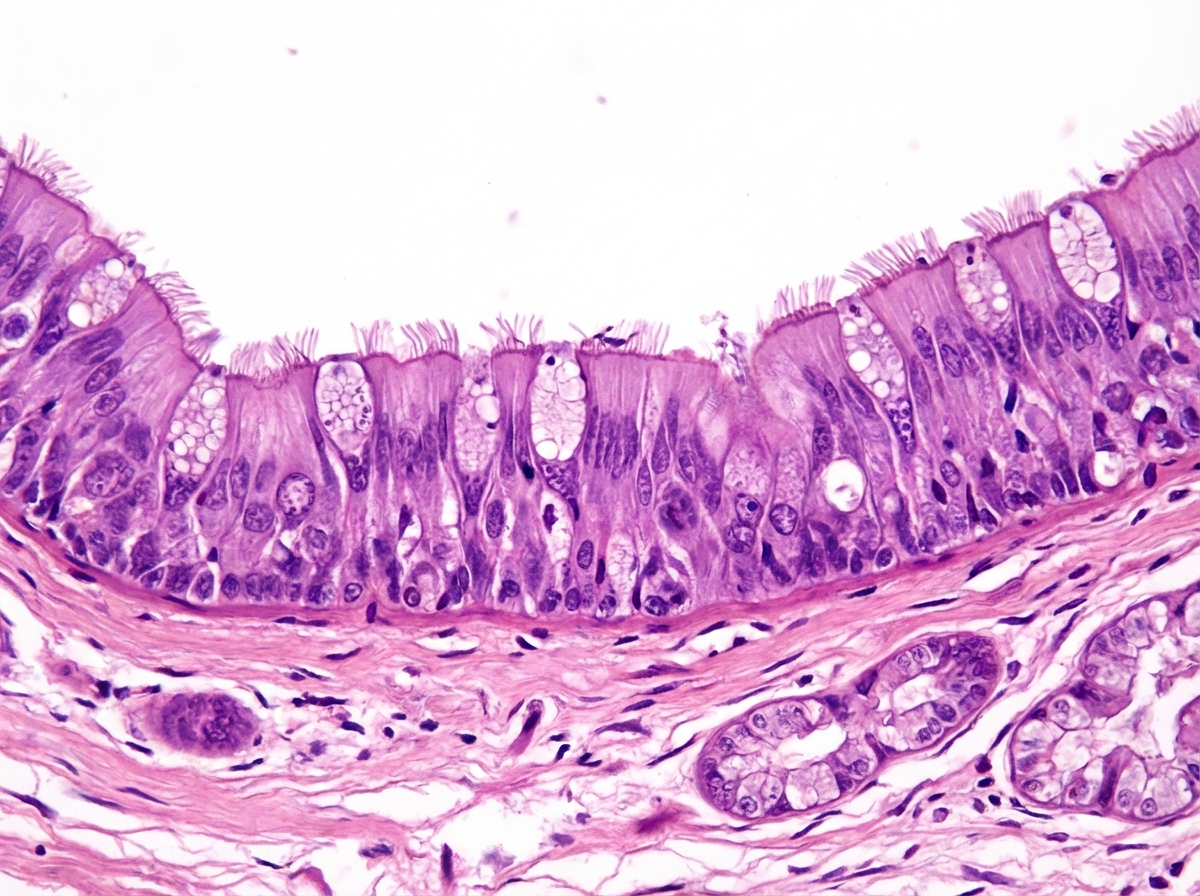
A research team is studying certain congenital anomalies of the respiratory tract. The method consists of marking a certain germinal layer with an isotope, following its development stages in chicken embryos, and finally analyzing the specimen. A given specimen of tissue is presented in the exhibit. Which of the following germinal structures most likely gave rise to the epithelial lining of this specimen?
A male newborn is delivered at term to a 26-year-old woman, gravida 2, para 3. The mother has no medical insurance and did not receive prenatal care. Physical examination shows microcephaly and ocular hypotelorism. There is a single nostril, cleft lip, and a solitary central maxillary incisor. An MRI of the head shows a single large ventricle and fused thalami. This patient's condition is most likely caused by abnormal expression of which of the following protein families?
A 26-year-old woman comes to the physician because she has not had a menstrual period for 5 weeks. Menarche was at the age of 14 years and menses occurred at regular 30-day intervals. She reports having unprotected sexual intercourse 3 weeks ago. A urine pregnancy test is positive. Which of the following best describes the stage of development of the embryo at this time?
During the third week of development, the blastocyst undergoes a variety of differentiation processes responsible for the formation of the gastrula and, eventually, the embryo. This differentiation creates cell lineages that eventually become a variety of body systems. What cell lineage, present at this date, is responsible for the formation of the liver?
Want unlimited practice?
Get full access to all questions, explanations, and performance tracking.
Scan to download app