
Implantation — MCQs

A 25-year-old woman is brought to the emergency department by her roommate with severe right lower quadrant pain for the last 8 hours. The pain is progressively getting worse and is associated with vomiting. When you ask the patient about her last menstrual period, she tells you that although she stopped keeping track of her cycle after undergoing surgical sterilization 1 year ago, she recalls bleeding yesterday. The physical examination reveals a hemodynamically stable patient with a pulse of 90/min, respiratory rate of 14/min, blood pressure of 125/70 mm Hg, and temperature of 37.0°C (98.6°F). The abdomen is tender to touch (more tender in the lower quadrants), and tenderness at McBurney's point is absent. Which of the following is the best next step in the management of this patient?
A researcher is studying physiologic and hormonal changes that occur during pregnancy. Specifically, they examine the behavior of progesterone over the course of the menstrual cycle and find that it normally decreases over time; however, during pregnancy this decrease does not occur in the usual time frame. The researcher identifies a circulating factor that appears to be responsible for this difference in progesterone behavior. In order to further examine this factor, the researcher denatures the circulating factor and examines the sizes of its components on a western blot as compared to several other hormones. One of the bands the researcher identifies in this circulating factor is identical to that of another known hormone with which of the following sites of action?
A 39-year-old woman, gravida 3, para 2, at 32 weeks' gestation comes to the emergency department 1 hour after the sudden onset of severe abdominal pain and nausea. She has had one episode of nonbloody vomiting. Pregnancy has been uncomplicated, except for a blood pressure measurement of 150/90 mm Hg on her last prenatal visit. Her first child was delivered vaginally; her second child was delivered by lower segment transverse cesarean section because of a nonreassuring fetal heart rate. She appears anxious and pale. Her temperature is 36.1°C (96°F), pulse is 115/min, and blood pressure is 92/65 mm Hg. Extremities are cool and clammy. Pelvic examination shows a rigid, tender uterus. The cervix is 30% effaced and 1 cm dilated; the vertex is at -1 station. The fetal heart rate is 100/min. Which of the following is the most likely diagnosis?
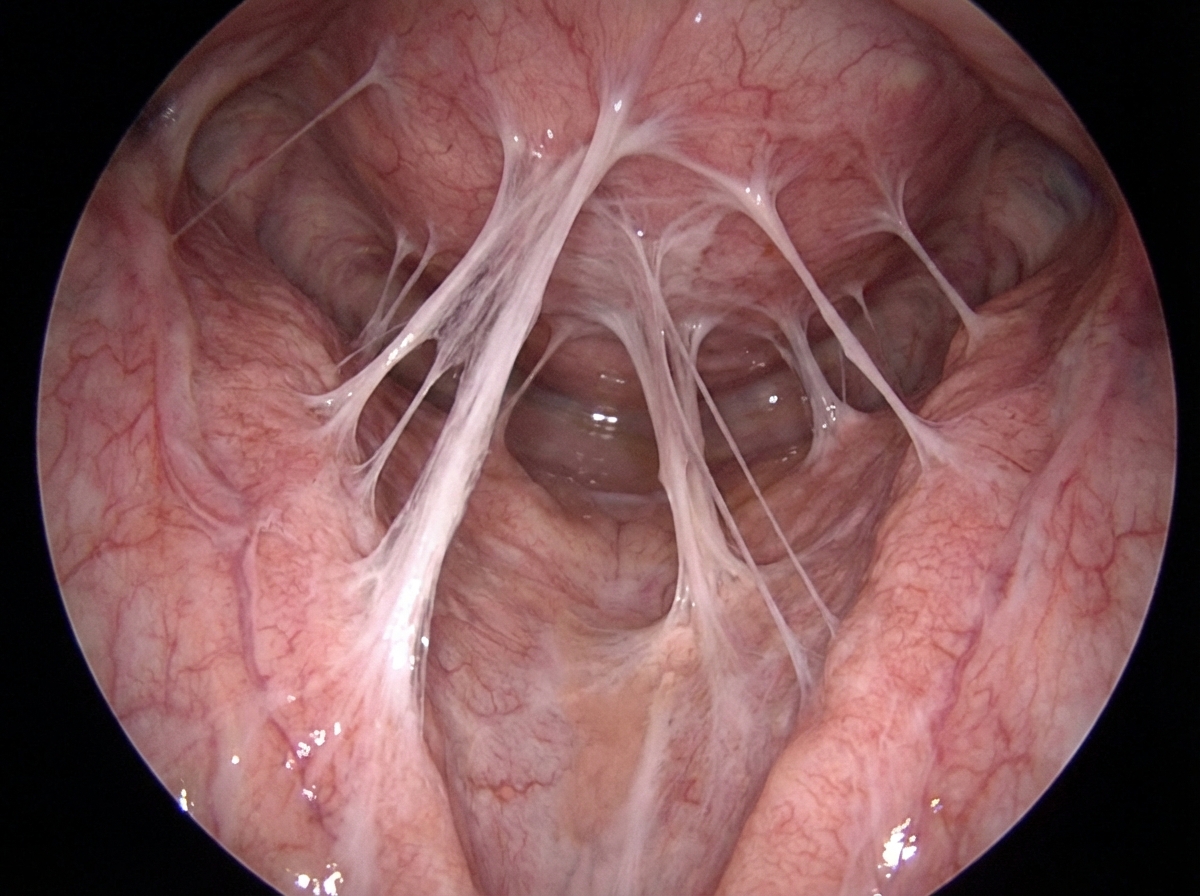
A 28-year-old woman and her husband are admitted to the office due to difficulties conceiving a child for the past year. Her menarche was at the age of 15 years, and her periods have been regular since then. Her medical history is positive for an abortion with curettage 5 years ago. A spermogram on the partner is performed, and it shows motile sperm cells. An ultrasound is performed on the patient and it is unremarkable. The laboratory results show that the FSH, LH, TSH, and prolactin levels are within normal ranges. A hysteroscopy is additionally performed and multiple adhesions are found in the uterus (refer to the image). Which of the following is the most likely composition of the scar tissue present in the uterus?
A 36-year-old woman, gravida 2, para 1, at 30 weeks' gestation comes to the physician for evaluation of increased urinary frequency. She has no history of major medical illness. Physical examination shows no abnormalities. Laboratory studies show an increased serum C-peptide concentration. Ultrasonography shows polyhydramnios and a large for gestational age fetus. Which of the following hormones is predominantly responsible for the observed laboratory changes in this patient?
A 34-year-old G3P2 presents at 33 weeks gestation with vaginal bleeding that started last night while she was asleep. She denies uterine contractions or abdominal pain. She had a cesarean delivery in her previous pregnancy. She also reports a 10 pack-year smoking history. The vital signs are as follows: blood pressure, 130/80 mm Hg; heart rate, 84/min; respiratory rate, 12/min; and temperature, 36.8℃ (98.2℉). The physical examination is negative for abdominal tenderness or palpable uterine contractions. The perineum is mildly bloody. On speculum examination, no vaginal or cervical lesions are seen. A small amount of blood continues to pass through the cervix. Which of the following findings would you expect on ultrasound examination?
A 23-year-old woman comes to the emergency department because of a 5-day history of nausea and vomiting. There is no associated fever, abdominal pain, constipation, diarrhea, or dysuria. She is sexually active and uses condoms inconsistently. Her last menstrual period was 10 weeks ago. Her temperature is 37°C (98.6°F), pulse is 90/min, respirations are 18/min, and blood pressure is 110/70 mm Hg. There is no rebound tenderness or guarding. A urine pregnancy test is positive. Ultrasonography shows an intrauterine pregnancy consistent in size with an 8-week gestation. The hormone that was measured in this patient's urine to detect the pregnancy is also directly responsible for which of the following processes?
Research is being conducted on embryoblasts. The exact date of fertilization is unknown. There is the presence of a cytotrophoblast and syncytiotrophoblast, marking the time when implantation into the uterus would normally occur. Within the embryoblast, columnar and cuboidal cells are separated by a membrane. Which of these cell layers begins to line the yolk sac cavity?
A 26-year-old woman comes to the physician because she has not had a menstrual period for 5 weeks. Menarche was at the age of 14 years and menses occurred at regular 30-day intervals. She reports having unprotected sexual intercourse 3 weeks ago. A urine pregnancy test is positive. Which of the following best describes the stage of development of the embryo at this time?
What is the pattern of inheritance in neural tube defects?
Want unlimited practice?
Get full access to all questions, explanations, and performance tracking.
Scan to download app