
Radiculopathy patterns by level — MCQs

Seven hours after undergoing left hip arthroplasty for chronic hip pain, a 67-year-old woman reports a prickling sensation in her left anteromedial thigh and lower leg. Neurologic examination shows left leg strength 3/5 on hip flexion and 2/5 on knee extension. Patellar reflex is decreased on the left. Sensation to pinprick and light touch are decreased on the anteromedial left thigh as well as medial lower leg. Which of the following is the most likely underlying cause of this patient's symptoms?
A 26-year-old woman presents with sudden-onset pain in her lower back. She says she was exercising in the gym several hours ago when she felt a sharp pain. The pain is radiating down the side of her leg and into her foot. On physical exam, her vital signs are as follows: HR 95, BP 120/70, T 37.2 degrees C. She has extreme pain shooting down her leg with a straight leg raise. Her sensation to light touch and pin-prick is intact throughout. Which of the following is the most likely diagnosis?
A 58-year-old man comes to the physician because of burning pain in his neck and arms for a year. He has also had paresthesias in his hands during this period. He has had increasing weakness in both hands during the past 3 months. He has type 2 diabetes mellitus, hypercholesterolemia, and hypertension. He was involved in a motor vehicle collision 3 years ago. Current medications include metformin, sitagliptin, enalapril, atorvastatin, and aspirin. He has had 7 sexual partners in his lifetime; he uses condoms inconsistently. He is oriented to time, place, and person. Vital signs are within normal limits. The pupils are equal and reactive to light. Examination of the upper extremities shows decreased muscle strength, absent reflexes, and decreased hand grip with fasciculations bilaterally. Sensation to temperature and pain is absent over the chest and bilateral upper arms. Vibration and joint position sensations are present in the upper limbs. Cranial nerve examination shows no focal findings. Examination of the lower extremities show no abnormalities. Which of the following is the most likely diagnosis?
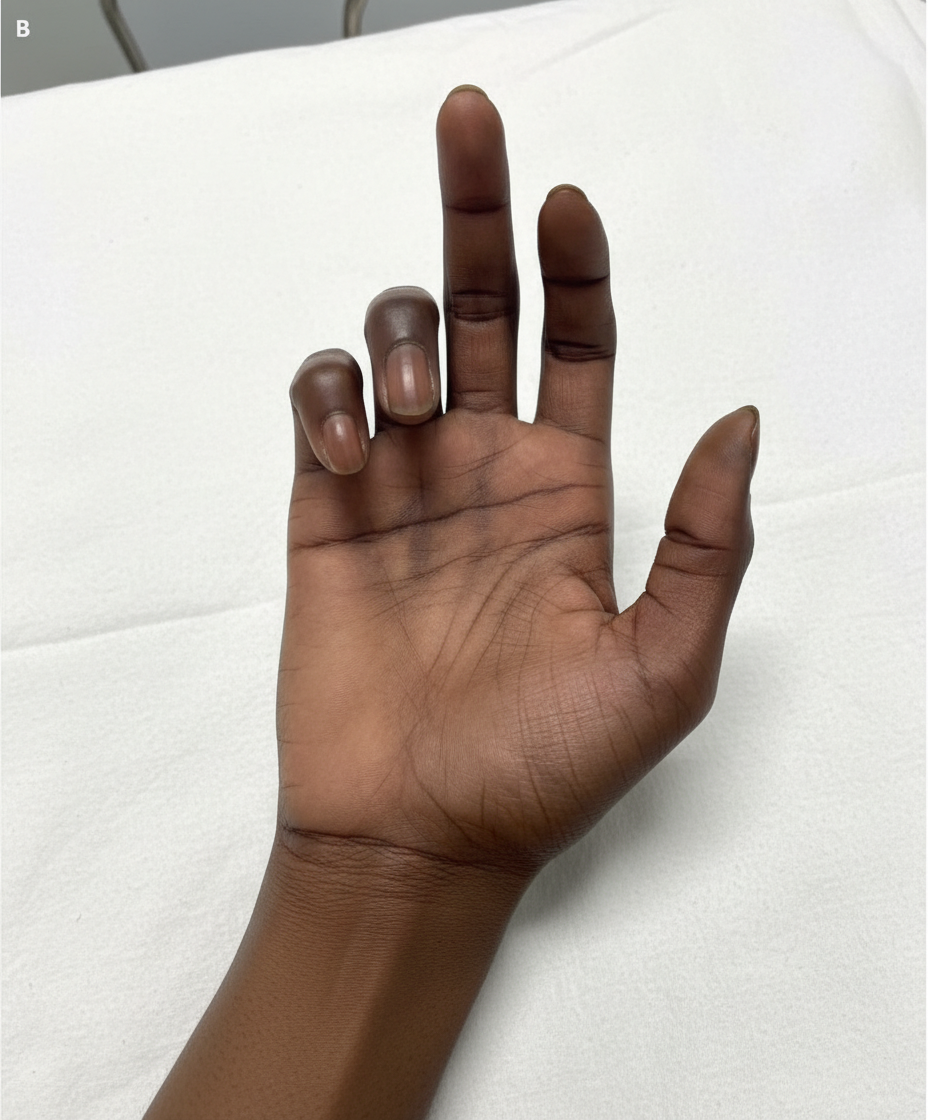
A 30-year-old man presents with weakness in his right hand. He says he has been an avid cyclist since the age of 20. He denies any recent trauma. Physical examination reveals decreased sensations over the 4th and 5th digits with difficulty extending the 4th and 5th digits. Strength is 4 out of 5 in the extensor muscles of the right hand and wrist. When the patient is asked to extend his fingers, the result is shown in the image. Which of the following nerves is most likely damaged in this patient?
A 57-year-old man presents to the ED complaining of back and left leg pain. He was lifting heavy furniture while helping his daughter move into college when all of sudden he felt a sharp pain at his back. The pain is described as severe, worse with movement, and shoots down his lateral thigh. The patient denies any bowel/urinary incontinence, saddle anesthesia, weight loss, or weakness. He denies any past medical history but endorses a family history of osteoporosis. He has been smoking 1 pack per day for the past 20 years. Physical examination demonstrated decreased sensation at the left knee, decreased patellar reflex, and a positive straight leg test. There is diffuse tenderness to palpation at the lower back but no vertebral step-offs were detected. What is the most likely etiology for this patient’s pain?
A 28-year-old woman, gravida 2, para 1, at 24 weeks gestation comes to the physician for a prenatal visit. She reports dull aching pain and paresthesia over her left hand during the last few weeks. The pain radiates to her shoulder and is worse at night. Her hand feels numb upon waking up in the morning. She has a sister who has multiple sclerosis. Her current medications include iron supplements and a multivitamin. Vital signs are within normal limits. When the wrist is passively held in full flexion, aggravation of paresthesia is perceived immediately. Which of the following is the most likely explanation for this patient's symptoms?
A 24-year-old man presents to the emergency department after a motor vehicle accident. The patient was at a stop when he was rear-ended from behind by a vehicle traveling at 11 miles per hour. The patient complains of severe back pain but states he otherwise feels well. The patient is currently seeing a physical therapist who is giving him exercises to alleviate the back pain that is present every morning, relived by activity, and worse with inactivity. He is a student at the university and is struggling with his grades. His temperature is 98.4°F (36.9°C), blood pressure is 117/78 mmHg, pulse is 116/min, respirations are 12/min, and oxygen saturation is 99% on room air. Physical exam demonstrates a decreased range of motion of the patient's spine and tenderness to palpation over the vertebrae. The rest of the exam is deferred due to pain. The patient is requesting a note to excuse him from final exams and work. Which of the following is the most likely diagnosis in this patient?
A 23-year-old woman presents to the emergency department with an acute exacerbation of her 3-month history of low back and right leg pain. She says she has had similar symptoms in the past, but this time the pain was so excruciating, it took her breath away. She describes the pain as severe, shock-like, and localized to her lower back and radiating straight down the back of her right thigh and to her calf, stopping at the ankle. Her pain is worse in the morning, and, sometimes, the pain wakes her up at night with severe buttock and posterior thigh pain but walking actually makes the pain subside somewhat. The patient reports no smoking history or alcohol or drug use. She has been working casually as a waitress and does find bending over tables a strain. She is afebrile, and her vital signs are within normal limits. On physical examination, her left straight leg raise test is severely limited and reproduces her buttock pain at 20° of hip flexion. Pain is worsened by the addition of ankle dorsiflexion. The sensation is intact. Her L4 and L5 reflexes are normal, but her S1 reflex is absent on the right side. A CT of the lumbar spine shows an L5–S1 disc protrusion with right S1 nerve root compression. Which of the following muscle-nerve complexes is involved in producing an S1 reflex?
A 59-year-old woman presents to the emergency room with severe low back pain. She reports pain radiating down her left leg into her left foot. She also reports intermittent severe lower back spasms. The pain started after lifting multiple heavy boxes at her work as a grocery store clerk. She denies bowel or bladder dysfunction. Her past medical history is notable for osteoporosis and endometrial cancer. She underwent a hysterectomy 20 years earlier. She takes alendronate. Her temperature is 99°F (37.2°C), blood pressure is 135/85 mmHg, pulse is 85/min, and respirations are 22/min. Her BMI is 21 kg/m^2. On exam, she is unable to bend over due to pain. Her movements are slowed to prevent exacerbating her muscle spasms. A straight leg raise elicits severe radiating pain into her left lower extremity. The patient reports that the pain is worst along the posterior thigh and posterolateral leg into the fourth and fifth toes. Palpation along the lumbar vertebral spines demonstrates mild tenderness. Patellar reflexes are 2+ bilaterally. The Achilles reflex is decreased on the left. Which nerve root is most likely affected in this patient?
A 14-year-old boy is brought to the physician for the evaluation of back pain for the past six months. The pain is worse with exercise and when reclining. He attends high school and is on the swim team. He also states that he lifts weights on a regular basis. He has not had any trauma to the back or any previous problems with his joints. He has no history of serious illness. His father has a disc herniation. Palpation of the spinous processes at the lumbosacral area shows that two adjacent vertebrae are displaced and are at different levels. Muscle strength is normal. Sensation to pinprick and light touch is intact throughout. When the patient is asked to walk, a waddling gait is noted. Passive raising of either the right or left leg causes pain radiating down the ipsilateral leg. Which of the following is the most likely diagnosis?
Want unlimited practice?
Get full access to all questions, explanations, and performance tracking.
Scan to download app