
Pelvic cross-sections — MCQs

A 60-year-old post-menopausal female presents to her gynecologist with vaginal bleeding. Her last period was over 10 years ago. Dilation and curettage reveals endometrial carcinoma so she is scheduled to undergo a total abdominal hysterectomy and bilateral salpingo-oophorectomy. During surgery, the gynecologist visualizes paired fibrous structures arising from the cervix and attaching to the lateral pelvic walls at the level of the ischial spines. Which of the following vessels is found within each of the paired visualized structure?
A 36-year-old woman comes to the physician for a 2-month history of urinary incontinence and a vaginal mass. She has a history of five full-term normal vaginal deliveries. She gave birth to a healthy newborn 2-months ago. Since then she has felt a sensation of vaginal fullness and a firm mass in the lower vagina. She has loss of urine when she coughs, sneezes, or exercises. Pelvic examination shows an irreducible pink globular mass protruding out of the vagina. A loss of integrity of which of the following ligaments is most likely involved in this patient's condition?
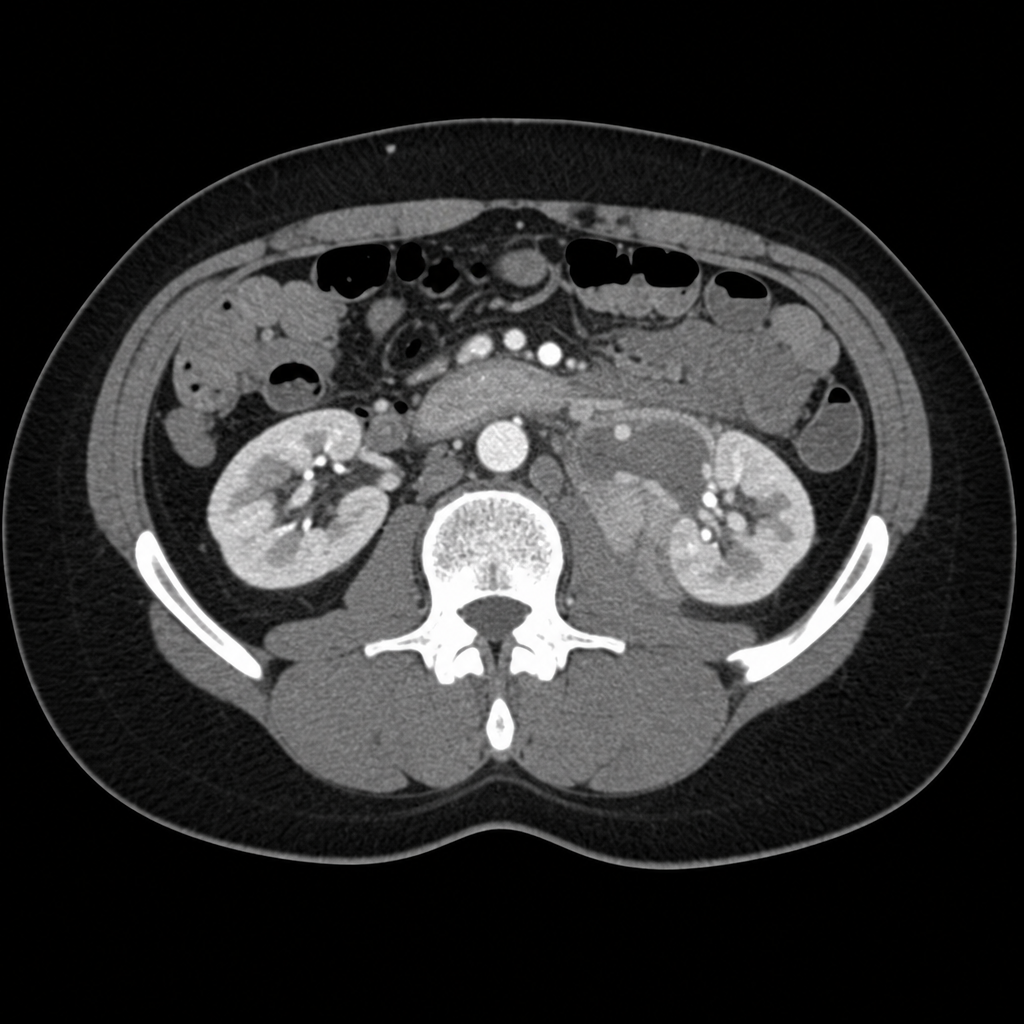
A 35-year-old woman comes to the physician because of progressive left flank pain over the past 2 weeks. She has a history of type 1 diabetes mellitus. Her temperature is 38°C (100.4°F). There is tenderness to percussion along the left flank. Passive extension of the left hip is painful. Her leukocyte count is 16,000/mm3. An axial CT scan is shown. The underlying pathology is most likely located in which of the following anatomical structures?
A child is in the nursery one day after birth. A nurse notices a urine-like discharge being expressed through the umbilical stump. What two structures in the embryo are connected by the structure that failed to obliterate during the embryologic development of this child?
A 47-year-old man is brought to the emergency department 1 hour after injuring his genital area when he fell astride his backyard fence. He was trimming a tree from the fence when he lost his balance. His vital signs are within normal limits. Examination shows blood at the urethral meatus, perineal ecchymoses, and a scrotal hematoma. An x-ray of the pelvis shows swelling of the soft tissue but no other abnormalities. Which part of the urinary tract is most likely damaged in this patient?
A 47-year-old woman comes to the physician because of involuntary leakage of urine for the past 4 months, which she has experienced when bicycling to work and when laughing. She has not had any dysuria or urinary urgency. She has 4 children that were all delivered vaginally. She is otherwise healthy and takes no medications. The muscles most likely affected by this patient's condition receive efferent innervation from which of the following structures?
Thirty minutes after normal vaginal delivery of twins, a 35-year-old woman, gravida 5, para 4, has heavy vaginal bleeding with clots. Physical examination shows a soft, enlarged, and boggy uterus. Despite bimanual uterine massage, administration of uterotonic drugs, and placement of an intrauterine balloon for tamponade, the bleeding continues. A hysterectomy is performed. Vessels running through which of the following structures must be ligated during the surgery to achieve hemostasis?
A 55-year-old man is brought to the emergency department by his wife after falling down. About 90 minutes ago, they were standing in their kitchen making lunch and chatting when he suddenly complained that he could not see as well, felt weak, and was getting dizzy. He began to lean to 1 side, and he eventually fell to the ground. He did not hit his head. In the emergency department, he is swaying while seated, generally leaning to the right. The general physical exam is unremarkable. The neurologic exam is notable for horizontal nystagmus, 3/5 strength in the right arm, ataxia of the right arm, and absent pinprick sensation in the left arm and left leg. The computed tomography (CT) scan of the head is unremarkable. Which of the following is the most likely single location of this patient's central nervous system lesion?
A 71-year-old man undergoes CT angiography for suspected mesenteric ischemia. Axial sections at the L1 level show a dissection flap in the superior mesenteric artery with the true lumen severely narrowed. The false lumen extends into a vessel that crosses anterior to the left renal vein. Coronal reconstructions show this vessel arising from the anterolateral aspect of the aorta at L2. The patient has left flank pain and hematuria in addition to abdominal pain. Synthesize the cross-sectional and vascular anatomy to determine the additional vessel involved.
A 29-year-old pregnant woman at 36 weeks gestation presents with severe right upper quadrant pain and elevated liver enzymes. CT (with abdominal shielding) shows a large subcapsular hematoma of the right hepatic lobe. An axial section at the level of T12 shows the hematoma is located between the liver capsule and parenchyma, with the collection tracking along the bare area of the liver. She develops hypotension. Evaluate the anatomical considerations for determining the optimal surgical approach.
Want unlimited practice?
Get full access to all questions, explanations, and performance tracking.
Scan to download app