
Cranial nerve nuclei — MCQs

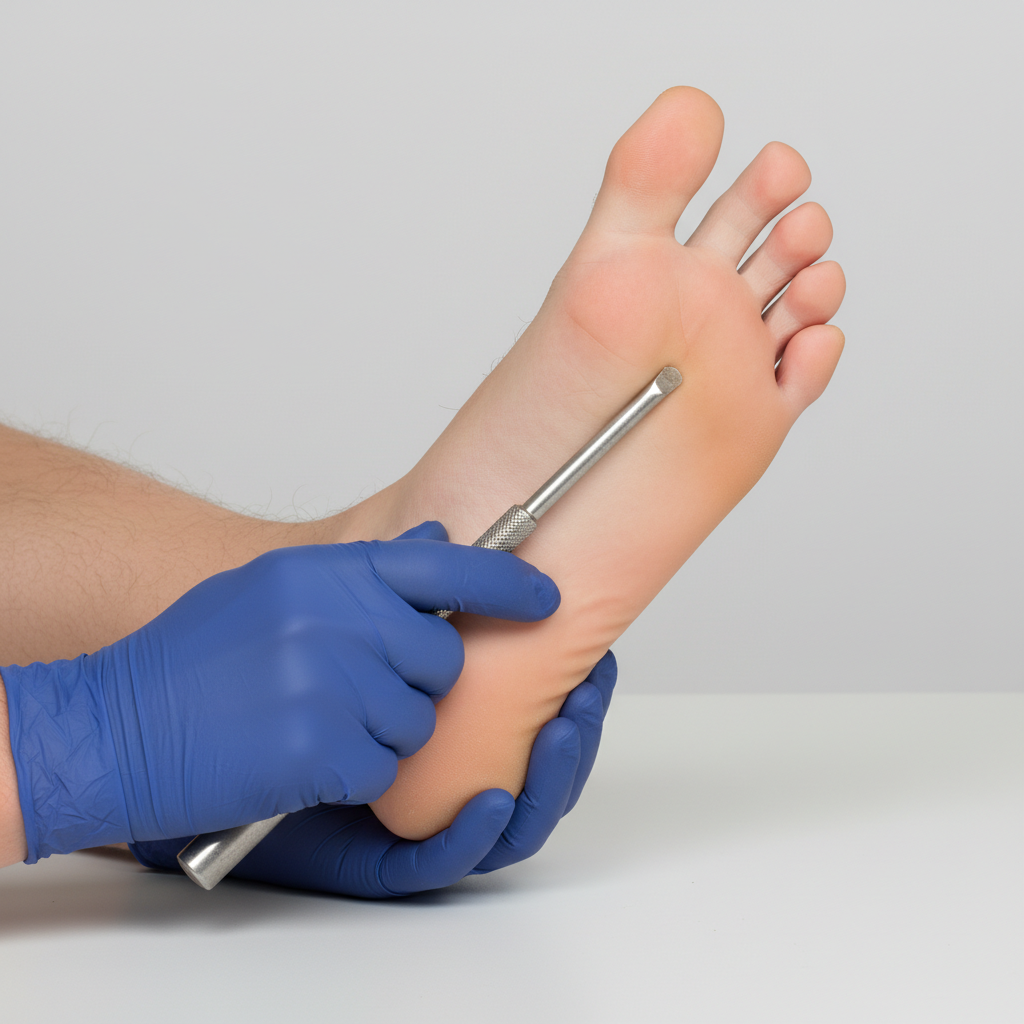
You are seeing a patient in clinic who presents with complaints of weakness. Her physical exam is notable for right sided hyperreflexia, as well as the reflex finding shown in the image below. Where is the most likely location of this patient's lesion?
During an examination of the cranial nerves, a patient shows inability to move their eye laterally past the midline. Which of the following structures in the cavernous sinus is most likely affected?
A researcher is studying the brains of patients who recently died from stroke-related causes. One specimen has a large thrombus in an area of the brain that is important in relaying many modalities of sensory information from the periphery to the sensory cortex. Which of the following embryologic structures gave rise to the part of the brain in question?
A 45-year-old patient presents with difficulty speaking and swallowing following a stroke. MRI reveals an infarct in the medulla. Which of the following cranial nerve nuclei is most likely affected?
A 20-year-old woman reports to student health complaining of 5 days of viral symptoms including sneezing and a runny nose. She started coughing 2 days ago and is seeking cough medication. She additionally mentions that she developed a fever 2 days ago, but this has resolved. On exam, her temperature is 99.0°F (37.2°C), blood pressure is 118/76 mmHg, pulse is 86/min, and respirations are 12/min. Changes in the activity of warm-sensitive neurons in which part of her hypothalamus likely contributed to the development and resolution of her fever?
A 72-year-old woman is brought in to the emergency department after her husband noticed that she appeared to be choking on her dinner. He performed a Heimlich maneuver but was concerned that she may have aspirated something. The patient reports a lack of pain and temperature on the right half of her face, as well as the same lack of sensation on the left side of her body. She also states that she has been feeling "unsteady" on her feet. On physical exam you note a slight ptosis on the right side. She is sent for an emergent head CT. Where is the most likely location of the neurological lesion?
A 72-year-old man comes to his primary care provider because of double vision and headache. He says these symptoms developed suddenly last night and have not improved. He has had type 2 diabetes mellitus for 32 years and essential hypertension for 19 years for which he takes metformin and lisinopril. His last recorded A1c was 9.4%. He has smoked 10 to 15 cigarettes a day for the past 35 years. Family history is significant for chronic kidney disease in his mother. Vital signs reveal a temperature of 36.9 °C (98.42°F), blood pressure of 137/82 mm Hg, and pulse of 72/min. On examination, there is ptosis of the right eye and it is deviated down and out. Visual acuity is not affected in either eye. Which of the following cranial nerves is most likely impaired in this patient?
A 47-year-old man presents to you with gradual loss of voice and difficulty swallowing for the past couple of months. The difficulty of swallowing is for both solid and liquid foods. His past medical history is insignificant except for occasional mild headaches. Physical exam also reveals loss of taste sensation on the posterior third of his tongue and palate, weakness in shrugging his shoulders, an absent gag reflex, and deviation of the uvula away from the midline. MRI scanning was suggested which revealed a meningioma that was compressing some cranial nerves leaving the skull. Which of the following openings in the skull transmit the affected cranial nerves?
A 32-year-old man presents to the emergency department with a severe headache. He says that the pain has been getting progressively worse over the last 24 hours and is located primarily in his left forehead and eye. The headaches have woken him up from sleep and it is not relieved by over-the-counter medications. He has been recovering from a sinus infection that started 1 week ago. His past medical history is significant for type 1 diabetes and he has a 10 pack-year history of smoking. Imaging shows thrombosis of a sinus above the sella turcica. Which of the following findings would most likely also be seen in this patient?
A 65-year-old woman presents to her physician with the complaint of ringing in her right ear. She says it started about 3 months ago with associated progressive difficulty in hearing on the same side. Past medical history is significant for a hysterectomy 5 years ago due to dysfunctional uterine bleeding. She is currently not taking any medications. She is a non-smoker and drinks socially. On otoscopic examination, a red-blue pulsatile mass is observed behind the right tympanic membrane. A noncontrast CT scan of the head shows significant bone destruction resulting in a larger jugular foramen highly suggestive of a tumor derived from neural crest cells. Which of the cranial nerves are most likely to be involved in this type of lesion?
Want unlimited practice?
Get full access to all questions, explanations, and performance tracking.
Scan to download app