
Palliative Surgical Interventions — MCQs

Based on healthcare utility values and life expectancy, which of the following measures can be calculated? Consider a scenario where the average life expectancy for a woman in Japan is 87 years, and there is an increase in life expectancy due to healthcare advancements.
A patient after undergoing thoracotomy complains of severe pain. The BEST method of pain control in this patient would be:
In case of professional misconduct, patients' records should be provided within how many hours?
What is the preferred palliative surgical procedure for rectal prolapse in elderly patients who are unfit for more invasive surgery?
Which of the following statements about the ABCDE approach in pediatric Advanced Life Support (PALS) is incorrect?
In a patient with esophageal cancer and dysphagia affecting liquid intake, what is the most appropriate intervention to ensure nutritional support?
All the following radioisotopes are used in painful body metastasis except
A 35-year-old HIV-positive woman (CD4 count 180/μL, on HAART) develops extensive perianal condyloma acuminata resistant to conventional treatments. HPV typing shows type 16. What is the most appropriate management approach?
Antiprogesterone compound RU-486 is effective for inducing abortion if the duration of pregnancy is what?
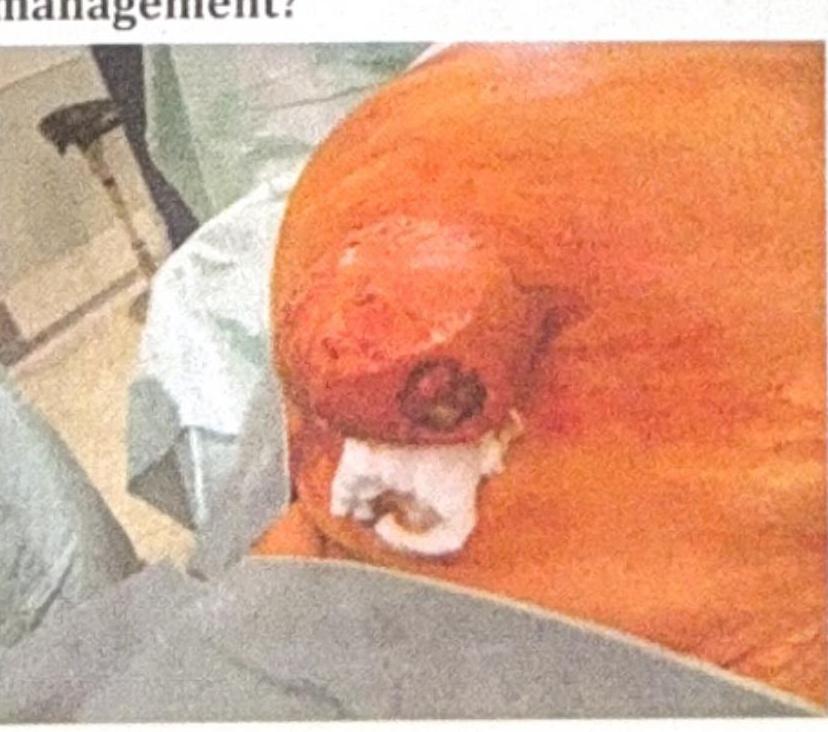
A patient presents with an umbilical mass, which was previously reducible but has now become irreducible with discharge coming out, as shown in the image. What is the most appropriate management?
Want unlimited practice?
Get full access to all questions, explanations, and performance tracking.
Scan to download app