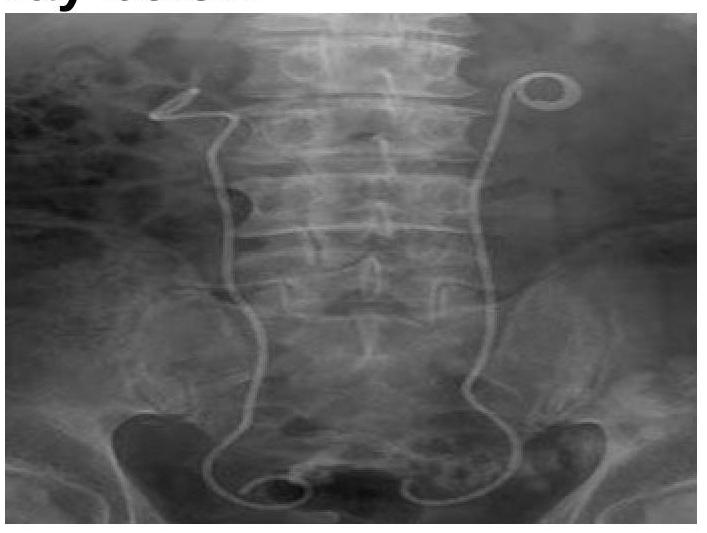
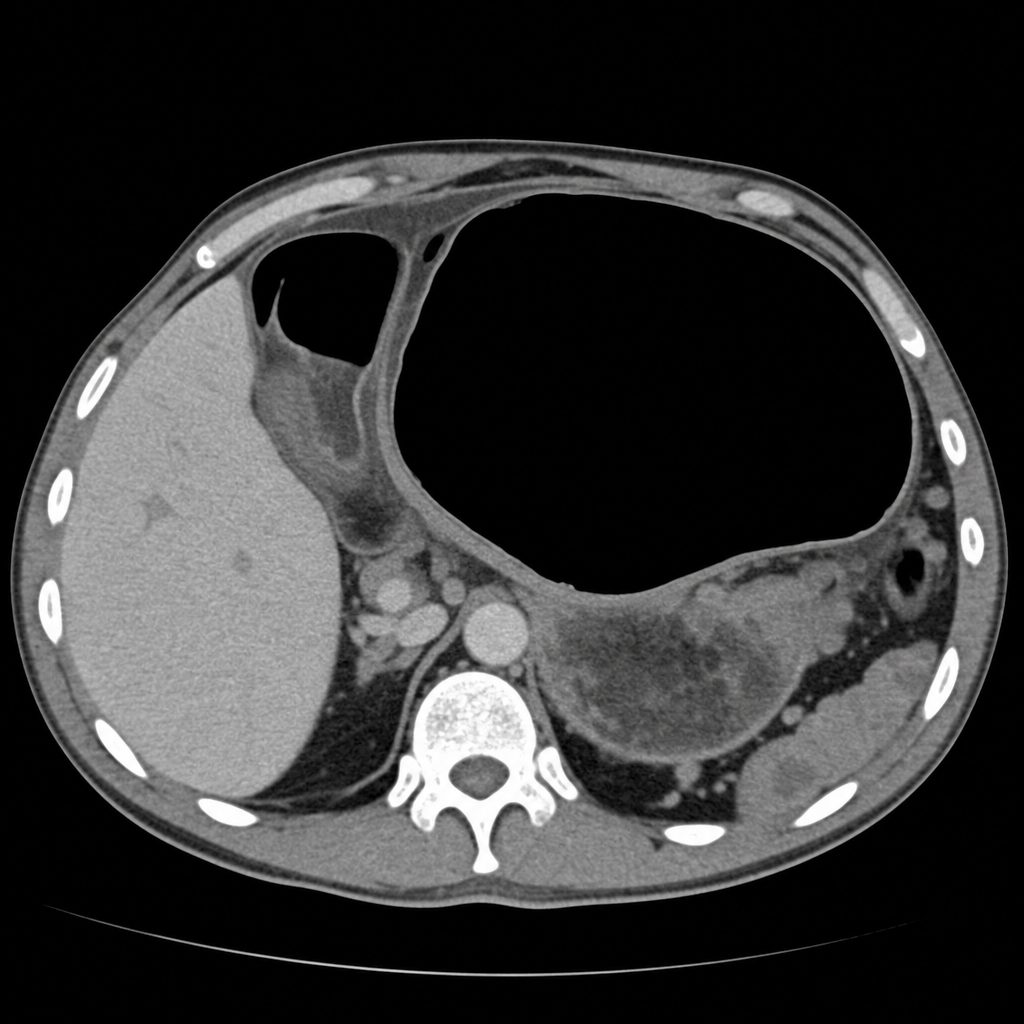
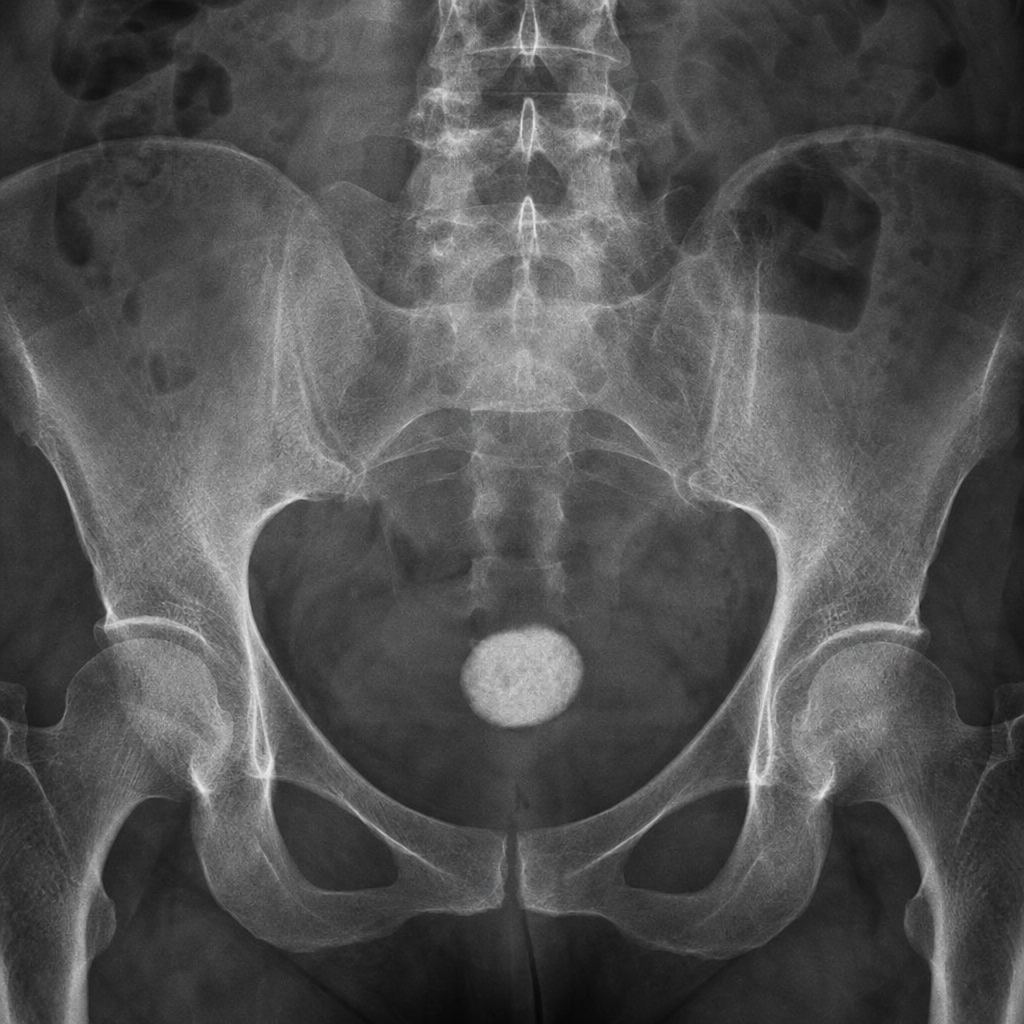
The 'coffee bean sign' is a radiologic finding in which of the following abdominal conditions?
What condition is characterized by 'scalloping' of the edge of the sigmoid colon on barium enema?
Hampton's line is a feature of which of the following?
Which condition is characterized by the 'accordian sign'?
A 65-year-old patient presents with abdominal distension and constipation. What is the most likely diagnosis based on the abdominal X-ray shown?
What is the investigation shown in the image?
Which of the following is a primary use of this imaging modality? 
A patient presents with a history of dysphagia, which is more pronounced for liquids than solids. Which radiological sign is most likely to be seen?
A male patient presented with complaints of hematuria and recurrent urinary tract infection. You notice the following finding in his CECT. What is the likely condition indicated by the arrow in the image?
Identify the part of the bowel in the barium study given below.
Explanation: **Explanation:** The **'Coffee Bean Sign'** is a classic radiological hallmark of **Sigmoid Volvulus**. This condition occurs when the sigmoid colon twists around its mesenteric axis, leading to a closed-loop obstruction. On a plain abdominal X-ray, the massively dilated, gas-filled sigmoid loop rises out of the pelvis and occupies much of the abdomen. The two medial walls of the dilated loop pressed against each other form a central dense line (the "cleft" of the bean), while the lateral walls form the outer curvature, mimicking the appearance of a giant coffee bean. **Analysis of Incorrect Options:** * **Ileocecal Tuberculosis:** Typically presents with a "conical cecum," "Stierlin’s sign" (rapid emptying of the terminal ileum), or "Fleischner sign" (inverted umbrella appearance of the ileocaecal valve), rather than massive loop dilation. * **Ulcerative Colitis:** In acute phases, it may show "Lead pipe appearance" (loss of haustrations) or "Thumbprinting" (mucosal edema). In severe cases, it leads to **Toxic Megacolon**, which shows generalized colonic dilation but lacks the specific coffee bean configuration. * **Crohn’s Disease:** Characterized by the "String sign of Kantor" (narrowing of the terminal ileum) and "Proud flesh" (widening of the pre-stenotic area). **High-Yield Clinical Pearls for NEET-PG:** * **Direction:** The coffee bean in sigmoid volvulus usually points toward the **Right Upper Quadrant**. * **Frimann-Dahl’s Sign:** The visualization of three dense lines (the walls of the sigmoid loop) converging towards the site of obstruction. * **Contrast Enema:** Shows a pathognomonic **"Bird’s Beak"** or "Ace of Spades" appearance at the site of the twist. * **Cecal Volvulus:** Unlike sigmoid, the dilated loop in cecal volvulus usually has only one air-fluid level and points toward the **Left Upper Quadrant**.
Explanation: **Explanation:** **Pneumatosis intestinalis** is the correct answer. This condition is characterized by the presence of gas within the wall of the gastrointestinal tract (submucosal or subserosal). On a barium enema, these intramural gas bubbles protrude into the lumen, creating a characteristic **"scalloped"** or "thumbprinting-like" appearance of the colonic margin. Unlike true thumbprinting caused by edema, these radiolucent areas represent gas collections that displace the barium column. **Analysis of Incorrect Options:** * **Diverticulosis:** Characterized by multiple small, flask-shaped outpouchings (diverticula) extending *outside* the colonic lumen, often described as a "saw-tooth" appearance when associated with muscular hypertrophy. * **Ulcerative Colitis:** Early stages show mucosal granularity or "lead-pipe" appearance (loss of haustrations) in chronic stages. It does not typically produce focal scalloping. * **Carcinoma Colon:** Usually presents as a focal, irregular narrowing with overhanging edges, famously known as the **"Apple-core" lesion**. **Clinical Pearls for NEET-PG:** * **Pneumatosis Cystoides Intestinalis:** A primary form where multiple gas-filled cysts form in the subserosa/submucosa; it is often asymptomatic but can lead to benign pneumoperitoneum. * **Secondary Pneumatosis:** Often a surgical emergency, associated with **Necrotizing Enterocolitis (NEC)** in neonates or mesenteric ischemia in adults. * **Radiological Sign:** On a plain X-ray, look for "linear or curvilinear lucencies" parallel to the bowel wall. * **Differential Diagnosis:** Scalloping can also be seen in **pseudomyxoma peritonei**, but this occurs on the *outer* surface of solid organs (like the liver or spleen) rather than the inner colonic lumen.
Explanation: **Explanation:** **Hampton’s line** is a classic radiologic sign seen on a barium meal study, representing a thin, sharp, lucent line (1–2 mm) across the neck of a gastric ulcer crater. **1. Why Benign Ulcers is correct:** Hampton’s line represents the **undermined mucosal edge** of a benign ulcer. In a benign process, the gastric mucosa is relatively healthy and pliable; as the ulcer erodes deeper into the submucosa, the intact mucosa overhangs the edge of the crater. When viewed in profile during a barium study, this overhanging edge appears as a thin radiolucent line separating the barium in the gastric lumen from the barium in the ulcer crater. Its presence is a highly reliable indicator of **benignity**. **2. Why other options are incorrect:** * **Malignant Ulcers:** In gastric cancer, the surrounding tissue is infiltrated by malignant cells, making the mucosa rigid, nodular, and irregular. Instead of a thin line, malignant ulcers typically show a "Carman’s Meniscus sign" or irregular, heaped-up margins that do not overhang the crater. * **Both/None:** Because Hampton’s line specifically requires preserved, pliable mucosal architecture, it is pathognomonic for benign lesions and does not occur in malignancy. **NEET-PG High-Yield Pearls:** * **Hampton’s Line:** Benign gastric ulcer (thin lucent line). * **Ulcer Collar:** A thicker lucent band at the ulcer base, also indicating a benign ulcer (due to edema). * **Carman’s Meniscus Sign:** Pathognomonic for a large **malignant** gastric ulcer. * **Radiation of Mucosal Folds:** In benign ulcers, folds are smooth and reach the very edge of the crater; in malignant ulcers, folds are clubbed, fused, or stop short of the crater.
Explanation: **Explanation:** The **'Accordion Sign'** is a classic radiological finding most commonly associated with **Pseudomembranous colitis** (caused by *Clostridioides difficile* infection). **1. Why Pseudomembranous Colitis is correct:** The sign occurs when oral contrast material becomes trapped between thickened, edematous haustral folds. On CT, the alternating layers of high-density contrast and low-density inflamed mucosa resemble the bellows of an accordion. This indicates severe colonic wall thickening and mucosal edema. **2. Analysis of Incorrect Options:** * **Intussusception:** Characterized by the **'Target sign'** or **'Doughnut sign'** on transverse ultrasound/CT, and the **'Pseudokidney sign'** on longitudinal views. * **Ileocecal TB:** Typically presents with a **'Conical cecum'**, **'Stierlin’s sign'** (rapid emptying of the inflamed segment), or the **'Fleischner sign'** (inverted umbrella appearance of the ileocaecal valve). * **Ischemic colitis:** Often shows **'Thumbprinting'** on plain X-ray or barium studies due to submucosal hemorrhage and edema, but lacks the specific "trapped contrast" pattern of the accordion sign. **3. NEET-PG High-Yield Pearls:** * **Pseudomembranous Colitis:** Look for a history of recent antibiotic use (especially Clindamycin or Fluoroquinolones). The gold standard for diagnosis is the detection of *C. difficile* toxins in stool. * **Other signs of Colitis:** **'Lead pipe appearance'** is seen in chronic Ulcerative Colitis due to loss of haustrations. * **Differential:** While highly suggestive of *C. difficile*, the accordion sign can occasionally be seen in other causes of severe edema, such as Crohn’s disease or infectious colitis, but for exam purposes, it is the hallmark of Pseudomembranous colitis.
Explanation: ***Sigmoid Volvulus*** - The abdominal X-ray shows a classic **coffee bean sign**, which is a massively dilated, inverted U-shaped loop of the sigmoid colon rising from the pelvis. - The loop is characteristically **ahaustral** (lacking haustra) and its apex points towards the right upper quadrant, confirming the diagnosis of sigmoid volvulus. *Caecal Volvulus* - A caecal volvulus typically appears as a **kidney-shaped** or comma-shaped dilated loop of bowel, often located in the left upper quadrant or mid-abdomen. - Unlike the sigmoid, the dilated caecum in a volvulus usually retains its **haustral markings**. *Intestinal Obstruction* - While a volvulus does cause an intestinal obstruction, this option is a general finding rather than the specific diagnosis indicated by the classic radiographic sign. - General large bowel obstruction typically shows colonic dilation proximal to the blockage, without the specific twisted appearance of the **coffee bean sign**. *Small Bowel Volvulus* - A small bowel volvulus would involve dilated loops of the small bowel, which would typically show **valvulae conniventes** (plicae circulares). - This condition is rare in adults and the image clearly shows a dilated, **ahaustral** segment of the large bowel, which is inconsistent with small bowel anatomy.
Explanation: ***Intravenous Pyelogram (IVP)*** - This investigation involves the intravenous injection of a **water-soluble iodinated contrast agent**, which is then excreted by the kidneys, allowing visualization of the entire urinary tract. - The image shows a plain radiograph where the **renal pelves**, **calyces**, both **ureters**, and the **bladder** are simultaneously opacified, which is characteristic of contrast being filtered and passed down the urinary system. *Retrograde Pyelogram* - In this procedure, contrast is injected directly into the **ureteric orifices** via a catheter placed during **cystoscopy**, filling the system from the bottom up. - It typically provides a denser opacification than an IVP and is often performed unilaterally. It does not assess renal function as the contrast is not filtered by the kidneys. *Computed Tomography (CT) Urography* - CT Urography uses intravenous contrast but acquires images using **computed tomography**, producing detailed, cross-sectional, and 3D reformatted images of the urinary tract. - The image provided is a two-dimensional **projectional radiograph** (a standard X-ray), not a CT scan which would show axial, coronal, or sagittal slices. *Magnetic Resonance Urography* - This technique uses **magnetic fields and radio waves** to generate images, avoiding ionizing radiation. It is excellent for visualizing soft tissues. - The image shown is clearly an X-ray, identifiable by the high contrast visualization of dense structures like bone, which differs significantly from the appearance of an MR image.
Explanation: ***Staging of esophageal cancer*** - The image displays an **Endoscopic Ultrasound (EUS)**, which is the most accurate modality for the locoregional staging of esophageal cancer. - EUS provides detailed imaging of the esophageal wall layers, allowing for precise assessment of the **depth of tumor invasion (T stage)** and involvement of **regional lymph nodes (N stage)**, which is critical for treatment planning. *Evaluation of gastroesophageal reflux disease (GERD)* - The diagnosis of GERD is primarily based on clinical symptoms and may be confirmed with **upper endoscopy** to look for esophagitis or **ambulatory pH monitoring**. - EUS is not used for evaluating reflux itself, as it doesn't measure acid exposure or lower esophageal sphincter function. *Identifying the cause of dysphagia* - The initial investigation for dysphagia typically involves a **barium esophagram** or a standard **upper endoscopy** to visualize the esophageal lumen directly. - EUS is a secondary test used to further characterize a mass or stricture already identified by other means, rather than as a primary tool for dysphagia workup. *Assessing cardiac and aortic pathology* - While EUS can visualize adjacent mediastinal structures, including the heart and aorta, it is not the primary imaging modality for their assessment. - **Echocardiography** is the standard for cardiac evaluation, and **CT or MR angiography** is superior for assessing aortic pathology.
Explanation: ***Rat-tail sign*** - Dysphagia that is more pronounced for liquids (**paradoxical dysphagia**) than solids is the hallmark symptom of **Achalasia**, a primary esophageal motility disorder. - The **rat-tail sign** (or **bird-beak sign**) seen on **barium swallow** is due to the non-relaxed, smoothly tapered distal esophagus resulting from **Lower Esophageal Sphincter (LES) failure** to relax. *Filling defect* - This is a general radiological term indicating any mass lesion protruding into the esophageal lumen, such as a **polyp**, **foreign body**, or a large tumor mass. - It is not specific to motility disorders like Achalasia, which cause smooth, concentric narrowing rather than a discrete filling absence. *Corkscrew esophagus* - This classic radiographic finding is characteristic of **Diffuse Esophageal Spasm (DES)**, where uncoordinated and severe contractions occur intermittently throughout the esophagus. - DES typically causes intermittent dysphagia and significant non-cardiac **chest pain**, and the dysphagia pattern is usually not strictly *liquids more than solids*. *Apple-core lesion* - The **apple-core lesion** (or **napkin-ring sign**) is the classical appearance of an infiltrative, malignant stricture, most commonly seen in cases of advanced **esophageal carcinoma**. - Malignant strictures cause progressive dysphagia, typically starting with difficulty swallowing **solids before liquids**, which contradicts the patient’s presentation.
Explanation: ***Horseshoe kidney*** - The CECT image shows the **fusion of the lower poles** of the kidneys across the midline, anterior to the great vessels, forming a characteristic U-shape. This connecting bridge of renal tissue is called an **isthmus**. - This congenital anomaly is associated with an increased risk of complications like **recurrent UTIs**, **nephrolithiasis** (kidney stones), and **hematuria** due to impaired urinary drainage and vesicoureteral reflux, which aligns with the patient's presentation. *Polycystic kidney disease* - This genetic disorder is characterized by the presence of **multiple, bilateral cysts** throughout the renal parenchyma, causing massive enlargement of the kidneys. - The provided image shows a fusion anomaly with relatively normal-appearing renal parenchyma, not the cystic changes typical of polycystic kidney disease. *Hydronephrosis* - Hydronephrosis refers to the **dilation of the renal pelvis and calyces** due to an obstruction of urine outflow. It is a finding, not a primary diagnosis of a structural anomaly. - While a horseshoe kidney can lead to hydronephrosis, the primary abnormality indicated by the arrows is the **renal fusion**, not a dilated collecting system. *Pancake kidney* - A pancake (or fused pelvic) kidney is a rare anomaly where the kidneys are completely fused into a **single, disc-shaped mass** located in the pelvis. - In contrast, a horseshoe kidney involves fusion typically at the lower poles, with two distinct renal masses still identifiable, as seen in the image.
Explanation: ***Jejunum*** - The barium study shows prominent, closely packed mucosal folds, known as **plicae circulares** (or valvulae conniventes), which create a characteristic **'feathery'** or **'stack of coins'** appearance distinctive to the jejunum. - Anatomically, the jejunum is primarily located in the **left upper quadrant** of the abdomen and has a wider diameter and thicker wall than the ileum, consistent with the radiographic findings. *Ileum* - The ileum has fewer, sparser, and less prominent **plicae circulares**, resulting in a smoother, more **'featureless'** appearance on a barium study compared to the jejunum. - It is typically located in the **right lower quadrant** of the abdomen, terminating at the ileocecal valve. *Transverse colon* - The transverse colon is part of the large intestine and is identified by its **haustra**, which are sacculations that give it a segmented appearance, not the fine, feathery pattern of the small bowel. - It generally has a larger caliber than the small intestine and is positioned more superiorly in the abdomen, spanning from the hepatic flexure to the splenic flexure. *Splenic flexure* - The splenic flexure is the sharp turn between the transverse colon and the descending colon, and like the rest of the colon, it would display **haustral markings**. - It is located high in the **left upper quadrant**, superior to where the jejunal loops are typically found.
Imaging of Liver
Practice Questions
Biliary Tract Imaging
Practice Questions
Pancreatic Imaging
Practice Questions
Spleen and Lymphatic System
Practice Questions
Gastrointestinal Tract Imaging
Practice Questions
Renal and Urinary Tract Imaging
Practice Questions
Adrenal Imaging
Practice Questions
Female Pelvic Imaging
Practice Questions
Male Pelvic Imaging
Practice Questions
Abdominal Trauma Imaging
Practice Questions
Acute Abdomen Imaging
Practice Questions
Imaging of Peritoneal Cavity and Retroperitoneum
Practice Questions
Get full access to all questions, explanations, and performance tracking.
Start For Free