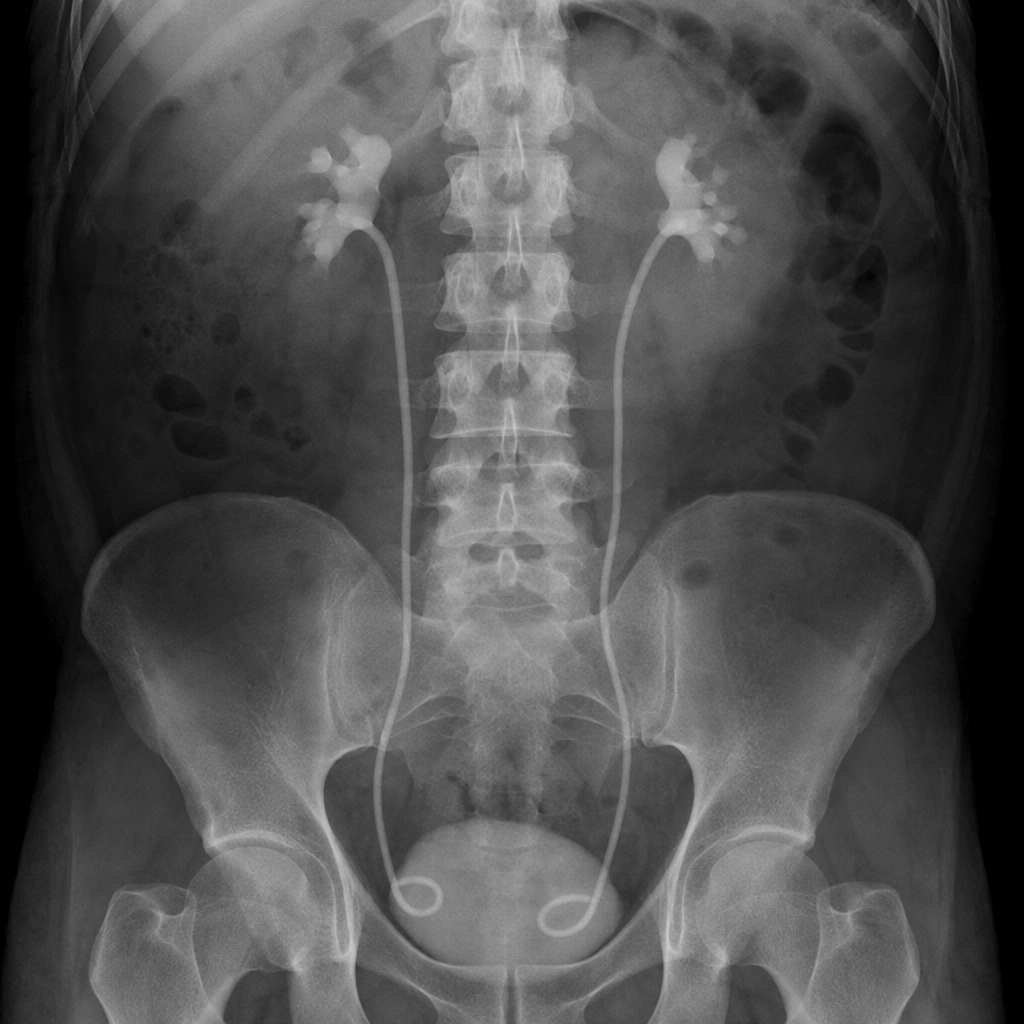
Which of the following MR imaging findings distinguishes vaginal atresia from Mullerian agenesis?
Which of the following findings is not typically seen on imaging of acute pyelonephritis?
CECT with nodular enhancement is suggestive of:
Widening of the C loop of the duodenum is a feature of which of the following?
What is the target sign on USG indicative of?
Kerley B lines are seen in which of the following conditions?
Which of the following imaging modalities is NOT employed in the PI-RADS reporting scheme for prostate glands?
Which of the following conditions is typically associated with a feline esophagus appearance on imaging?
The "doughnut sign" is characteristically seen in which of the following conditions?
Which diagnostic imaging modality is used to diagnose vesicoureteric reflux?
Explanation: ### Explanation The fundamental distinction between **Vaginal Atresia** and **Mullerian Agenesis (Mayer-Rokitansky-Küster-Hauser syndrome)** lies in the embryological origin of the structures involved. **1. Why "Presence of a cervix" is correct:** * **Vaginal Atresia:** This is a canalization failure of the **urogenital sinus** (which forms the lower 2/3 of the vagina). Because the Mullerian ducts develop normally, the **cervix, uterus, and fallopian tubes are present**. On MRI, you will see a normal uterus and cervix, but the lower vagina is replaced by fibrous tissue, often leading to *hematocolpos* (blood in the upper vagina). * **Mullerian Agenesis (MRKH):** This is a failure of the **Mullerian ducts** to develop. Consequently, the **cervix and uterus are absent** (or present only as rudimentary horns). The presence of a cervix on MRI effectively rules out MRKH. **2. Why other options are incorrect:** * **Amount of upper vaginal dilatation:** While both can present with primary amenorrhea, dilatation depends on the presence of functioning endometrium and the degree of obstruction, not the specific diagnosis. * **Length of the atresia:** The length of the vaginal deficit can vary in both conditions and is not a definitive diagnostic feature for differentiating the two. * **Hymeneal ring appearance:** This is a physical exam finding (specifically for imperforate hymen) rather than a distinguishing MRI feature between atresia and agenesis. **High-Yield Clinical Pearls for NEET-PG:** * **MRKH Syndrome:** Characterized by 46,XX karyotype, normal ovaries (secondary sexual characteristics present), and **renal anomalies** (30-40% of cases, e.g., renal agenesis). * **MRI Protocol:** MRI is the gold standard for pelvic anomalies to visualize the "Mullerian remnants." * **Differential:** If a patient has primary amenorrhea and a **bulge** at the introitus, think **Imperforate Hymen**. If there is **no bulge** but a palpable pelvic mass, think **Vaginal Atresia**.
Explanation: **Explanation:** Acute pyelonephritis is a clinical diagnosis, but imaging (USG or CT) is often used to assess complications. The hallmark of acute pyelonephritis on imaging is **decreased perfusion**, not increased. **Why "Increased Vascularity" is the correct answer (the finding NOT seen):** In acute pyelonephritis, the inflammatory process leads to interstitial edema and leukocyte infiltration. This causes compression of the small intrarenal vessels and capillaries. Consequently, Doppler ultrasound or contrast-enhanced CT typically shows **decreased/absent vascularity** or "striated nephrograms" in the affected segments. Increased vascularity is more characteristic of tumors or certain chronic inflammatory conditions, but not acute bacterial infection of the renal parenchyma. **Analysis of Incorrect Options:** * **A. Grossly enlarged kidney:** Edema and inflammatory cell infiltration cause the kidney to swell, leading to global or focal reniform enlargement. * **B. Focal areas of hypoechogenicity:** On ultrasound, the edema reduces the echogenicity of the renal parenchyma compared to the normal cortex. * **C. Perinephric edema:** Inflammation often spreads to the surrounding Gerota’s fascia, manifesting as "stranding" on CT or fluid collections/thickening on ultrasound. **High-Yield Clinical Pearls for NEET-PG:** * **Gold Standard Imaging:** Contrast-Enhanced CT (CECT) is the most sensitive modality for diagnosing pyelonephritis and its complications (e.g., abscess). * **Striated Nephrogram:** A classic CT finding characterized by linear bands of delayed enhancement due to tubular obstruction and interstitial edema. * **Emphysematous Pyelonephritis:** A life-threatening necrotizing infection (common in diabetics) characterized by **gas** within the renal parenchyma.
Explanation: **Explanation:** **Hemangioma** is the most common benign tumor of the liver. The characteristic finding on Contrast-Enhanced Computed Tomography (CECT) is **peripheral globular/nodular enhancement** during the arterial phase. This enhancement follows a "centripetal" pattern, meaning it fills in progressively from the periphery toward the center in the venous and delayed phases (the "filling-in" phenomenon). The density of the enhancement typically matches that of the aorta. **Analysis of Incorrect Options:** * **Hepatic Adenoma:** Typically shows early, intense, relatively uniform arterial enhancement (not nodular) and may show "washout" or become isodense on delayed scans. It is often associated with oral contraceptive use. * **Focal Nodular Hyperplasia (FNH):** Characterized by intense, homogeneous arterial enhancement with a pathognomonic **central stellate scar** that shows delayed enhancement. It does not exhibit peripheral nodularity. * **Cholangiocarcinoma:** Usually presents as a hypoattenuating mass with **delayed capsular retraction** and progressive internal enhancement due to its fibrous (desmoplastic) stroma. **High-Yield Pearls for NEET-PG:** * **Hemangioma:** Most common benign liver tumor; "Peripheral nodular puddling" is the buzzword. * **FNH:** Second most common benign tumor; "Spoke-wheel appearance" on angiography; Sulfur colloid uptake on scintigraphy (due to Kupffer cells). * **Hepatocellular Carcinoma (HCC):** Shows "Arterial hyperenhancement" with "Rapid venous washout." * **MRI:** Hemangiomas appear as "Light bulb bright" on T2-weighted images.
Explanation: **Explanation:** The **C-loop of the duodenum** (comprising the 1st, 2nd, and 3rd parts) anatomically cradles the **head of the pancreas**. Any space-occupying lesion or enlargement of the pancreatic head will exert outward pressure on the inner curvature of the duodenum, leading to the classic radiological sign of **"Widening of the C-loop."** **Why the correct answer is right:** * **Pancreatic head growth:** Whether due to **Carcinoma of the head of the pancreas** or **Chronic Pancreatitis** (inflammatory mass), the enlargement pushes the descending (2nd) part of the duodenum laterally and the horizontal (3rd) part inferiorly. This increases the diameter of the duodenal sweep on a Barium swallow or CT scan. **Why the incorrect options are wrong:** * **Carcinoma of the stomach:** Typically involves the lesser or greater curvature of the stomach. While it can cause gastric outlet obstruction, it does not characteristically widen the duodenal loop. * **Splenic involvement:** The spleen is located in the left hypochondrium, related to the tail of the pancreas. Splenomegaly may displace the stomach medially but has no effect on the duodenal C-loop. * **Involvement of the upper renal pole:** The right kidney lies posterior to the duodenum. While a massive renal mass might displace the duodenum anteriorly, it does not cause the circumferential widening characteristic of pancreatic head pathology. **High-Yield Clinical Pearls for NEET-PG:** * **Frostberg’s Inverted 3 Sign:** A classic barium sign in pancreatic head cancer where the duodenum is fixed at the ampulla of Vater while the rest is pushed out, resembling a reversed '3'. * **Rosewood Sign:** Displacement of the duodenal bulb seen in pancreatic masses. * **Double Duct Sign:** On MRCP/ERCP, simultaneous dilatation of the Common Bile Duct (CBD) and the Pancreatic Duct is highly suggestive of a pancreatic head malignancy.
Explanation: **Explanation:** The **Target Sign** (also known as the "Doughnut Sign") on ultrasonography is a classic radiological hallmark of **Congenital Hypertrophic Pyloric Stenosis (CHPS)**. It is seen in the transverse plane of the pylorus. **1. Why Option A is Correct:** In CHPS, there is hypertrophy and hyperplasia of the circular muscle layers of the pylorus. On a transverse USG scan, the **hypoechoic (dark) hypertrophied muscle** forms a thick outer ring, while the **hyperechoic (bright) mucosa/submucosa** and the narrowed lumen form the central core. This creates the appearance of a target or a doughnut. **2. Why Other Options are Incorrect:** * **Gastric Ulcers:** These are typically diagnosed via endoscopy or barium studies (showing an "ulcer niche"). While wall thickening can occur, it does not produce the specific concentric target appearance seen in CHPS. * **Achalasia:** This is a motility disorder of the Lower Esophageal Sphincter (LES). On imaging (Barium swallow), it presents with the "Bird’s Beak" appearance, not a target sign on USG. **3. High-Yield Clinical Pearls for NEET-PG:** * **USG Criteria for CHPS:** Pyloric muscle thickness **>3 mm** and pyloric canal length **>14–17 mm**. * **Other Signs in CHPS:** * **Cervix Sign:** On longitudinal USG, the pylorus indenting the antrum resembles a cervix. * **String Sign:** Seen on Barium studies due to the severely narrowed canal. * **Clinical Presentation:** A 3–6 week old infant with **non-bilious, projectile vomiting** and a palpable "olive-shaped" mass in the epigastrium. * **Metabolic Abnormality:** Hypochloremic, hypokalemic metabolic alkalosis (Paradoxical aciduria).
Explanation: **Explanation:** Kerley B lines are a classic radiological sign seen on a chest X-ray. They represent **interlobular septal thickening** caused by the accumulation of fluid, cells, or connective tissue in the peripheral pulmonary interstitium. 1. **Why "All of the above" is correct:** * **Pulmonary Edema (Option A):** This is the most common cause. Increased pulmonary venous pressure (as seen in Left Ventricular Failure or Mitral Stenosis) leads to transudation of fluid into the interlobular septa. * **Congenital Heart Disease (Option B):** Conditions causing chronic pulmonary venous hypertension or increased pulmonary blood flow (e.g., Total Anomalous Pulmonary Venous Return or large VSDs) can lead to septal thickening. * **Sarcoidosis (Option C):** In granulomatous diseases, the septa thicken due to cellular infiltration or fibrosis rather than fluid. 2. **Understanding Kerley Lines:** * **Kerley B lines:** Short (1–2 cm), thin, horizontal lines perpendicular to the pleura, most commonly seen at the **costophrenic angles** (bases). * **Kerley A lines:** Longer (2–6 cm) lines radiating from the hila toward the central parenchyma. * **Kerley C lines:** Short, fine lines forming a reticular (mesh-like) pattern throughout the lungs. **High-Yield Clinical Pearls for NEET-PG:** * **Mnemonic for Kerley B lines (CHIPS):** **C**arcinomatosis lymphangitica, **H**eart failure (Pulmonary edema), **I**diopathic pulmonary fibrosis, **P**neumoconiosis, **S**arcoidosis. * **Carcinomatosis Lymphangitica:** Often presents with unilateral Kerley B lines (highly suggestive of malignancy). * **Mitral Stenosis:** Classically associated with Kerley B lines due to chronic elevation of left atrial pressure.
Explanation: The **PI-RADS (Prostate Imaging-Reporting and Data System)** is a standardized scoring system used to evaluate the risk of clinically significant prostate cancer using **Multiparametric MRI (mpMRI)**. ### Why Magnetic Resonance Spectroscopy (MRS) is the Correct Answer: In earlier versions (PI-RADS v1), MRS was considered an optional component. However, since the introduction of **PI-RADS v2 and the current v2.1**, MRS has been **officially excluded** from the scoring criteria. This is due to its high technical complexity, lack of standardization across centers, and the fact that it does not significantly improve diagnostic accuracy when compared to the three core sequences. ### Explanation of Incorrect Options: The PI-RADS v2.1 scoring is based on three essential "multiparametric" pillars: * **T2-weighted Imaging (T2WI):** Provides high-resolution anatomical detail. It is the **dominant sequence** for evaluating the **Transition Zone (TZ)**. * **Diffusion-weighted MRI (DWI):** Measures the random motion of water molecules. It is the **dominant sequence** for evaluating the **Peripheral Zone (PZ)**. It includes the Apparent Diffusion Coefficient (ADC) map and high b-value images. * **Dynamic Contrast Enhancement (DCE):** Evaluates the vascularity of a lesion. It is used as a "tie-breaker" in the peripheral zone to upgrade a PI-RADS 3 lesion to a PI-RADS 4. ### High-Yield Clinical Pearls for NEET-PG: * **Dominant Sequence (PZ):** DWI (Peripheral Zone = Diffusion). * **Dominant Sequence (TZ):** T2WI (Transition Zone = T2). * **PI-RADS Scale:** Ranges from **1 (Very low risk)** to **5 (Very high risk)**. * **Biparametric MRI:** A newer trend that excludes DCE (using only T2 and DWI) to reduce cost and avoid gadolinium, but PI-RADS v2.1 still officially includes DCE.
Explanation: ### Explanation **Correct Answer: A. Eosinophilic esophagitis** The **"Feline Esophagus"** (also known as shires or esophageal rings) refers to the appearance of multiple, fine, concentric mucosal rings on a barium swallow study. This appearance mimics the normal anatomy of a cat’s esophagus. In humans, this is a classic radiological hallmark of **Eosinophilic Esophagitis (EoE)**. The rings are caused by the contraction of the *muscularis mucosae* in response to chronic allergic inflammation. In addition to rings, EoE may present with a "small-caliber esophagus" or linear furrows. **Analysis of Incorrect Options:** * **B. Radiation esophagitis:** Typically presents as long-segment smooth tapering or strictures due to fibrosis, rather than discrete concentric rings. * **C. Gastroesophageal reflux disease (GERD):** While chronic GERD can cause "feline folds" (transient transverse folds), it more commonly presents with distal esophageal strictures, erosions, or a hiatal hernia. The term "Feline Esophagus" is most strongly associated with EoE in modern medical examinations. * **D. Carcinoma of the esophagus:** Usually presents as an irregular, asymmetric filling defect with "apple-core" narrowing or abrupt mucosal destruction. **NEET-PG High-Yield Pearls:** * **Clinical Presentation:** EoE is often seen in young males with a history of atopy (asthma, eczema) presenting with **food impaction** or dysphagia. * **Endoscopy:** Shows "stacked rings" (trachealization of the esophagus). * **Histology:** The gold standard for diagnosis is ≥15 eosinophils per high-power field (HPF) on biopsy. * **Management:** First-line treatments include proton pump inhibitors (PPIs), topical steroids (fluticasone/budesonide), and dietary elimination.
Explanation: **Explanation:** The **"Doughnut Sign"** (also known as the Target sign) in the context of **Congenital Hypertrophic Pyloric Stenosis (CHPS)** is a classic ultrasonographic finding. It is visualized in the **transverse plane** and is formed by the thickened, hypoechoic ring of the pyloric muscle (the "doughnut") surrounding the echogenic central mucosa. For a diagnosis of CHPS, the pyloric muscle thickness typically exceeds **3 mm** and the pyloric channel length exceeds **14–17 mm**. **Analysis of Options:** * **Intussusception:** While this also presents with a "Target" or "Doughnut" sign on ultrasound, it is formed by layers of bowel-within-bowel. However, in standard radiology examinations, if CHPS is an option, it is the more classic association for the term "Doughnut sign" specifically regarding the pylorus. * **Carcinoma of the Colon:** This typically presents with the **"Apple Core" sign** on a barium enema due to circumferential narrowing of the lumen. * **Volvulus:** Sigmoid volvulus characteristically shows the **"Coffee Bean" sign** or "Omega" sign on an abdominal X-ray. **High-Yield Clinical Pearls for NEET-PG:** * **Clinical Triad of CHPS:** Non-bilious projectile vomiting, palpable "olive-shaped" mass in the epigastrium, and visible gastric peristalsis. * **Metabolic Profile:** Hypochloremic, hypokalemic metabolic alkalosis with paradoxical aciduria. * **Other Signs in CHPS:** "String sign" (narrowed pyloric canal) and "Beak sign" on Barium swallow. * **Treatment of Choice:** Ramstedt’s pyloromyotomy.
Explanation: **Explanation:** **Vesicoureteric Reflux (VUR)** is the retrograde flow of urine from the bladder into the ureters and potentially the kidneys. To diagnose this, the imaging modality must demonstrate the dynamic movement of urine during the physiological process of voiding. 1. **Why Micturating Cystourethrography (MCU/VCUG) is the Correct Answer:** MCU is the **gold standard** for diagnosing and grading VUR. The procedure involves catheterizing the bladder, filling it with radiopaque contrast, and taking fluoroscopic images while the patient voids. This allows for the direct visualization of contrast moving upward into the ureters, which should normally be prevented by the vesicoureteric valve mechanism. It also helps evaluate the posterior urethra (e.g., to rule out Posterior Urethral Valves). 2. **Why Other Options are Incorrect:** * **X-ray Abdomen (KUB):** This is a static, non-contrast study. While it can detect radiopaque calculi or bowel gas patterns, it cannot visualize the flow of urine or the internal anatomy of the ureters. * **CECT Abdomen:** While excellent for detecting renal scarring or masses, CECT is not a dynamic study of voiding. Contrast is excreted downward; it does not reliably demonstrate the retrograde flow characteristic of VUR. * **Intravenous Pyelography (IVP):** IVP is an antegrade study (contrast moves from kidneys to bladder). While it may show secondary signs like a dilated ureter (hydroureter), it cannot definitively diagnose reflux. **High-Yield Clinical Pearls for NEET-PG:** * **Grading:** VUR is graded (I-V) based on the International Reflux Study in Children, primarily using MCU findings. * **Radionuclide Cystogram (RNC):** This is more sensitive than MCU and involves less radiation, making it ideal for **follow-up** of VUR, though it provides less anatomical detail. * **Initial Screening:** Ultrasound is often the first-line screening tool for UTI in children to look for hydronephrosis, but MCU remains the definitive diagnostic test for VUR.
Imaging of Liver
Practice Questions
Biliary Tract Imaging
Practice Questions
Pancreatic Imaging
Practice Questions
Spleen and Lymphatic System
Practice Questions
Gastrointestinal Tract Imaging
Practice Questions
Renal and Urinary Tract Imaging
Practice Questions
Adrenal Imaging
Practice Questions
Female Pelvic Imaging
Practice Questions
Male Pelvic Imaging
Practice Questions
Abdominal Trauma Imaging
Practice Questions
Acute Abdomen Imaging
Practice Questions
Imaging of Peritoneal Cavity and Retroperitoneum
Practice Questions
Get full access to all questions, explanations, and performance tracking.
Start For Free