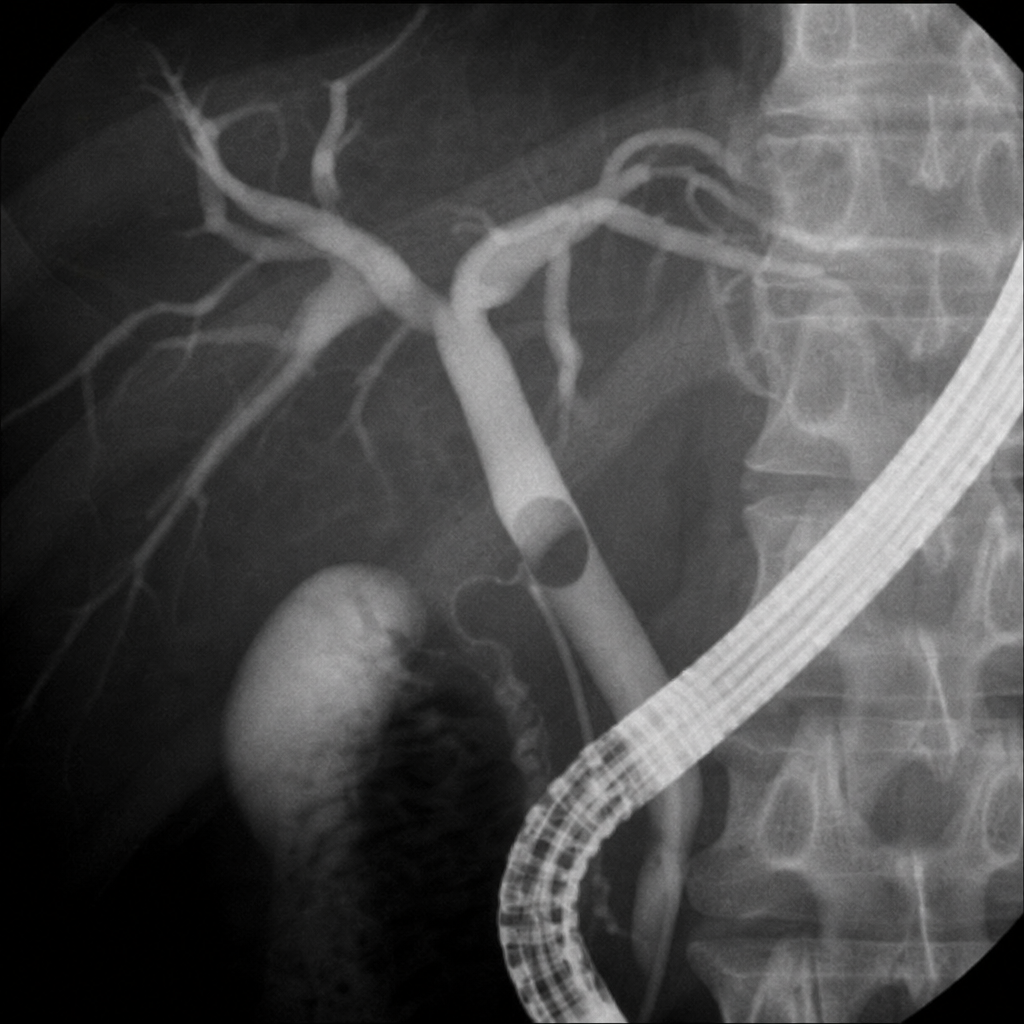
Gas in the biliary tree on plain abdominal X-ray is suggestive of which of the following conditions?
Rigler's triad consists of which of the following, except?
Semen analysis of a young man presenting with primary infertility revealed low volume, fructose-negative ejaculate with azoospermia. Which of the following is the most useful imaging modality to evaluate the cause of his infertility?
Which radiological finding of urinary bladder calcification resembles a fetal head in the pelvis?
Which of the following is a specific diagnostic criterion for Budd-Chiari syndrome?
Which imaging modality is BEST used to detect distant metastasis in pancreatic cancer?
Diffuse esophageal dilatation on barium swallow is seen in which of the following conditions?
Early arterial phase enhancement on CECT scan of the liver indicates which of the following?
What is the location of the stricture in the given RGU?

What is the best diagnostic investigation for acute appendicitis in children?
Explanation: **Explanation:** The presence of gas in the biliary tree on a plain abdominal X-ray is known as **pneumobilia**. This occurs when there is an abnormal communication between the gastrointestinal tract and the biliary system, allowing enteric gas to reflux upwards. **1. Why Biliary Enteric Fistula is Correct:** The most common cause of pneumobilia is a **biliary-enteric fistula**, typically a cholecystoduodenal fistula. This often results from a large gallstone eroding through the gallbladder wall into the duodenum. On X-ray, this appears as linear, branching radiolucencies in the right upper quadrant, typically located centrally (near the hilum) due to the direction of bile flow. This is a key component of **Rigler’s Triad** (pneumobilia, small bowel obstruction, and ectopic gallstone) seen in gallstone ileus. **2. Why Other Options are Incorrect:** * **Empyema of the gallbladder:** This refers to pus in the gallbladder. While it indicates severe infection, it does not typically produce gas unless complicated by gas-forming organisms (Emphysematous cholecystitis), where gas would be seen in the **gallbladder wall/lumen**, not the biliary tree. * **Mirizzi Syndrome:** This is extrinsic compression of the common hepatic duct by a stone impacted in the cystic duct. It causes obstructive jaundice but does not create a passage for gas. * **Porcelain Gallbladder:** This is intramural calcification of the gallbladder wall. It appears as a radio-opaque (white) rim on X-ray, not radiolucent gas. **Clinical Pearls for NEET-PG:** * **Pneumobilia vs. Portal Venous Gas:** Pneumobilia is **central** (near the hilum), whereas portal venous gas is **peripheral** (carried by centrifugal blood flow). * **Common Causes:** Iatrogenic (post-ERCP/sphincterotomy) is the #1 cause overall; Biliary-enteric fistula is the most common spontaneous cause. * **Rigler’s Triad:** Diagnostic for Gallstone Ileus.
Explanation: **Explanation:** **Rigler’s Triad** is the classic radiological finding diagnostic of **Gallstone Ileus**. Gallstone ileus occurs when a large gallstone erodes through the gallbladder wall into the adjacent bowel (usually the duodenum) via a cholecystoenteric fistula, leading to a mechanical small bowel obstruction. **Why Cholangitis is the correct answer (the "Except"):** While gallstone ileus involves the biliary system, **Cholangitis** is a clinical diagnosis characterized by Charcot’s Triad (fever, jaundice, RUQ pain). It is not a component of the radiological Rigler’s Triad. **Analysis of incorrect options (Components of the Triad):** * **Intestinal obstruction (Option A):** Usually presents as dilated loops of small bowel with fluid levels on an abdominal X-ray. * **Gas in the bile duct (Option C):** Also known as **Pneumobilia**. This occurs because the fistula allows air from the gut to enter the biliary tree. * **Ectopic gallstone (Option D):** A radiopaque stone is visualized outside the gallbladder fossa, typically lodged at the **ileocecal valve** (the narrowest part of the small intestine). **High-Yield Clinical Pearls for NEET-PG:** * **Rigler’s Triad vs. Rigler’s Sign:** Do not confuse these. **Rigler’s Sign** (or the double-wall sign) refers to gas on both sides of the bowel wall, indicating **pneumoperitoneum**. * **Most common site of obstruction:** Terminal ileum/Ileocecal valve. * **Imaging Modality of Choice:** CT abdomen is superior to X-ray as it can identify all three components of the triad more reliably. * **Demographics:** Typically seen in elderly females with a history of chronic cholecystitis.
Explanation: ### Explanation The clinical presentation of **low-volume, fructose-negative azoospermia** is a classic indicator of **Ejaculatory Duct Obstruction (EDO)** or congenital bilateral absence of the vas deferens (CBAVD). Since fructose is produced in the seminal vesicles, its absence in the ejaculate suggests that the connection between the seminal vesicles and the urethra is blocked or absent. **1. Why Transrectal Ultrasonography (TRUS) is the Correct Answer:** TRUS is the gold standard imaging modality for evaluating the prostate, seminal vesicles, and ejaculatory ducts. In cases of obstructive azoospermia, TRUS can visualize: * **Dilated seminal vesicles** (width >15 mm). * **Ejaculatory duct cysts** or midline prostatic cysts (Utricle cysts). * **Calcifications** within the ejaculatory ducts. It is highly sensitive for identifying surgically correctable causes of male infertility, such as EDO. **2. Why Other Options are Incorrect:** * **A. Colour duplex ultrasonography of the scrotum:** This is the investigation of choice for **varicoceles** or testicular pathology. While useful for infertility, it does not explain fructose-negative ejaculate, which points to a more proximal (pelvic) obstruction. * **C. Retrograde urethrography (RGU):** This is used to visualize urethral strictures or trauma. It does not provide information regarding the seminal vesicles or ejaculatory ducts. * **D. Spermatic venography:** This was historically used to diagnose subclinical varicoceles but has been largely replaced by Doppler ultrasound. It has no role in evaluating azoospermia. **3. Clinical Pearls for NEET-PG:** * **Fructose-negative ejaculate + Acidic pH:** Highly suggestive of EDO or CBAVD. * **CBAVD:** Strongly associated with **CFTR gene mutations** (Cystic Fibrosis). * **TRUS Findings in EDO:** Seminal vesicle anteroposterior diameter >15 mm is considered dilated. * **Treatment:** Ejaculatory duct obstruction can often be treated via **Transurethral Resection of the Ejaculatory Ducts (TURED).**
Explanation: **Explanation:** **1. Why Schistosomiasis is correct:** Urinary Schistosomiasis (caused by *Schistosoma haematobium*) is the most common cause of bladder calcification worldwide. The calcification occurs in the walls of the bladder due to the deposition of calcium salts around the dead ova of the parasite. On a plain X-ray (KUB), this appears as a thin, curvilinear, radio-opaque line outlining the bladder wall. When the bladder is empty or partially filled, this circumferential calcification mimics the appearance of a **fetal head** (specifically the skull vault) resting in the pelvis. This is a classic radiological sign for the NEET-PG exam. **2. Analysis of Incorrect Options:** * **Adenocarcinoma of the bladder:** While some mucinous adenocarcinomas can show punctate or stippled calcification, it is rare and does not follow the smooth, curvilinear contour of the entire bladder wall. * **Bladder stone:** These typically present as a solid, central, mobile radio-opacity (often laminated). They do not outline the bladder wall and thus do not resemble a fetal head. * **Marion’s disease:** Also known as congenital bladder neck obstruction. It leads to bladder hypertrophy and secondary changes but does not characteristically cause the circumferential wall calcification seen in Schistosomiasis. **3. High-Yield Clinical Pearls for NEET-PG:** * **Schistosomiasis:** Associated with **Squamous Cell Carcinoma (SCC)** of the bladder (unlike the usual Transitional Cell Carcinoma). * **Radiological Sign:** The calcification is often described as a **"China-fied bladder"** or "Eggshell calcification" of the bladder wall. * **Ureteric involvement:** Can cause "Lead pipe" ureter (straight, dilated, and calcified) and distal ureteric strictures. * **Diagnosis:** Presence of terminal-spined eggs in urine.
Explanation: ### Explanation **Budd-Chiari Syndrome (BCS)** is characterized by the obstruction of hepatic venous outflow, occurring at any level from the small hepatic veins to the junction of the inferior vena cava (IVC) and the right atrium. **Why Option A is Correct:** **Intrahepatic collaterals** are considered a **specific** radiologic sign of BCS. When the primary hepatic veins are thrombosed or stenosed, the liver attempts to decompress itself by forming new vascular pathways. These typically appear as "comma-shaped" or "tortuous" vessels connecting the obstructed hepatic veins to systemic circulation or patent accessory veins. Their presence is highly suggestive of chronic BCS. **Analysis of Incorrect Options:** * **B. Dilated paraumbilical vein:** This is a sign of **portal hypertension**, not specifically BCS. While BCS can lead to portal hypertension, a dilated paraumbilical vein (part of the *Caput Medusae* complex) is more commonly associated with cirrhosis of any etiology. * **C. Post-acoustic shadowing:** This is an ultrasound artifact seen behind highly attenuating structures like gallstones or calcifications. It has no diagnostic relevance to venous outflow obstruction. **Clinical Pearls for NEET-PG:** * **Classic Triad:** Abdominal pain, ascites, and hepatomegaly. * **Caudate Lobe Hypertrophy:** The most common imaging finding. The caudate lobe often enlarges because its venous drainage (directly into the IVC) is usually spared. * **"Spider-web" Appearance:** Seen on hepatic venography when small collateral vessels form around an occluded main hepatic vein. * **Contrast Enhancement:** On CT, the liver may show a "nutmeg" appearance (mottled enhancement) due to venous congestion. * **US Doppler:** The gold standard initial screening tool, showing absent or reversed flow in hepatic veins.
Explanation: **Explanation:** The primary goal in staging pancreatic adenocarcinoma is determining resectability. While multiple modalities are used, **Positron-emission tomography with fluorodeoxyglucose (PET-FDG)** is the most sensitive modality for detecting **distant metastasis** (M staging), particularly occult liver or peritoneal spread that may be missed by conventional cross-sectional imaging. PET-FDG relies on the increased glycolytic activity of malignant cells; identifying distant metabolic activity can change the management plan in up to 15-20% of patients by preventing unnecessary radical surgery (Whipple’s procedure) in those with advanced disease. **Analysis of Incorrect Options:** * **Dual-phase, contrast-enhanced spiral CT (Option B):** This is the **initial investigation of choice** and the gold standard for assessing **local resectability** and vascular invasion (SMA/Celiac axis involvement). However, it is less sensitive than PET for small, distant deposits. * **Endoscopic Ultrasound (EUS) (Option C):** This is the most sensitive modality for detecting **small pancreatic tumors (<2 cm)** and allows for Fine Needle Aspiration (FNA). It is excellent for T-staging but cannot evaluate distant metastasis. * **MRCP (Option D):** This is a non-invasive tool used primarily to visualize the biliary and pancreatic ducts (e.g., "Double duct sign"). It is not used for systemic staging. **High-Yield Clinical Pearls for NEET-PG:** * **Best Initial Test:** Contrast-Enhanced CT (Pancreatic Protocol). * **Most Sensitive for Small Tumors:** EUS. * **Double Duct Sign:** Simultaneous dilatation of the Common Bile Duct and Main Pancreatic Duct; highly suggestive of pancreatic head carcinoma. * **Tumor Marker:** CA 19-9 (used for monitoring prognosis and recurrence, not for primary diagnosis).
Explanation: **Explanation:** The correct answer is **Trypanosomiasis (Chagas Disease)**. **1. Why Trypanosomiasis is correct:** Chagas disease, caused by the parasite *Trypanosoma cruzi*, leads to the destruction of the **myenteric (Auerbach’s) plexus** throughout the esophagus. This results in a complete loss of peristalsis and failure of the lower esophageal sphincter (LES) to relax. While Achalasia also shows dilatation, Chagas disease typically causes **massive, diffuse dilatation** (often termed "megaesophagus") that is more extensive than idiopathic achalasia because the neurogenic destruction can involve the entire length of the organ. **2. Analysis of Incorrect Options:** * **Achalasia:** While it causes esophageal dilatation with a "Bird’s beak" appearance, the question specifically points toward Trypanosomiasis in a competitive context because Chagas is the classic cause of the most extreme, diffuse "mega-syndromes" (megaesophagus and megacolon). * **Scleroderma (Systemic Sclerosis):** This typically causes **mild to moderate dilatation** of the lower two-thirds of the esophagus due to smooth muscle atrophy and fibrosis. A key differentiator is that the LES in scleroderma is **patulous (incompetent)**, leading to severe reflux, unlike the hypertensive LES in Achalasia/Chagas. * **Etidronate therapy:** Bisphosphonates like etidronate are associated with pill-induced **esophagitis and strictures**, not diffuse dilatation. **3. NEET-PG High-Yield Pearls:** * **Bird’s Beak/Rat Tail sign:** Classic for Achalasia on Barium Swallow. * **Sigmoid Esophagus:** Term used for the advanced, tortuous, and dilated esophagus seen in end-stage Achalasia or Chagas. * **Glass Tube/Stovepipe Esophagus:** Seen in Scleroderma (due to lack of primary peristalsis). * **Tertiary Contractions (Corkscrew Esophagus):** Classic for Diffuse Esophageal Spasm (DES).
Explanation: ### Explanation **Correct Answer: B. Hepatocellular carcinoma (HCC)** **The Underlying Concept:** The liver has a dual blood supply: the **portal vein (75%)** and the **hepatic artery (25%)**. Normal liver parenchyma derives most of its blood from the portal vein. However, **Hepatocellular Carcinoma (HCC)** is a highly vascular tumor that derives its blood supply almost exclusively (90-100%) from the **hepatic artery**. On a Triple-Phase Contrast-Enhanced CT (CECT), HCC exhibits a classic enhancement pattern: 1. **Early Arterial Phase:** Intense, "bright" enhancement (Hypervascularity) as the contrast enters via the hepatic artery. 2. **Portal Venous/Delayed Phase:** Rapid "washout," appearing hypodense compared to the surrounding liver which is now enhancing via the portal vein. **Why the other options are incorrect:** * **A. Hydatid Cyst:** Typically appears as a well-defined fluid-density lesion with a "cyst-within-a-cyst" appearance (daughter cysts) and peripheral wall calcification. It does not show internal arterial enhancement. * **C. Hepatic Abscess:** Usually presents as a low-attenuation collection with **peripheral rim enhancement** (target sign), not diffuse early arterial enhancement. * **D. Simple Hepatic Cyst:** These are benign, fluid-filled structures that show **no enhancement** in any phase (0-10 HU). **High-Yield Clinical Pearls for NEET-PG:** * **Classic Triad for HCC on CT:** Arterial enhancement + Portal venous washout + Pseudocapsule. * **Tumor Marker:** Elevated **Alpha-fetoprotein (AFP)** is highly suggestive of HCC. * **Hemangioma:** Shows peripheral globular enhancement with "centripetal fill-in" (contrast moves from periphery to center). * **Focal Nodular Hyperplasia (FNH):** Shows intense arterial enhancement with a characteristic **central stellate scar**.
Explanation: ***Bulbar urethra*** - The **bulbar urethra** is the most common site of urethral strictures, particularly following **trauma** or **infection**. - On **retrograde urethrography (RGU)**, bulbar strictures appear as **smooth narrowing** in the **posterior penile/perineal region**, which is the typical location seen in most imaging studies. *Membranous urethra* - The **membranous urethra** is located within the **urogenital diaphragm** and is less commonly affected by strictures. - **RGU** may not adequately visualize this segment due to its **short length** and **deep pelvic location**. *Penile urethra* - The **penile urethra** extends from the **penoscrotal junction** to the **external meatus** and is less frequently involved in stricture formation. - **Penile strictures** typically result from **hypospadias repair** or **lichen sclerosus**, which are less common causes. *Prostatic urethra* - The **prostatic urethra** is rarely affected by **inflammatory strictures** and is better evaluated by **voiding cystourethrography (VCUG)**. - **RGU** has limited ability to visualize the **prostatic segment** due to **contrast flow limitations** in retrograde studies.
Explanation: **Explanation:** The diagnosis of acute appendicitis in children relies on balancing diagnostic accuracy with the principles of radiation safety (**ALARA principle** – As Low As Reasonably Achievable). **Why USG is the Correct Answer:** Ultrasonography (USG) is the **initial and best diagnostic investigation** of choice in the pediatric population. Children have a thinner abdominal wall and less omental fat, which allows for better visualization of the appendix using a high-frequency linear transducer. It is non-invasive, widely available, and, most importantly, avoids exposure to ionizing radiation, to which the developing pediatric tissues are highly sensitive. * **Key USG finding:** A non-compressible, blind-ended tubular structure in the right iliac fossa with an outer diameter **>6 mm**. **Why Other Options are Incorrect:** * **CECT (Contrast-Enhanced CT):** While CECT is the **most sensitive and specific** (Gold Standard) investigation for appendicitis in adults, it is reserved as a second-line study in children if USG is inconclusive. This is due to the high radiation dose and potential risks of IV contrast. * **MRI:** MRI is highly accurate and avoids radiation, but it is not the "best" initial choice due to high cost, limited availability, and the frequent need for sedation in young children to ensure motion-free images. It is primarily used in pregnant patients. * **X-ray:** Plain radiographs have very low sensitivity. While they may occasionally show a radio-opaque **appendicolith** (fecalith) or localized ileus, they cannot definitively diagnose or rule out appendicitis. **Clinical Pearls for NEET-PG:** * **Target Sign:** Seen on axial USG/CT sections representing the inflamed layers of the appendix. * **McBurney’s Point:** Maximum tenderness located 1/3rd of the distance from the ASIS to the umbilicus. * **Alvarado Score:** A clinical scoring system used to risk-stratify patients; a score of ≥7 is highly suggestive of appendicitis.
Imaging of Liver
Practice Questions
Biliary Tract Imaging
Practice Questions
Pancreatic Imaging
Practice Questions
Spleen and Lymphatic System
Practice Questions
Gastrointestinal Tract Imaging
Practice Questions
Renal and Urinary Tract Imaging
Practice Questions
Adrenal Imaging
Practice Questions
Female Pelvic Imaging
Practice Questions
Male Pelvic Imaging
Practice Questions
Abdominal Trauma Imaging
Practice Questions
Acute Abdomen Imaging
Practice Questions
Imaging of Peritoneal Cavity and Retroperitoneum
Practice Questions
Get full access to all questions, explanations, and performance tracking.
Start For Free