What is this appearance, seen in early pregnancy, known as?

The Carman meniscus sign in a barium meal is pathognomic of which of the following conditions?
What is the initial investigation for suspected gallbladder stones?
Which investigation is most sensitive for detecting minimal intraperitoneal free air?
Which pattern is seen in the jejunum on an X-ray?
A 30-year-old female presents with right hypochondrial pain. CT scan reveals floating membranes in the liver. What is the most likely diagnosis?
Radiographic findings of cardiac achalasia include all except?
What is the best investigation to diagnose Meckel's diverticulum?
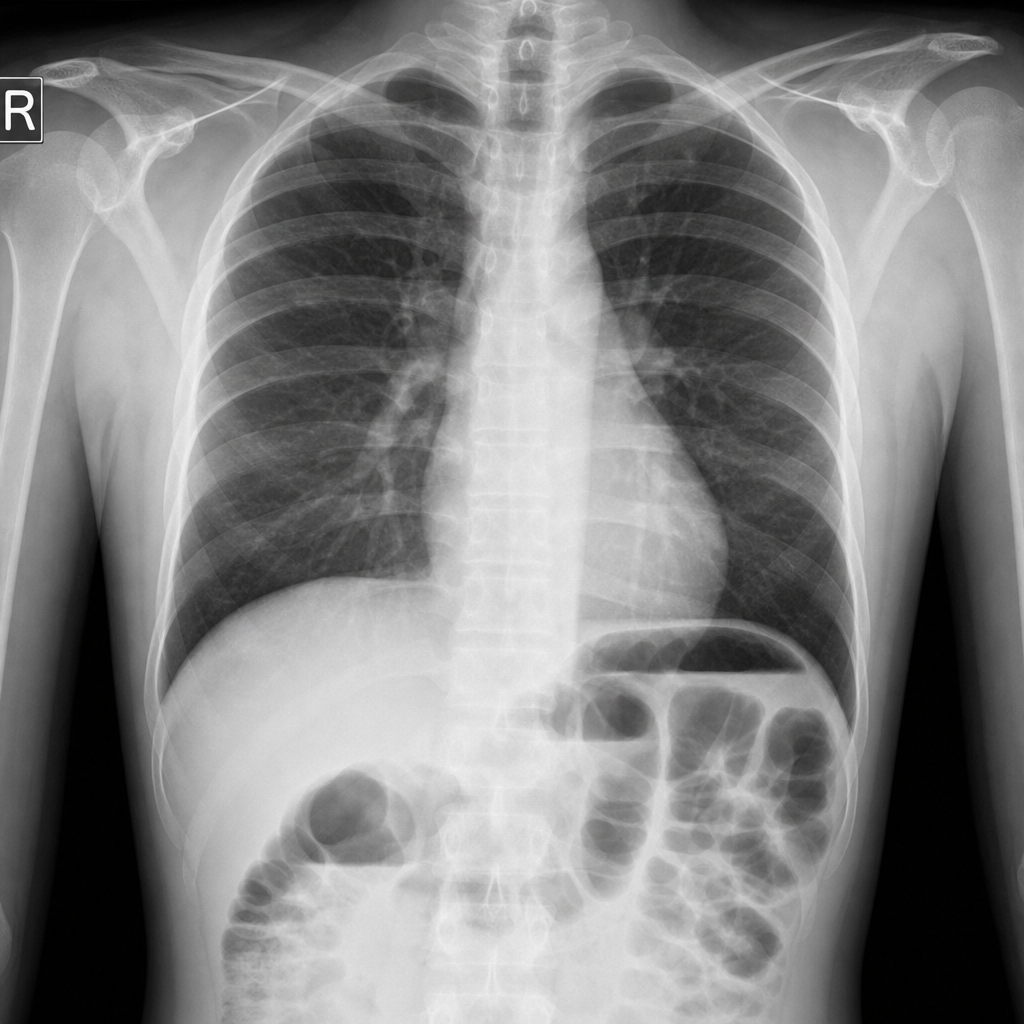
A 30-year-old patient presents with acute abdominal pain and obstipation. An X-ray is provided. What is the most likely diagnosis?

Which of the following investigations is NOT used for the diagnosis of protein-losing enteropathy?
Explanation: ***Double bleb sign*** - Seen on **transvaginal ultrasound** at approximately **5-6 weeks gestation**, representing the **amnion** and **yolk sac** as two distinct fluid-filled structures within the gestational sac. - This sign confirms **early intrauterine pregnancy** and indicates normal embryonic development with proper formation of extraembryonic structures. *Yolk sac sign* - Refers to the **single yolk sac** visualization within the gestational sac, typically seen around **5-5.5 weeks**. - Does not involve the characteristic **two separate blebs** (amnion + yolk sac) that define the double bleb sign. *Double decidual sac sign* - An earlier ultrasound finding seen around **4-5 weeks** showing **two concentric rings** of decidual tissue around the gestational sac. - Represents the **decidua capsularis** and **decidua parietalis**, not the amnion and yolk sac structures. *Twin peak sign* - A finding in **dichorionic diamniotic twin pregnancies** showing a **triangular projection** of placental tissue at the membrane insertion site. - Used to differentiate **chorionicity** in multiple pregnancies, not relevant to single early pregnancy appearances.
Explanation: ### Explanation **1. Why Malignant Gastric Ulcer is Correct:** The **Carman Meniscus Sign** is a classic radiological finding on a barium meal study, specifically associated with **large, ulcerating gastric malignancies** (usually adenocarcinoma). * **Mechanism:** When manual compression is applied during the procedure, the barium is trapped within the large, irregular ulcer crater. The crater is surrounded by heaped-up, firm, neoplastic mucosal margins (the tumor mass). * **Appearance:** The barium collection appears **semilunar (crescent-shaped)** with its convexity directed toward the gastric wall and its concavity facing the gastric lumen. This "meniscus" is pathognomonic for a malignant ulcer. **2. Why Other Options are Incorrect:** * **Lipoma of the stomach:** These are intramural, submucosal lesions. On barium meal, they typically present as a smooth, well-demarcated "filling defect" with the "molar tooth sign" or "squeeze sign," but not a meniscus-shaped ulcer. * **Gastric polyposis:** This presents as multiple small, rounded filling defects within the barium column. It does not involve the deep, necrotic ulceration required to form the Carman meniscus. * **Gastric lymphoma:** While lymphoma can cause ulceration, it more commonly presents with markedly thickened, distorted rugal folds (bull’s eye lesions) or diffuse infiltration. The specific Carman meniscus geometry is characteristic of primary gastric carcinoma. **3. High-Yield Clinical Pearls for NEET-PG:** * **Kirklin Complex:** This refers to the combination of the Carman meniscus sign and the surrounding radiolucent zone (representing the elevated malignant rim). * **Benign vs. Malignant Ulcers:** * **Benign:** Ulcer crater projects *outside* the predicted gastric contour; presence of **Hampton’s line** (thin lucent line at the neck). * **Malignant:** Ulcer crater lies *inside* the predicted gastric contour; presence of **Carman Meniscus sign**. * **Double Contrast Barium Meal:** The gold standard for detecting mucosal lesions before endoscopy.
Explanation: **Explanation:** **Ultrasound (USG)** is the **initial and gold standard investigation** for suspected gallbladder stones (cholelithiasis). It has a high sensitivity and specificity (>95%) for detecting stones. The underlying medical concept relies on the fact that gallstones are dense structures that reflect sound waves, appearing as **hyperechoic foci** with characteristic **posterior acoustic shadowing**. Additionally, USG is non-invasive, cost-effective, lacks radiation, and can simultaneously assess for signs of inflammation (e.g., gallbladder wall thickening or pericholecystic fluid). **Analysis of Incorrect Options:** * **Fasting Respiratory Correlate Pulmonary (FRCP):** This is a distractor term and not a standard radiological investigation for biliary disease. (Note: Do not confuse with ERCP, which is an invasive therapeutic procedure). * **MRCP:** While highly sensitive for detecting stones in the *bile ducts* (choledocholithiasis), it is expensive and time-consuming. It is reserved as a second-line investigation when USG is inconclusive or ductal stones are suspected. * **CT Scan:** CT is inferior to USG for gallstones because many stones are "iso-attenuating" (radiolucent) to bile, making them invisible on a standard CT. CT is, however, the best modality for detecting complications like gallbladder perforation or emphysematous cholecystitis. **High-Yield Clinical Pearls for NEET-PG:** * **WES Triad:** (Wall-Echo-Shadow) is a classic USG sign seen when the gallbladder is completely filled with stones. * **HIDA Scan:** The most sensitive/accurate test for **Acute Cholecystitis** (shows non-visualization of the gallbladder). * **Oral Cholecystography:** Historically used but now obsolete; it relied on the functional ability of the gallbladder to concentrate dye.
Explanation: **Explanation:** The detection of pneumoperitoneum (free intraperitoneal air) is a critical step in diagnosing a perforated hollow viscus. **Why Chest X-ray (CXR) is the Correct Answer:** An **Erect (Standing) Chest X-ray** is the most sensitive plain radiographic projection for detecting minimal free air. It can detect as little as **1–2 ml** of air. The physiological basis is that air, being less dense than abdominal viscera, rises to the highest point of the peritoneal cavity. In the upright position, this air collects under the domes of the diaphragm, appearing as a thin, radiolucent crescent (the "cupola sign" or "gas under diaphragm"). The CXR is superior to an abdominal X-ray because the X-ray beam is tangential to the diaphragmatic domes, providing better contrast and sharper detail. **Analysis of Incorrect Options:** * **Standing X-ray Abdomen (A):** While it can show free air, the diaphragm is often at the very edge of the film or excluded, and the beam centering is not optimized for the subdiaphragmatic space. * **Right Lateral Decubitus (B):** This is incorrect because air would collect over the liver. However, the liver's density can mask small amounts of air, and the stomach/bowel gas on the left side can cause confusion. * **Left Lateral Decubitus (D):** This is the **second-best** choice if the patient cannot stand. Air rises and collects between the liver and the right lateral abdominal wall. It is easier to visualize here because there is no gastric bubble to mimic free air. **NEET-PG High-Yield Pearls:** * **Gold Standard:** While CXR is the most sensitive *plain film*, **Non-contrast CT (NCCT)** is the overall gold standard for detecting pneumoperitoneum (detecting <1 ml of air). * **Rigler’s Sign:** Visualization of both sides of the bowel wall due to large amounts of free air (seen on supine films). * **Football Sign:** A large ovoid lucency representing massive pneumoperitoneum. * **Positioning:** For maximum sensitivity, the patient should remain upright for at least **5–10 minutes** before the X-ray to allow air to migrate upwards.
Explanation: **Explanation:** The correct answer is **A. Valvulae connivantes**. **1. Why Valvulae connivantes is correct:** Valvulae connivantes (also known as Plicae circulares or Kerckring folds) are the mucosal folds of the small intestine. They are most prominent in the **jejunum**. On an abdominal X-ray, especially in cases of small bowel obstruction, these folds appear as thin, closely spaced lines that **span the entire width of the bowel lumen**. This "stack of coins" appearance is a classic radiologic hallmark used to distinguish the jejunum from the ileum (which has fewer folds and appears smoother) and the large intestine. **2. Why the other options are incorrect:** * **B. Taenia coli:** These are three longitudinal bands of smooth muscle found in the **large intestine**. On X-ray, the contraction of these bands creates **haustrations**. Unlike valvulae connivantes, haustral folds are thicker, further apart, and **do not span the entire diameter** of the bowel. * **C. Reverse 3 sign:** This is a specific radiologic sign seen on a barium swallow or during an ERCP, typically associated with **Carcinoma of the Head of the Pancreas** or periampullary tumors (Frostberg’s sign), where the duodenal loop is indented. It is not a normal pattern of the jejunum. **High-Yield Clinical Pearls for NEET-PG:** * **Jejunum vs. Ileum:** Jejunum is in the LUQ (Left Upper Quadrant) with prominent folds; Ileum is in the RLQ (Right Lower Quadrant) with a featureless/smooth appearance. * **Small Bowel Obstruction (SBO):** Characterized by dilated loops (>3 cm), valvulae connivantes, and multiple air-fluid levels on erect films. * **Large Bowel Obstruction (LBO):** Characterized by peripheral distribution and haustrations that do not cross the entire lumen.
Explanation: ### Explanation **Correct Answer: B. Hydatid Cyst** The presence of **"floating membranes"** within a hepatic cystic lesion is a pathognomonic radiological sign for **Hydatid disease** (Cystic Echinococcosis), caused by *Echinococcus granulosus*. This is known as the **Water-Lily Sign**. It occurs when the endocyst (the inner germinal layer) ruptures and detaches from the pericyst (the host-derived outer layer), causing the collapsed membranes to float within the cyst fluid. **Why other options are incorrect:** * **Amoebiasis (Amoebic Liver Abscess):** Typically presents as a "anchovy sauce" appearance on aspiration. On CT, it appears as a well-defined, low-attenuation lesion with a peripheral enhancing rim, but it lacks internal membranes or daughter cysts. * **Tuberculosis:** Hepatic TB usually presents as hepatomegaly with multiple small "miliary" granulomas or a large "tuberculoma" which may show central necrosis or calcification, but not floating membranes. * **Hepatocellular Carcinoma (HCC):** This is a solid, hypervascular tumor showing "wash-in" (arterial phase enhancement) and "wash-out" (venous/delayed phase) on contrast CT. It is not primarily a cystic lesion. **High-Yield Clinical Pearls for NEET-PG:** * **Gharbi Classification:** Used to stage Hydatid cysts (Type I: Pure fluid; Type II: Floating membranes; Type III: Daughter cysts/honeycomb; Type IV: Solid/Heterogeneous; Type V: Calcified wall). * **Other Signs:** **"Honeycomb sign"** (multiple daughter cysts) and **"Eggshell calcification"** of the cyst wall. * **Treatment:** PAIR (Puncture, Aspiration, Injection of scolicidal agent, Re-aspiration) or surgical resection, always covered with **Albendazole**. * **Risk:** Avoid simple aspiration if Hydatid is suspected due to the risk of **anaphylactic shock** from spillage of cyst contents.
Explanation: **Explanation:** **Achalasia Cardia** is a primary esophageal motility disorder characterized by the failure of the Lower Esophageal Sphincter (LES) to relax and the absence of progressive peristalsis. **Why Option D is correct:** **Diffuse Esophageal Spasm (DES)** is a distinct clinical entity and a differential diagnosis for achalasia, not a radiographic finding of it. In DES, the esophagus shows uncoordinated, simultaneous contractions, leading to a characteristic **"Corkscrew" or "Rosary bead" appearance** on a barium swallow. In contrast, Achalasia is defined by aperistalsis. **Why the other options are incorrect:** * **Esophageal Dilatation (A):** Chronic obstruction at the LES leads to proximal pooling of food and saliva, causing the esophagus to dilate (Megaesophagus). On a chest X-ray, this may appear as a widened mediastinum with an absent gastric air shadow. * **Rat-tail appearance (B):** Also known as the **"Bird’s beak" appearance**, this represents the smooth, symmetric, conical narrowing of the distal esophagus at the level of the gastroesophageal junction. * **Failure of LES to relax (C):** This is the hallmark pathophysiologic and manometric finding of Achalasia. On fluoroscopy, the "beak" only opens intermittently and incompletely, often requiring the hydrostatic pressure of a large column of barium to force it open. **High-Yield Clinical Pearls for NEET-PG:** * **Gold Standard Investigation:** Esophageal Manometry (shows incomplete LES relaxation and aperistalsis). * **Heller’s Myotomy:** The surgical treatment of choice. * **Chagas Disease:** Can cause secondary achalasia (Pseudoachalasia) due to destruction of the myenteric (Auerbach’s) plexus by *Trypanosoma cruzi*. * **Sigmoid Esophagus:** The term used for the advanced, tortuous stage of esophageal dilatation in achalasia.
Explanation: **Explanation:** **Technetium-99m (Tc-99m) pertechnetate scan**, also known as the **Meckel’s scan**, is the investigation of choice for diagnosing Meckel’s diverticulum. The underlying medical concept relies on the fact that approximately 50–60% of symptomatic Meckel’s diverticula contain **ectopic gastric mucosa**. Tc-99m pertechnetate has a high affinity for the mucin-secreting cells of the gastric mucosa. When injected intravenously, the radionuclide concentrates in the ectopic tissue in the ileum, appearing as a "hot spot" on scintigraphy, typically in the right lower quadrant. **Why other options are incorrect:** * **X-ray Abdomen:** Generally non-specific. It may show signs of intestinal obstruction or perforation (pneumoperitoneum) but cannot visualize the diverticulum itself. * **Ultrasonography:** While it may occasionally detect a diverticulum as a blind-ending tubular structure (especially during complications like diverticulitis), it is operator-dependent and lacks the sensitivity of nuclear imaging. * **Barium Study:** Small bowel follow-through or enteroclysis often fails to fill the diverticulum due to its narrow neck or the presence of heterotopic tissue, leading to a high false-negative rate. **High-Yield Clinical Pearls for NEET-PG:** * **Rule of 2s:** 2% of the population, 2 feet from the ileocecal valve, 2 inches long, 2 types of ectopic tissue (Gastric > Pancreatic), and usually presents before age 2. * **Sensitivity:** The Meckel’s scan is most sensitive in children (up to 90%) but less so in adults due to a lower incidence of ectopic gastric mucosa. * **Pharmacological Enhancement:** To increase the sensitivity of the scan, **Pentagastrin** (increases uptake), **H2 blockers like Cimetidine** (prevents release of pertechnetate from cells), or **Glucagon** (decreases peristalsis) can be used.
Explanation: ***Small bowel obstruction*** - Classic X-ray findings include **central dilated small bowel loops** with **valvulae conniventes** (complete mucosal folds) and **stepladder air-fluid levels**. - **Paucity of colonic gas** distally is characteristic, as obstruction prevents bowel contents from reaching the colon. *Large bowel obstruction* - X-ray shows **peripheral dilated colonic loops** with **haustrations** (incomplete mucosal folds), not central small bowel dilation. - **Cecal dilation** is often prominent, and small bowel may appear normal or minimally dilated. *Gastric outlet obstruction* - X-ray typically shows **marked gastric distension** with a **dilated stomach** containing air-fluid levels. - **Minimal small bowel gas** is present, as obstruction occurs at the **pylorus** or **duodenum**. *Duodenal atresia* - Characteristic **double-bubble sign** on X-ray showing dilated **stomach** and **proximal duodenum**. - This condition occurs in **neonates**, not 30-year-old patients, and presents shortly after birth.
Explanation: **Explanation:** Protein-losing enteropathy (PLE) is characterized by the excessive loss of serum proteins into the gastrointestinal tract. Nuclear medicine plays a crucial role in diagnosing and localizing the site of protein loss. **Why Option D is Correct:** **Technetium-labeled seclomumab** is a monoclonal antibody scan used specifically for imaging **inflammatory bowel disease (IBD)** to detect areas of active inflammation by targeting granulocytes. It is not a diagnostic tool for the generalized quantification or localization of protein leakage in PLE. **Why the Other Options are Incorrect:** * **Technetium-labeled albumin (99mTc-HSA) scan:** This is the most commonly used radionuclide study for PLE. Since albumin is the primary protein lost in this condition, labeling it allows for the visualization of tracer leakage into the bowel loops. * **Technetium-labeled dextran scan:** 99mTc-Dextran is an alternative tracer. It has a smaller molecular size than albumin and is often used to detect protein loss, especially when rapid clearance or specific localization is required. * **Indium-labeled transferrin scan:** $^{111}$In-transferrin is a highly effective tracer for PLE. It has a longer half-life than Technetium, allowing for delayed imaging (up to 24–48 hours), which increases sensitivity for detecting intermittent or low-grade protein loss. **High-Yield Clinical Pearls for NEET-PG:** * **Gold Standard for Diagnosis:** The biochemical gold standard is the **alpha-1 antitrypsin clearance test** (measured in stool). * **Imaging Goal:** While the alpha-1 antitrypsin test confirms the diagnosis, **Radionuclide scans** are superior for **localizing** the specific segment of the gut where the protein loss is occurring. * **Common Causes of PLE:** Primary intestinal lymphangiectasia (Waldmann's disease), Menetrier’s disease, and post-Fontan procedure complications.
Imaging of Liver
Practice Questions
Biliary Tract Imaging
Practice Questions
Pancreatic Imaging
Practice Questions
Spleen and Lymphatic System
Practice Questions
Gastrointestinal Tract Imaging
Practice Questions
Renal and Urinary Tract Imaging
Practice Questions
Adrenal Imaging
Practice Questions
Female Pelvic Imaging
Practice Questions
Male Pelvic Imaging
Practice Questions
Abdominal Trauma Imaging
Practice Questions
Acute Abdomen Imaging
Practice Questions
Imaging of Peritoneal Cavity and Retroperitoneum
Practice Questions
Get full access to all questions, explanations, and performance tracking.
Start For Free