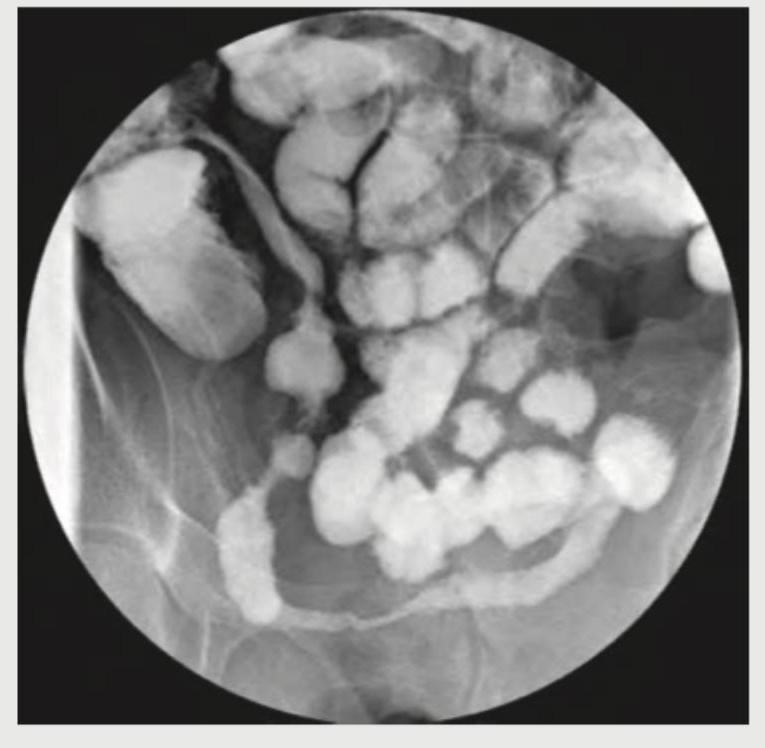
Colonic diverticulosis is best diagnosed by which imaging modality?
In case of suspected perforation, which radiological view is best?
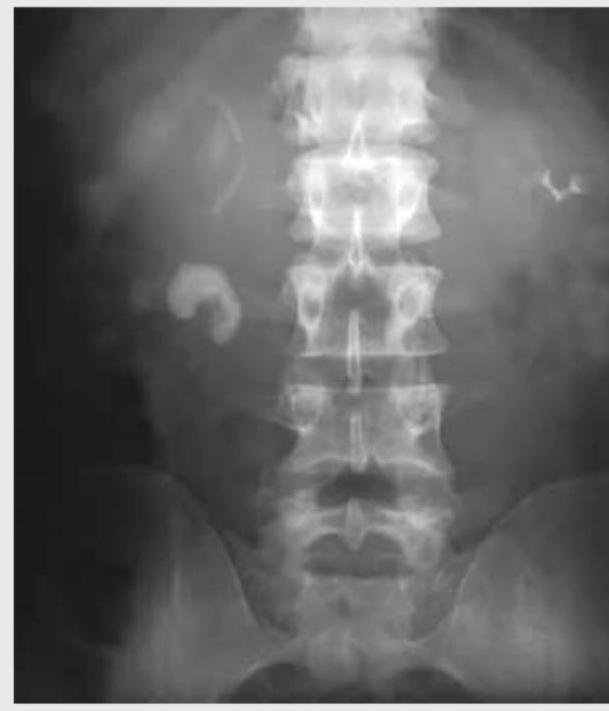
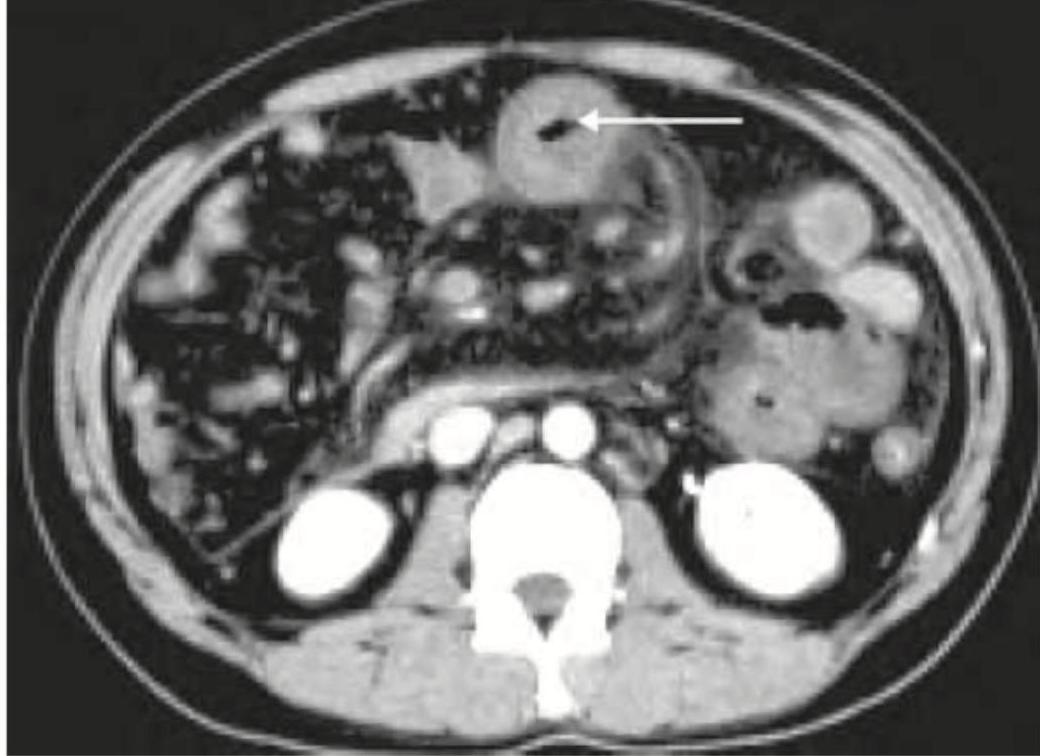
The given image shows findings most consistent with which of the following conditions?

What is the most appropriate investigation for the diagnosis of common bile duct stones?
Extraluminal abdominal calcification in a newborn may be seen in which of the following conditions?
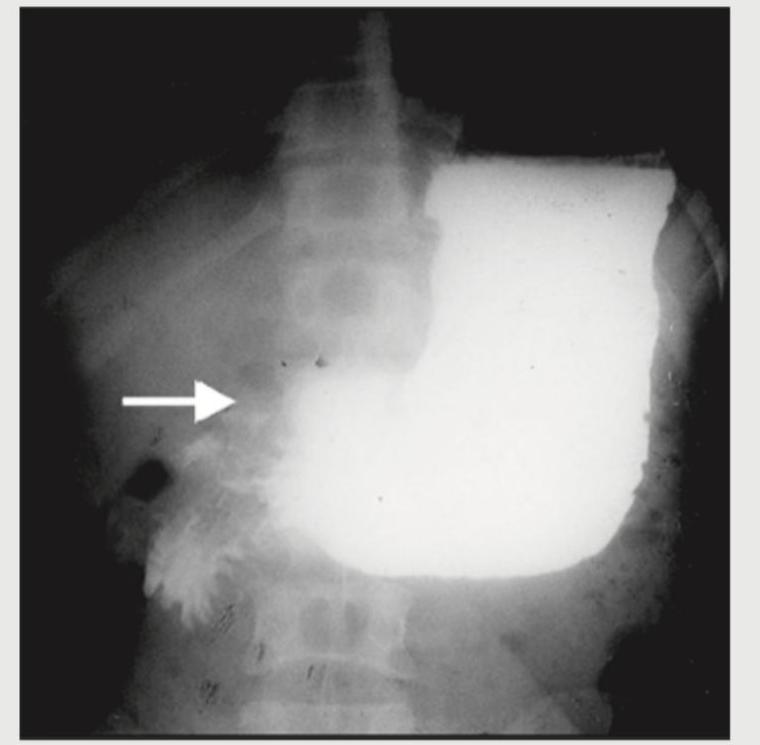
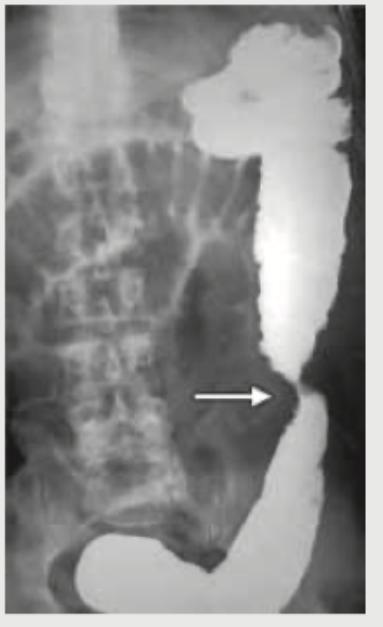
The String sign is seen in which of the following conditions?
For purely diagnostic purposes, what is the preferred mode of visualizing the biliary tree?
What is the investigation of choice for acute cholecystitis?
What is the earliest pathological change seen on X-ray in ulcerative colitis?
Light bulb appearance in MRI scan is/are seen in which of the following conditions?
Explanation: **Explanation:** **Colonic diverticulosis** refers to the presence of multiple outpouchings (diverticula) of the colonic mucosa and submucosa through the muscular layers. **Why Barium Enema is the Correct Answer:** Historically and for the specific diagnosis of "diverticulosis" (the presence of sacs without inflammation), **Barium Enema** is considered the gold standard and most sensitive imaging modality. It provides excellent mucosal detail, allowing for the visualization of the characteristic "saw-tooth" appearance of the colon and the filling of the diverticular sacs with contrast, which appear as flask-shaped outpouchings. **Analysis of Incorrect Options:** * **Colonoscopy (A):** While it can visualize diverticula, it is primarily used to rule out malignancy. It is less sensitive than barium studies for quantifying the extent of diverticulosis and carries a risk of perforation if acute inflammation is present. * **Nuclear Scan (B):** Technetium-99m labeled RBC scans are used to localize the site of **active diverticular bleeding**, not for the primary diagnosis of diverticulosis. * **CT Scan (D):** CT is the **investigation of choice for Acute Diverticulitis** (to look for wall thickening, fat stranding, or abscesses). However, for simple, non-inflamed diverticulosis, it is less sensitive than a barium enema in detecting small mucosal outpouchings. **NEET-PG High-Yield Pearls:** * **Most common site:** Sigmoid colon (due to high intraluminal pressure). * **Investigation of choice for Diverticulosis:** Barium Enema. * **Investigation of choice for Acute Diverticulitis:** Contrast-Enhanced CT (CECT). * **Contraindication:** Barium enema and Colonoscopy are **contraindicated** in the acute phase of diverticulitis due to the high risk of perforation.
Explanation: **Explanation:** The primary radiological sign of a hollow viscus perforation is **pneumoperitoneum** (free intraperitoneal air). The **Erect Chest X-ray** (or Erect Abdomen) is the gold standard initial screening view because air, being lighter than fluid and solid organs, rises to the highest point in the peritoneal cavity. In the upright position, this air collects under the diaphragm, appearing as a thin, radiolucent crescent (the "crescent sign"). As little as 1–2 ml of free air can be detected on a well-taken erect film. **Analysis of Options:** * **A. Erect (Correct):** Gravity allows air to rise and contrast against the undersurface of the diaphragm and the density of the liver/spleen. * **B. Supine:** In this position, air collects anteriorly and spreads out. It is difficult to visualize unless there is a large volume, where it may show the **Rigler sign** (gas on both sides of the bowel wall) or the **Football sign**. * **C. Lateral Decubitus:** This is the alternative if the patient is too ill to stand. The patient lies on their **left side** (Left Lateral Decubitus) so that air rises and collects between the liver and the right abdominal wall. While sensitive, it is secondary to the erect view. **Clinical Pearls for NEET-PG:** * **Most sensitive view:** The **Left Lateral Decubitus** is technically more sensitive than the erect view for very small amounts of air, but the **Erect Chest X-ray** remains the "best" and most common initial investigation. * **Gold Standard Investigation:** While X-ray is the initial step, **NCCT (Non-Contrast CT) Abdomen** is the most sensitive overall imaging modality for detecting pneumoperitoneum. * **Positioning Tip:** For maximum sensitivity, the patient should remain in the erect or decubitus position for **10–20 minutes** before the film is taken to allow air to migrate.
Explanation: ***Ischemic colitis*** - The image demonstrates classic **"thumbprinting"** sign on plain X-ray, characterized by **mucosal edema** and **submucosal hemorrhage** creating rounded protrusions into the colonic lumen. - **Ischemic colitis** typically affects the **splenic flexure** and **sigmoid colon** in elderly patients, showing **wall thickening** and loss of haustral markings. *Ileal atresia* - Presents with **multiple dilated small bowel loops** on X-ray, typically in **newborns** with **bilious vomiting**. - Shows **absence of gas** in the distal bowel beyond the point of atresia, not the thumbprinting pattern seen here. *Meconium ileus* - Radiologically shows **soap bubble appearance** in the **right lower quadrant** due to **inspissated meconium** mixed with air. - Associated with **cystic fibrosis** in neonates, presenting with **small bowel obstruction** without the colonic changes observed. *Crohn's disease* - Demonstrates **"string sign"** on imaging due to **strictures** and **skip lesions** affecting the **terminal ileum** predominantly. - Shows **cobblestone appearance** with **deep ulcerations** and **fistula formation**, distinct from the acute thumbprinting pattern.
Explanation: **Explanation:** The diagnosis and management of Common Bile Duct (CBD) stones (choledocholithiasis) require high sensitivity and, ideally, therapeutic capability. **Why ERCP is the Correct Answer:** Endoscopic Retrograde Cholangiopancreatography (ERCP) is traditionally considered the **Gold Standard** for the diagnosis of CBD stones. Its primary advantage is that it is both **diagnostic and therapeutic**. Once stones are identified via fluoroscopy with contrast injection, they can be immediately removed via sphincterotomy and stone extraction (using balloons or baskets). While MRCP is now the preferred non-invasive diagnostic tool, ERCP remains the definitive "investigation of choice" in clinical scenarios where intervention is anticipated. **Analysis of Incorrect Options:** * **Ultrasonography (USG):** This is the **initial/screening investigation** for biliary disease. While excellent for detecting gallstones (cholelithiasis) and CBD dilation, it has low sensitivity (approx. 20-50%) for directly visualizing stones in the distal CBD due to interference from overlying bowel gas. * **Oral Cholecystography:** This historical method involves oral contrast to visualize the gallbladder. It is obsolete and cannot reliably visualize the CBD or detect choledocholithiasis. * **Intravenous Cholangiography:** This involves IV contrast excreted into the bile. It has been replaced by safer, more accurate modalities like MRCP and ERCP due to high toxicity and poor opacification in jaundiced patients. **High-Yield Clinical Pearls for NEET-PG:** * **Best Initial Investigation:** USG Abdomen. * **Best Non-Invasive Investigation (Gold Standard for Diagnosis):** MRCP (Magnetic Resonance Cholangiopancreatography). * **Gold Standard (Diagnostic + Therapeutic):** ERCP. * **IOC for Gallstones (Cholelithiasis):** USG. * **Most sensitive per-operative method:** Intraoperative Ultrasound or Cholangiography.
Explanation: **Explanation:** The presence of **extraluminal abdominal calcification** in a newborn is a pathognomonic radiological sign of **Meconium Peritonitis**. **Why Meconium Peritonitis is correct:** Meconium peritonitis is a sterile chemical peritonitis resulting from intrauterine bowel perforation (often due to atresia, volvulus, or meconium ileus). When meconium escapes into the peritoneal cavity, the high content of pancreatic enzymes triggers an intense inflammatory response. This leads to the deposition of calcium salts on the peritoneal surfaces. On an X-ray, this appears as scattered, linear, or rim-like calcifications within the abdomen but outside the bowel loops. **Analysis of Incorrect Options:** * **Meconium Aspiration:** This is a respiratory pathology where the neonate inhales meconium-stained amniotic fluid into the lungs. It presents with respiratory distress and patchy opacities on chest X-ray, not abdominal calcification. * **Hirschsprung’s Disease:** This is a functional low-bowel obstruction due to aganglionosis. While it causes dilated bowel loops and a "cutoff" sign on contrast enema, it does not typically cause intrauterine perforation or extraluminal calcification. * **Meconium Plug Syndrome:** This involves a transient functional colonic obstruction caused by thick meconium. It does not involve perforation or peritoneal calcification. **High-Yield Pearls for NEET-PG:** * **Most common cause:** In many cases, it is associated with **Cystic Fibrosis** (due to meconium ileus leading to perforation). * **Antenatal Diagnosis:** Can be detected on prenatal ultrasound as hyperechoic foci in the fetal abdomen or ascites. * **Radiological Patterns:** Calcifications can be "speckled" (diffuse), "rim-like" (scrotal calcification if the processus vaginalis is patent), or "generalized." * **Scrotal Calcification:** If a male infant has a patent processus vaginalis, meconium can enter the scrotum, leading to palpable hard scrotal masses—a classic clinical "distractor" in exams.
Explanation: The **"String Sign"** is a classic radiological finding characterized by a thin, thread-like appearance of a contrast-filled lumen, indicating severe narrowing or stenosis. ### **Explanation of Options:** * **Crohn’s Disease (Kantor’s String Sign):** This is the most classic association. It occurs due to severe narrowing of the terminal ileum caused by transmural inflammation, edema, and subsequent fibrosis/cicatrization. On a Barium meal follow-through, the lumen appears as a thin string. * **TB of the Ileocaecal Region:** Similar to Crohn’s, intestinal tuberculosis causes circumferential thickening and fibrotic strictures of the ileum and ileocaecal valve. This leads to a narrowed lumen, producing a string-like appearance on contrast studies. * **Idiopathic Hypertrophic Pyloric Stenosis (IHPS):** In infants, hypertrophy of the pyloric muscle causes extreme narrowing of the pyloric canal. On a Barium swallow, the elongated, constricted canal appears as a "string" connecting the stomach to the duodenum. ### **High-Yield Clinical Pearls for NEET-PG:** 1. **Kantor’s String Sign:** Specifically refers to Crohn’s disease. 2. **Stierlin’s Sign:** Seen in Ileocaecal TB (rapid emptying of the inflamed segment). 3. **String Sign of Chiari:** Seen in **Budd-Chiari Syndrome** (narrowing of the IVC). 4. **Carotid String Sign:** Seen in **Carotid Artery Dissection** or severe stenosis. 5. **IHPS Ultrasound Signs:** Look for "Target sign" or "Donut sign" (transverse) and "Cervix sign" (longitudinal). Since all three conditions involve a pathologically narrowed lumen that can manifest as a thin line of contrast, **"All of the above"** is the correct answer.
Explanation: ### Explanation **1. Why MRCP is the Correct Answer:** Magnetic Resonance Cholangiopancreatography (MRCP) is the preferred **diagnostic** modality for visualizing the biliary tree because it is **non-invasive** and does not require ionizing radiation or iodinated contrast. It utilizes T2-weighted sequences (where static/slow-moving fluids like bile and pancreatic juice appear hyperintense/bright) to provide high-resolution, three-dimensional images of the biliary anatomy. Its high sensitivity and specificity for detecting choledocholithiasis and biliary strictures make it the first-line diagnostic tool, sparing patients from the risks of invasive procedures. **2. Why Other Options are Incorrect:** * **ERCP (Option A):** While once the gold standard, ERCP is now primarily a **therapeutic** modality. It is invasive and carries a significant risk of complications, most notably **post-ERCP pancreatitis** (occurring in 3-10% of cases), bleeding, and perforation. It should not be used for purely diagnostic purposes if MRCP is available. * **PTC (Option B):** This is an invasive procedure involving the percutaneous puncture of the liver. It is reserved for cases where ERCP has failed or is anatomically impossible (e.g., post-Roux-en-Y gastric bypass) and is typically used for **intervention** (e.g., biliary drainage/stenting). * **CT Angiogram (Option D):** This is used to visualize vascular structures (arteries/veins), not the biliary ductal system. While CT can show biliary dilatation, it is not the preferred modality for detailed ductal visualization. **3. High-Yield Clinical Pearls for NEET-PG:** * **Gold Standard for Diagnosis:** MRCP. * **Gold Standard for Therapy:** ERCP. * **Investigation of Choice (IOC) for Gallstones:** Ultrasound (USG) Abdomen. * **IOC for Choledocholithiasis (Common Bile Duct stones):** MRCP. * **MRCP Sequence:** Heavily T2-weighted imaging (Bile appears white, background is dark). * **Most common complication of ERCP:** Acute Pancreatitis.
Explanation: **Explanation:** **1. Why USG is the Correct Answer:** Ultrasonography (USG) is the **initial investigation of choice** and the gold standard screening tool for acute cholecystitis. It is highly sensitive (approx. 90-95%) and specific. Its advantages include being non-invasive, radiation-free, cost-effective, and widely available. * **Key USG findings:** Gallbladder wall thickening (>3 mm), pericholecystic fluid, presence of gallstones (usually impacted in the neck), and the **Ultrasonographic Murphy’s sign** (maximal tenderness over the gallbladder when compressed by the USG probe), which has a high predictive value. **2. Why Other Options are Incorrect:** * **B. HIDA Scan (Radionuclide Scan):** This is the **most sensitive/accurate** investigation (Gold Standard for diagnosis). However, it is not the "investigation of choice" because it is time-consuming, expensive, and involves radiation. It is reserved for cases where USG is inconclusive. * **C. CT Scan:** While CT is excellent for identifying complications like perforation, gangrene, or emphysematous cholecystitis, it is less sensitive than USG for detecting gallstones and is not used as a first-line tool. * **D. X-ray:** Only 10-15% of gallstones (pigment stones) are radio-opaque. X-rays are generally unhelpful for diagnosing acute cholecystitis. **3. High-Yield Clinical Pearls for NEET-PG:** * **IOC for Gallstones/Cholecystitis:** USG. * **Most Accurate Test for Acute Cholecystitis:** HIDA Scan (Positive result = Non-visualization of the gallbladder due to cystic duct obstruction). * **IOC for Choledocholithiasis (CBD stones):** MRCP (Non-invasive) or ERCP (Gold standard/Therapeutic). * **Emphysematous Cholecystitis:** Characterized by air in the GB wall; more common in diabetics; CT is the most sensitive for this subtype.
Explanation: **Explanation:** In **Ulcerative Colitis (UC)**, the disease process is characterized by continuous, superficial inflammation starting from the rectum and extending proximally. **Why Mucosal Granularity is correct:** The earliest radiological sign of UC on a double-contrast barium enema is **mucosal granularity**. This occurs due to edema and hyperemia of the mucosa, which creates a fine, "sandpaper-like" appearance. As the disease progresses, these granules may enlarge, leading to stippling or a "picket-fence" appearance. **Analysis of Incorrect Options:** * **Loss of haustration (Option A):** This is a feature of **chronic** or long-standing UC. The colon becomes a rigid, shortened, and featureless tube, commonly referred to as the **"Lead-pipe colon."** * **Aphthous ulcerations (Option B):** These are small, shallow ulcers surrounded by a halo of edema. They are the hallmark early sign of **Crohn’s Disease**, not UC. * **Skip lesions (Option D):** These refer to areas of diseased bowel separated by normal segments. This is a classic feature of **Crohn’s Disease**. UC is characterized by continuous involvement without skip areas. **High-Yield Clinical Pearls for NEET-PG:** * **Collar-button ulcers:** Deep, undermined ulcers seen in UC when the disease penetrates the submucosa. * **Pseudopolyps:** Islands of regenerating mucosa surrounded by areas of ulceration; seen in chronic UC. * **Toxic Megacolon:** A life-threatening complication of UC where the transverse colon dilates >6 cm. * **Backwash Ileitis:** Involvement of the terminal ileum in UC (seen in ~10% of pancolitis cases).
Explanation: **Explanation:** The **"Light Bulb Appearance"** is a classic radiological sign seen on **T2-weighted MRI** images. It refers to a lesion that exhibits intense, bright hyperintensity (shining like a light bulb) compared to the surrounding liver or muscle tissue. **1. Why Pheochromocytoma is correct:** Pheochromocytomas are catecholamine-secreting tumors of the adrenal medulla. Due to their high cellularity, vascularity, and presence of cystic or necrotic components, they have a very high water content. On T2-weighted MRI sequences, this results in a characteristic **marked hyperintensity**. While not present in 100% of cases, it is a highly specific diagnostic clue for this "10% tumor." **2. Why the other options are incorrect:** * **Adrenal Adenoma:** These are the most common adrenal masses. They typically contain intracellular lipid (fat). Therefore, they are best identified by **signal dropout on "Out-of-Phase" Chemical Shift MRI**, not by T2 hyperintensity. * **Adrenal Cortical Tumor (Carcinoma):** These are usually large, heterogeneous, and aggressive. While they may have some T2 signal, they do not typically show the uniform, intense "light bulb" brightness seen in pheochromocytoma. * **Adrenal Calcification:** Calcifications appear as areas of **signal void (black)** on all MRI sequences (T1 and T2) and do not exhibit hyperintensity. **3. High-Yield Clinical Pearls for NEET-PG:** * **Rule of 10s for Pheochromocytoma:** 10% bilateral, 10% malignant, 10% pediatric, 10% extra-adrenal (Paraganglioma). * **Nuclear Medicine:** The investigation of choice for localization is **123I-MIBG scan**. * **Biochemical Test:** Best initial screening test is plasma free metanephrines or 24-hour urinary metanephrines. * **Other "Light Bulb" signs:** Also classically described for **Hepatic Hemangiomas** on T2-weighted MRI.
Imaging of Liver
Practice Questions
Biliary Tract Imaging
Practice Questions
Pancreatic Imaging
Practice Questions
Spleen and Lymphatic System
Practice Questions
Gastrointestinal Tract Imaging
Practice Questions
Renal and Urinary Tract Imaging
Practice Questions
Adrenal Imaging
Practice Questions
Female Pelvic Imaging
Practice Questions
Male Pelvic Imaging
Practice Questions
Abdominal Trauma Imaging
Practice Questions
Acute Abdomen Imaging
Practice Questions
Imaging of Peritoneal Cavity and Retroperitoneum
Practice Questions
Get full access to all questions, explanations, and performance tracking.
Start For Free