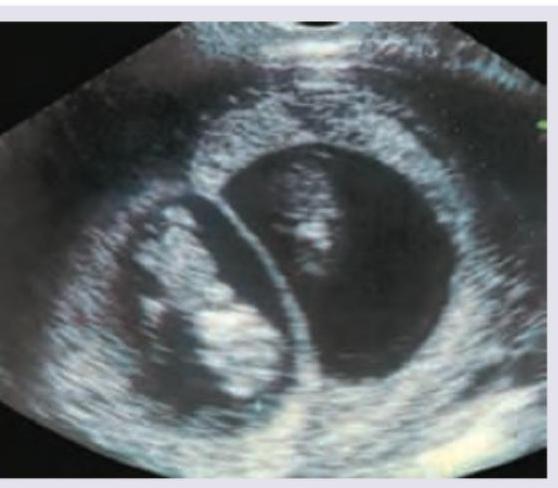
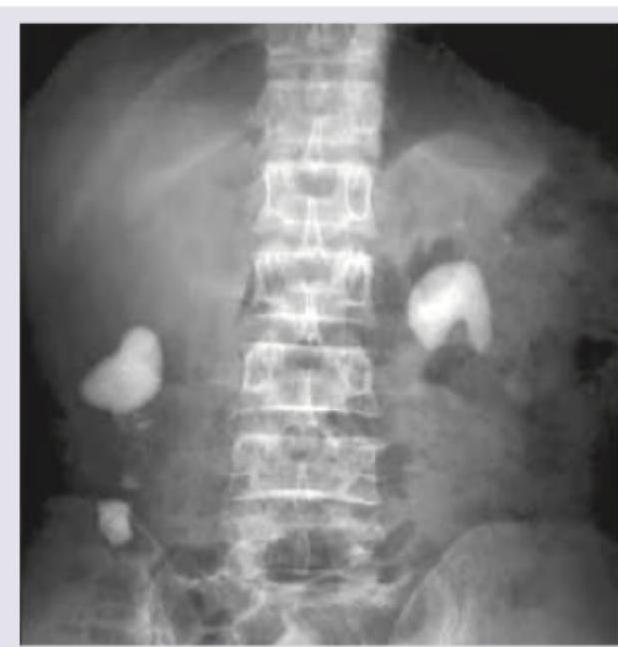
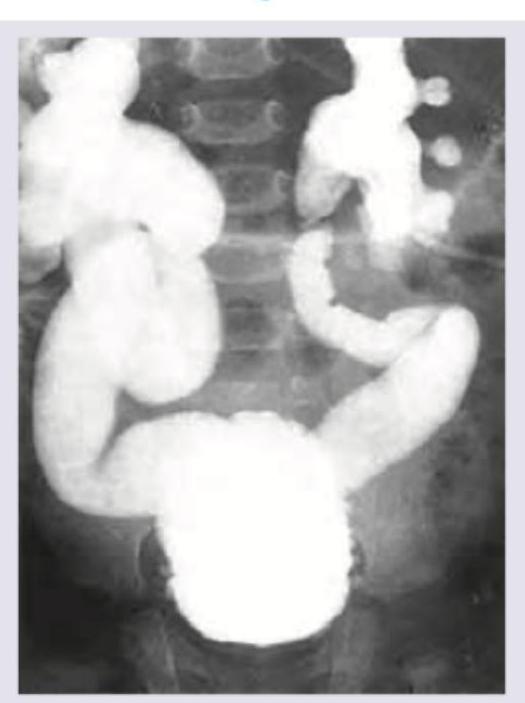
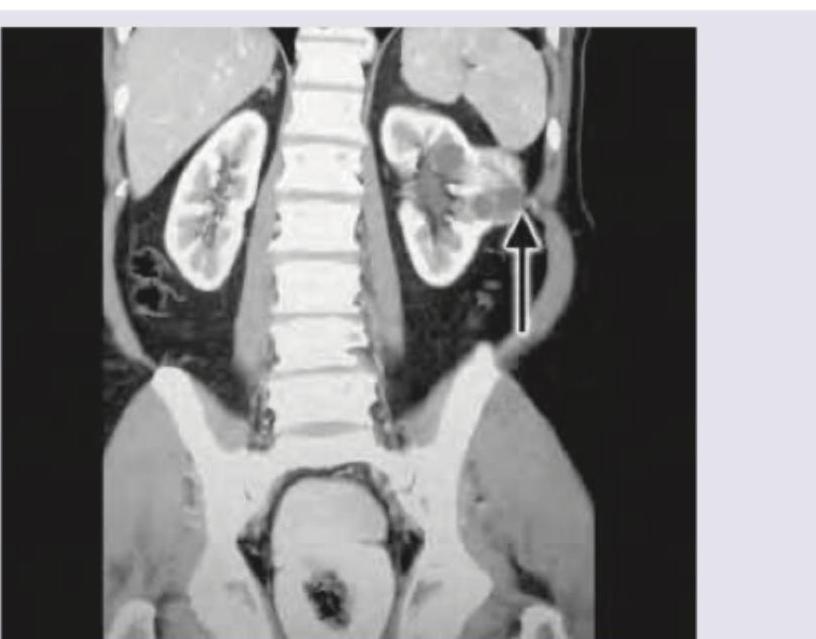
Minimal ascites can be best detected by which imaging modality?
Balthazar grading is used for acute pancreatitis based on findings on which imaging modality?
Which investigation is used for assessing the proper functioning of the biliary system?
Crumbled egg shell calcification of the liver is typically seen in which condition?
The nephrogram phase of an intravenous pyelogram (IVP) is due to dye in which part of the kidney?
The 'Adderhead' appearance is seen in which of the following conditions?
Increased liver attenuation with intracellular infiltration is seen in?
What is the characteristic radiographic finding of a 'saw tooth' appearance on a barium study?
Whirlpool sign is a characteristic feature of which of the following conditions?
What is the investigation of choice for detecting small para-aortic lymph nodes?
Explanation: **Explanation:** **1. Why Ultrasound (USG) is the Correct Answer:** Ultrasound is the most sensitive and preferred initial modality for detecting minimal ascites. It can detect as little as **5–10 mL** of fluid in the peritoneal cavity. Its high sensitivity is due to the fact that fluid is anechoic (black), providing a sharp contrast against the echogenic (bright) surfaces of the liver and pelvic organs. The best site to detect minimal fluid in a supine patient is **Morison’s pouch** (hepatorenal recess) or the **Pouch of Douglas** in the pelvis. **2. Why Other Options are Incorrect:** * **Plain X-ray Abdomen:** This is the least sensitive modality. Ascites only becomes visible on X-ray when the volume exceeds **500–1000 mL**. Signs like "ground-glass appearance" or "Dog’s ear sign" (fluid in the paravesical fossae) indicate massive, not minimal, ascites. * **CT Scan:** While CT is highly accurate and can detect small amounts of fluid (approx. 30 mL), it is not the "best" first-line choice due to ionizing radiation, higher cost, and the fact that USG is more sensitive for trace amounts of free fluid. * **MRI:** Although sensitive, MRI is never the primary modality for detecting ascites due to its high cost, lack of portability, and long scan times. **3. High-Yield Clinical Pearls for NEET-PG:** * **Minimum fluid for clinical detection:** 500–1500 mL (via shifting dullness). * **Puddle Sign:** A physical exam maneuver used to detect small amounts of fluid (approx. 120 mL), though USG remains superior. * **FAST Scan (Focused Assessment with Sonography for Trauma):** Uses USG to quickly identify hemoperitoneum (blood) in the perihepatic, perisplenic, pelvic, and pericardial spaces. * **Order of sensitivity for fluid detection:** USG > CT > Clinical Exam > X-ray.
Explanation: **Explanation:** The **Balthazar score** is a radiological grading system used to assess the severity of **acute pancreatitis** specifically based on **Contrast-Enhanced Computed Tomography (CECT)** findings. It evaluates the presence of pancreatic inflammation and peripancreatic fluid collections to predict prognosis and the risk of complications. **Why CT is the correct answer:** CECT is the gold standard for diagnosing complications of acute pancreatitis. The Balthazar grading (Grades A to E) assesses the size, shape, and contour of the pancreas along with the number of fluid collections. When combined with the degree of pancreatic necrosis, it forms the **CT Severity Index (CTSI)**, which correlates strongly with patient morbidity and mortality. **Why other options are incorrect:** * **Ultrasound (USG):** While often the first-line investigation to look for gallstones (etiology), USG is limited by overlying bowel gas and cannot accurately grade the severity or necrosis of the pancreas. * **MRI:** Though MRI (MRCP) is excellent for visualizing the biliary tree and detecting "walled-off necrosis," the Balthazar score was historically developed and validated specifically for CT. * **ERCP:** This is an invasive therapeutic procedure used to remove ductal stones or place stents; it is not a diagnostic grading tool for parenchymal inflammation. **High-Yield Clinical Pearls for NEET-PG:** * **Balthazar Grades:** A (Normal), B (Enlargement), C (Inflammation/Peripancreatic fat stranding), D (Single fluid collection), E (Two or more collections or gas). * **CT Severity Index (CTSI):** Balthazar Score (0–4 points) + Necrosis Score (0–6 points). A score of 7–10 indicates severe disease. * **Timing:** CECT is most accurate for assessing necrosis **48–72 hours** after the onset of symptoms. * **Modified CTSI:** A newer version that includes extrapancreatic complications (e.g., pleural effusion, ascites).
Explanation: **Explanation:** The assessment of the biliary system requires a multi-modal approach to evaluate both **anatomy** (structure) and **physiology** (function). 1. **Ultrasound (USG):** This is the **initial investigation of choice** for the biliary system. It is highly sensitive for detecting anatomical abnormalities such as gallstones (cholelithiasis), gallbladder wall thickening (cholecystitis), and biliary ductal dilatation. By observing gallbladder contraction after a fatty meal, it also provides a basic assessment of function. 2. **CT Scan:** While less sensitive than USG for gallstones, CT is superior for evaluating the distal common bile duct, detecting peri-ampullary tumors, and identifying complications like perforation or abscess formation. It assesses the patency and flow within the biliary tree. 3. **HIDA Scan (Hepatobiliary Iminodiacetic Acid Scan):** This is a nuclear medicine study and is the **gold standard for assessing biliary function**. It tracks the production and flow of bile from the liver into the gallbladder and small intestine. It is specifically used to diagnose **Acute Cholecystitis** (demonstrated by non-visualization of the gallbladder) and **Biliary Atresia** in neonates. Since all three modalities contribute essential information regarding the structural integrity and functional patency of the biliary tract, **Option D** is the correct answer. **High-Yield Clinical Pearls for NEET-PG:** * **IOC (Investigation of Choice) for Gallstones:** Ultrasound. * **Most Sensitive/Gold Standard for Acute Cholecystitis:** HIDA Scan. * **Best for Biliary Atresia:** HIDA Scan (after 5 days of Phenobarbitone priming). * **Best for Choledocholithiasis (Non-invasive):** MRCP (Magnetic Resonance Cholangiopancreatography).
Explanation: **Explanation:** The correct answer is **Hydatid cyst** (caused by *Echinococcus granulosus*). **Why Hydatid Cyst is Correct:** Calcification occurs in approximately 20–30% of hepatic hydatid cysts, usually signifying quiescence or death of the parasite. The characteristic **"crumbled eggshell"** or curvilinear calcification represents the calcification of the **pericyst** (the outermost host-derived layer). When the cyst wall collapses or becomes irregular, it takes on this classic appearance on a plain X-ray or CT scan. **Analysis of Incorrect Options:** * **Hemangioma:** Typically shows a "peripheral globular enhancement" with centripetal fill-in on dynamic CT. Calcification is rare but, if present, is usually a central **phlebolith**. * **Hepatoma (HCC):** Calcification is uncommon (seen in <10% of cases). When present, it is usually dystrophic, chunky, or punctate, rather than a thin shell. * **Liver Abscess:** Pyogenic or amoebic abscesses rarely calcify. If they do, it is usually a late, non-specific finding during the healing phase. **NEET-PG High-Yield Pearls:** * **Water Lily Sign:** Seen on MRI/CT when the endocyst ruptures and membranes float in the pericyst. * **Dot-in-Cyst Sign:** Represents the scolex within the cyst. * **Gharbi Classification:** Used for ultrasound staging of hydatid cysts (Type I: Pure fluid; Type II: Fluid with split wall; Type III: Daughter cysts/Honeycomb; Type IV: Heterogeneous; Type V: Calcified wall). * **Treatment of Choice:** PAIR (Puncture, Aspiration, Injection, Re-aspiration) or surgical resection, always covered with Albendazole.
Explanation: **Explanation:** The **Nephrogram Phase** is the initial stage of an Intravenous Pyelogram (IVP), occurring within 1–3 minutes after the injection of contrast medium. **Why Proximal Convoluted Tubules (PCT) is correct:** The contrast used in IVP (water-soluble iodinated contrast) is filtered by the glomerulus. Once filtered, it enters the renal tubules. The "blush" or opacification of the renal parenchyma seen during the nephrogram phase is primarily due to the high concentration of contrast medium within the **proximal convoluted tubules**. Because the PCTs make up the bulk of the renal cortex, their opacification creates the characteristic dense appearance of the kidney before the dye moves into the drainage system. **Analysis of Incorrect Options:** * **Renal Pelvis:** Opacification of the renal pelvis occurs during the **Pyelogram Phase** (usually after 5–10 minutes), representing the excretory stage where contrast collects in the calyces and pelvis. * **Nephron:** While the PCT is part of the nephron, "Nephron" is too broad a term. The nephrogram specifically highlights the tubular concentration, particularly in the cortex (PCT). * **Collecting Tubules:** These are located deeper in the medulla and lead to the renal papillae. Contrast reaches these later than the PCT; their opacification contributes more to the late nephrogram and early pyelogram phase. **High-Yield Clinical Pearls for NEET-PG:** * **Immediate/Early Nephrogram:** Seen in acute ureteric obstruction (e.g., calculus). * **Persistent/Increasingly Dense Nephrogram:** Classic sign of **Acute Tubular Necrosis (ATN)** or severe hypotension. * **Rim Nephrogram:** Characteristic of **Hydronephrosis** (contrast outlines the compressed parenchyma). * **Striated Nephrogram:** Often seen in **Acute Pyelonephritis** or renal vein thrombosis.
Explanation: **Explanation:** The **'Adderhead' appearance** (also known as the **Cobra-head sign**) is a classic radiological finding seen on an Intravenous Pyelogram (IVP) or contrast-enhanced CT. It represents a **simple ureterocele**, which is a congenital cystic dilatation of the distal-most intramural portion of the ureter. **Why it occurs:** The appearance is created by the contrast-filled, dilated distal ureter (the "head" of the cobra/adder) surrounded by a thin, radiolucent halo. This halo represents the combined thickness of the ureteral wall and the bladder mucosa, protruding into the bladder lumen. **Analysis of Incorrect Options:** * **Vesical diverticula:** These appear as contrast-filled outpouchings extending *outside* the bladder wall, often described as "ears" in children (bladder ears). * **Carcinoma of the urinary bladder:** Typically presents as an irregular, fixed filling defect within the bladder lumen, lacking the characteristic symmetrical halo of a ureterocele. * **Urethral stricture:** This is an obstructive lesion of the urethra, best visualized on a Retrograde Urethrogram (RGU) as a segment of narrowing, not as a bladder filling defect. **High-Yield Clinical Pearls for NEET-PG:** * **Cobra-head sign:** Pathognomonic for **simple (adult-type)** ureteroceles. * **Ectopic ureteroceles:** More common in children and often associated with a **duplicated collecting system** (Weigert-Meyer Law: the upper pole ureter inserts ectopically and prone to ureterocele). * **Reverse Cobra-head sign:** Can be seen in cases of bladder tumors or stones mimicking the appearance, but the lucent halo is usually thicker or irregular. * **Management:** Asymptomatic cases require no treatment; symptomatic cases (UTI, stones) are managed via endoscopic transurethral incision.
Explanation: **Explanation:** The correct answer is **Fatty liver**. This question focuses on the correlation between tissue composition and attenuation on Computed Tomography (CT). **1. Why Fatty Liver is Correct:** In fatty liver (steatosis), there is an **intracellular accumulation** of triglycerides within hepatocytes. On a CT scan, fat has a lower physical density than normal liver parenchyma. Consequently, as fat content increases, the overall **liver attenuation decreases** (measured in Hounsfield Units, HU). A non-contrast CT showing liver attenuation at least 10 HU less than the spleen, or absolute values below 40 HU, is diagnostic of fatty liver. **2. Why Other Options are Incorrect:** * **Hemochromatosis:** This involves the deposition of iron (a high-atomic-number element) within hepatocytes. Iron significantly **increases** liver attenuation (often >75 HU), making the liver appear "hyperdense" or brighter on CT. * **Amyloidosis:** While amyloid is an intracellular/extracellular protein infiltration, it typically results in **decreased** attenuation or hepatomegaly, but it is not the classic or most common cause associated with the specific "intracellular infiltration" pattern described in standard radiology teaching for this context. * **All:** Since Hemochromatosis increases attenuation while Fatty Liver decreases it, they cannot both be correct. **High-Yield Clinical Pearls for NEET-PG:** * **Normal Liver Attenuation:** Typically ranges from **50 to 60 HU** (slightly higher than the spleen). * **Gold Standard for Fat Quantification:** **MRI (Proton Density Fat Fraction - PDFF)** is more sensitive than CT for detecting early steatosis. * **Amiodarone Toxicity:** Another high-yield cause of **increased** liver attenuation (due to iodine content in the drug). * **Wilson’s Disease:** Can show variable attenuation but is often associated with decreased attenuation if fatty change predominates.
Explanation: **Explanation:** The **'Saw-tooth' appearance** is a classic radiographic sign of **Diverticulosis**, specifically when associated with muscular hypertrophy of the colonic wall (often seen in the pre-diverticular stage or in diverticular disease). This appearance is caused by two factors: 1. **Circular muscle hypertrophy:** The thickening of the muscle layers creates deep haustral folds. 2. **Mucosal herniation:** Multiple small outpocketings (diverticula) filled with barium protrude between these thickened muscle bands, creating a jagged, serrated contour resembling the teeth of a saw. **Analysis of Incorrect Options:** * **A. Intussusception:** Characterized by the **'Coiled spring' appearance** or 'Claw sign' on barium enema, representing barium trapped between the intussusceptum and the intussuscipiens. * **B. Ileocecal Tuberculosis:** Typically presents with a **'Conical cecum'** (shrunken cecum), **'Stierlin sign'** (rapid emptying of the inflamed segment), or **'Fleischner sign'** (inverted umbrella appearance of the ileocecal valve). * **C. Ischemic Colitis:** Classically shows **'Thumbprinting'** on a plain radiograph or barium study, which represents focal submucosal edema and hemorrhage. **High-Yield Clinical Pearls for NEET-PG:** * **Most common site for Diverticulosis:** Sigmoid colon (due to high intraluminal pressure). * **Investigation of Choice (IOC) for Acute Diverticulitis:** Contrast-Enhanced CT (CECT). Barium enema and colonoscopy are **contraindicated** in the acute phase due to the risk of perforation. * **Lead Pipe Appearance:** Seen in Chronic Ulcerative Colitis (loss of haustrations). * **Apple Core Sign:** Characteristic of Colorectal Carcinoma.
Explanation: **Explanation:** The **Whirlpool Sign** is a classic radiological finding most commonly associated with **Midgut Volvulus**. It occurs when the bowel loops and the mesenteric vessels (specifically the Superior Mesenteric Vein and its tributaries) wrap around the narrow stalk of the Superior Mesenteric Artery (SMA). On Ultrasound or CT, this creates a swirling, clockwise pattern of soft tissue and vessel shadows. **Why the correct answer is right:** * **Midgut Volvulus:** In cases of intestinal malrotation, the mesentery has a narrow base, making it prone to twisting. The "whirlpool" represents the torsion of the mesentery and the SMV around the fixed SMA. This is a surgical emergency often presenting in neonates with bilious vomiting. **Why the other options are wrong:** * **Sigmoid Volvulus:** Characterized by the **"Coffee Bean Sign"** or **"Omega Sign"** on X-ray. While a "whirl" can sometimes be seen on CT, the "Whirlpool Sign" is the hallmark description for Midgut Volvulus in medical exams. * **Intussusception:** Classically presents with the **"Target Sign"** or **"Donut Sign"** on transverse USG/CT and the **"Pseudokidney Sign"** on longitudinal views. * **Diverticulosis:** Typically presents with small, out-pouchings of the colonic wall (saw-tooth appearance) and does not involve mesenteric torsion. **High-Yield Clinical Pearls for NEET-PG:** * **Gold Standard Investigation:** Upper GI Contrast Study (Barium Swallow/Meal) showing a **"Corkscrew appearance"** of the duodenum. * **Ladd’s Procedure:** The definitive surgical treatment for malrotation/volvulus. * **Vessel Orientation:** On Ultrasound, a reversal of the normal relationship between the SMA and SMV (SMV located to the left of SMA) is highly suggestive of malrotation.
Explanation: **Explanation:** **CT scan** is the investigation of choice for detecting small para-aortic lymph nodes because of its superior spatial resolution and ability to visualize the retroperitoneum without interference from overlying bowel gas. It allows for precise measurement of the short-axis diameter of nodes (typically considered pathological if >10 mm) and can detect changes in nodal density or morphology. Contrast-enhanced CT (CECT) further helps in differentiating lymph nodes from adjacent vascular structures. **Why other options are incorrect:** * **Ultrasound scan:** While useful for screening, it is highly operator-dependent. It often fails to visualize the para-aortic region adequately due to interference from overlying bowel gas or patient habitus (obesity). * **Lymphangiography:** Historically, this was the gold standard for evaluating nodal internal architecture. However, it is an invasive, technically difficult procedure involving the injection of oil-based contrast into lymphatic vessels. It has been almost entirely replaced by non-invasive cross-sectional imaging (CT/MRI). * **Arteriography:** This is used to visualize the lumen of arteries. While it may show displacement of vessels by massive nodal bulk, it cannot visualize the lymph nodes themselves. **Clinical Pearls for NEET-PG:** * **Gold Standard for Nodal Staging:** While CT is the "investigation of choice" for size and location, **PET-CT** is superior for detecting metastasis in normal-sized nodes (functional imaging). * **MRI:** Preferred over CT in patients with contrast allergies or for specific pelvic malignancies (e.g., Rectal or Cervical cancer) due to better soft-tissue contrast. * **Nodal Size Cut-off:** In the abdomen, a short-axis diameter **>10 mm** is generally the threshold for considering a lymph node suspicious for malignancy or infection.
Imaging of Liver
Practice Questions
Biliary Tract Imaging
Practice Questions
Pancreatic Imaging
Practice Questions
Spleen and Lymphatic System
Practice Questions
Gastrointestinal Tract Imaging
Practice Questions
Renal and Urinary Tract Imaging
Practice Questions
Adrenal Imaging
Practice Questions
Female Pelvic Imaging
Practice Questions
Male Pelvic Imaging
Practice Questions
Abdominal Trauma Imaging
Practice Questions
Acute Abdomen Imaging
Practice Questions
Imaging of Peritoneal Cavity and Retroperitoneum
Practice Questions
Get full access to all questions, explanations, and performance tracking.
Start For Free