Diagnose the uterine condition shown on hysterosalpingogram.

A linear filling defect on ERCP is characteristic of which of the following conditions?
When should an invertogram be performed in a newborn?
The endometrium during the proliferative phase appears as all except:
What is the best investigation for planning radiotherapy for carcinoma of the esophagus?
Which of the following is NOT a radiological sign of uterine fibroid?
Spider leg deformity of calyces on IVP is seen in which of the following conditions?
Gas under the diaphragm is seen in which of the following conditions?
Claw sign or pincer sign is seen in which of the following conditions?
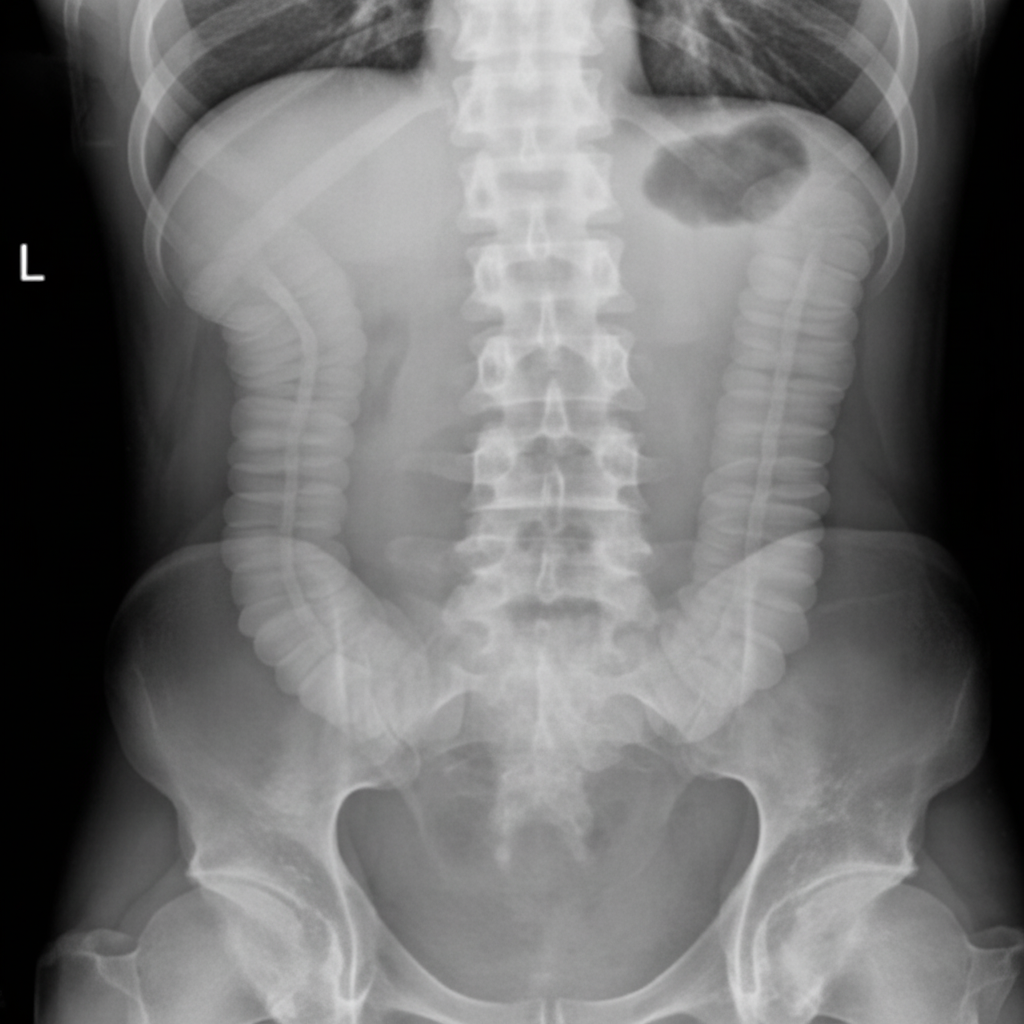
What is the diagnosis suggested by the barium study film?

Explanation: ***Bicornuate uterus*** - Shows **two diverging uterine horns** with a **fundal indentation >1 cm** and **intercornual angle >105°** on HSG. - Associated with **recurrent pregnancy loss** and **preterm delivery** due to reduced uterine capacity and abnormal contractions. *Unicornuate uterus* - HSG would show a **single horn** with **banana-shaped** or **comma-shaped** uterine cavity. - Often associated with **ipsilateral renal agenesis** and represents incomplete development of one Müllerian duct. *Arcuate uterus* - Shows a **mild fundal indentation <1 cm** with **intercornual angle <105°** on HSG. - Considered a **mild variant** with minimal clinical significance and lower risk of pregnancy complications. *Normal uterus* - HSG demonstrates a **smooth triangular uterine cavity** with no fundal indentation. - Shows **symmetrical fallopian tubes** with normal spillage of contrast into the peritoneal cavity.
Explanation: **Explanation:** The characteristic finding of a **linear filling defect** on Endoscopic Retrograde Cholangiopancreatography (ERCP) is highly suggestive of **Biliary Ascariasis** (*Ascaris lumbricoides*). These worms are long, cylindrical nematodes that can migrate from the duodenum into the common bile duct (CBD). On imaging, they appear as smooth, longitudinal, non-shadowing filling defects that may sometimes show movement. **Analysis of Options:** * **Worm in the biliary tree (Correct):** *Ascaris* typically presents as a long, linear, or "spaghetti-like" filling defect. If the contrast enters the worm's alimentary canal, it may create a "double-tube" sign. * **Bile duct stone:** These typically appear as **rounded or faceted** filling defects, often with a meniscus sign. They are usually mobile but not linear. * **Pancreatic duct stone:** These are usually radio-opaque on plain X-ray and appear as irregular filling defects within the pancreatic duct, often associated with chronic pancreatitis, rather than linear shapes in the biliary tree. * **Stricture:** A stricture presents as a **segmental narrowing** or "cutoff" of the duct (e.g., the "rat-tail" appearance in malignancy) rather than a filling defect within a patent lumen. **NEET-PG High-Yield Pearls:** * **USG Finding:** The "Strip sign" or "Inner tube sign" (a thick-walled tube with a central canal) is the classic sonographic appearance of Biliary Ascariasis. * **Clinical Presentation:** Often presents as biliary colic in a patient from an endemic area, sometimes triggered by pregnancy or prior cholecystectomy. * **Management:** Most cases are managed conservatively with anthelmintics; ERCP is reserved for extraction if the worm fails to migrate back to the intestine.
Explanation: **Explanation:** The **invertogram** (Wangensteen-Rice view) is a specialized radiographic technique used to assess the level of atresia in newborns with **Anorectal Malformations (ARM)**. **Why 6 hours is the correct timing:** In a newborn, the gastrointestinal tract is initially empty of air. After birth, the infant swallows air, which must travel through the entire length of the bowel to reach the distal-most rectal pouch. It takes approximately **6 to 12 hours** for swallowed air to reach the rectum. Performing the X-ray before this period may lead to a false-positive diagnosis of a "high" lesion, as the air column has not yet reached its most distal point, potentially leading to incorrect surgical planning. **Analysis of Incorrect Options:** * **A, B, and C (Immediately, 2 hours, 4 hours):** These timeframes are too early. At these stages, the air is likely still in the stomach or small intestine. An invertogram performed during this window would show a large gap between the gas bubble and the perineal skin marker, inaccurately suggesting a high-level atresia. **Clinical Pearls for NEET-PG:** * **Positioning:** The infant is held upside down for 3–5 minutes before the X-ray (with a radio-opaque marker on the anal dimple) to allow air to displace any meconium and reach the end of the pouch. * **Key Landmark:** The **PC line** (Pubococcygeal line) is used to classify the malformation. If the gas bubble is above this line, it is a "High" lesion; if below, it is "Low." * **Modern Alternative:** Prone cross-table lateral radiography is now often preferred over the invertogram as it is less stressful for the neonate and avoids respiratory compromise. * **Associated Anomalies:** Always remember the **VACTERL** association when a case of ARM is presented.
Explanation: The endometrial appearance on ultrasound changes predictably according to the menstrual cycle. This question tests the distinction between the **proliferative** and **secretory** phases. ### **Explanation of the Correct Answer** **Option C (Maximum thickness)** is the correct answer because the endometrium reaches its **maximum thickness during the secretory phase** (luteal phase), not the proliferative phase. Under the influence of progesterone, the endometrium becomes edematous and glycogen-rich, typically measuring between **7–14 mm**. In contrast, the proliferative phase endometrium is thinner, usually measuring 4–8 mm. ### **Analysis of Incorrect Options** * **B & D (Trilaminar appearance & Hypoechoic stratum functionale):** During the late proliferative phase (periovulatory period), the endometrium classically appears as a **"triple-line" (trilaminar)** structure. This consists of a central echogenic line (uterine cavity), surrounded by two **hypoechoic layers (stratum functionale)**, which are bounded by the outer echogenic lines. * **A (Echogenic stratum basale):** The outermost layers of the trilaminar appearance represent the stratum basale and the interface with the myometrium, which appear echogenic (bright) on ultrasound. ### **NEET-PG High-Yield Pearls** * **Early Proliferative Phase:** Thin, bright echogenic line (2–4 mm). * **Late Proliferative (Periovulatory):** Classic **Trilaminar** appearance. * **Secretory Phase:** Uniformly **hyperechoic** (bright) and thick due to mucus and glycogen storage; the "triple-line" disappears. * **Post-menopausal thickness:** Should ideally be **<5 mm**. If >5 mm or if there is post-menopausal bleeding, an endometrial biopsy is indicated to rule out malignancy. * **Best time for USG:** To evaluate for polyps or fibroids, the early proliferative phase (Day 5–10) is best as the endometrium is thinnest.
Explanation: **Explanation:** The correct answer is **PET scan (Positron Emission Tomography)**, specifically PET-CT, which is now considered the gold standard for planning radiotherapy in esophageal carcinoma. **Why PET Scan is Correct:** Radiotherapy planning requires precise **Target Volume Delineation**. PET scans utilize 18F-FDG uptake to differentiate viable tumor tissue from peritumoral edema, atelectasis, or normal tissue. This functional imaging allows for more accurate identification of the "Gross Tumor Volume" (GTV) and involved lymph nodes compared to anatomical imaging alone. Studies show that PET-CT significantly alters the radiation field in up to 30-40% of patients, preventing "geographical miss" of the tumor and sparing healthy surrounding tissues (like the heart and lungs) from unnecessary radiation. **Why Other Options are Incorrect:** * **CT Scan:** While CT is excellent for anatomical mapping and dose calculation, it often fails to distinguish the exact longitudinal extent of the tumor or identify small involved lymph nodes, leading to less precise targeting. * **Ultrasound:** Transabdominal ultrasound has no role in esophageal staging or RT planning. While **Endoscopic Ultrasound (EUS)** is the best for T and N staging, it cannot be used for radiotherapy contouring or detecting distant metastasis. * **MRI:** MRI provides superior soft-tissue contrast but is not the primary modality for RT planning in the esophagus due to motion artifacts (respiratory/cardiac) and lack of standardized protocols compared to PET-CT. **Clinical Pearls for NEET-PG:** * **Best for T and N staging:** Endoscopic Ultrasound (EUS). * **Best for M (Metastasis) staging:** PET-CT. * **Best for RT Planning:** PET-CT. * **Initial investigation of choice:** Barium swallow (shows "Rat-tail" or "Bird-beak" appearance depending on pathology). * **Definitive diagnosis:** Endoscopic biopsy.
Explanation: **Explanation:** The correct answer is **D**. This option describes the classic MRI features of **Adenomyosis**, not uterine fibroids (leiomyomas). In adenomyosis, there is ectopic endometrial tissue within the myometrium, which causes a diffuse or focal thickening of the **junctional zone** (typically >12 mm) and often results in its ill-defined appearance or interruption. **Analysis of Options:** * **Option A:** Fibroids often undergo various types of degeneration. **Calcification** (popcorn calcification) is common, especially in postmenopausal women, and appears as echogenic foci with posterior acoustic shadowing on Ultrasound (USG). * **Option B:** **Red degeneration** (necrobiosis) usually occurs during pregnancy. On MRI, it characteristically shows a **high signal intensity rim on T1-weighted images** due to the presence of methemoglobin or proteinaceous fluid within obstructed peripheral veins. * **Option C:** On USG, the appearance of a fibroid is highly variable. While most are **hypoechoic** compared to the myometrium, they can be isoechoic or even hyperechoic depending on the degree of fibrous tissue, fat, or calcification present. **High-Yield Clinical Pearls for NEET-PG:** * **Gold Standard Investigation:** MRI is the most sensitive and specific imaging modality for characterizing fibroids and differentiating them from adenomyosis. * **Classic MRI Appearance:** A typical non-degenerated fibroid is **well-circumscribed** and shows **low signal intensity** (dark) on both T1 and T2-weighted images. * **Adenomyosis vs. Fibroid:** Fibroids displace the junctional zone and have clear borders (pseudocapsule), whereas adenomyosis invades/thickens the junctional zone and has indistinct margins.
Explanation: **Explanation:** The **"Spider Leg Deformity"** on Intravenous Pyelogram (IVP) is a classic radiological sign of **Hypernephroma** (Renal Cell Carcinoma). **Why Hypernephroma is correct:** Hypernephroma is a solid parenchymal tumor that originates from the renal cortex. As the tumor grows, it exerts a mass effect on the adjacent collecting system. This leads to the **elongation, narrowing, and stretching** of the renal calyces. On an IVP, these stretched, thin calyces resemble the long, spindly legs of a spider. **Analysis of Incorrect Options:** * **Hydronephrosis:** Characterized by the dilation of the pelvis and calyces. Early signs include "cupping" loss, followed by "clubbing" and eventually "ballooning" of calyces, rather than stretching. * **Wilm’s Tumor:** While it also causes mass effect, it typically presents as a large intrarenal mass that causes **distortion and displacement** of the entire kidney and collecting system, often described as a "claw sign" or "mangled" appearance, rather than the specific spider leg pattern. * **Pyelonephritis:** Acute pyelonephritis often shows a normal IVP or generalized swelling. Chronic pyelonephritis is characterized by **cortical scarring** overlying a clubbed calyx. **High-Yield Clinical Pearls for NEET-PG:** * **Triad of RCC:** Hematuria (most common), flank pain, and palpable mass (seen in only 10% of cases). * **Stauffer Syndrome:** Reversible hepatic dysfunction associated with RCC (a common paraneoplastic syndrome). * **Investigation of Choice:** Contrast-Enhanced CT (CECT) is the gold standard for diagnosing and staging RCC. * **Other IVP Signs:** "Flower-vase appearance" is seen in Horseshoe kidney; "Cobra head sign" is seen in Ureterocele.
Explanation: **Explanation:** The presence of gas under the diaphragm on an upright chest X-ray is the hallmark of **pneumoperitoneum** (free intraperitoneal air). This occurs when air escapes from a hollow viscus or is introduced into the peritoneal cavity. * **Enteric Fever (Typhoid):** Intestinal perforation is a dreaded complication of enteric fever, typically occurring in the 3rd week of illness due to necrosis of Peyer's patches in the terminal ileum. This leads to the escape of bowel gas into the peritoneum, appearing as a radiolucent crescent under the diaphragm. * **Chilaiditi’s Syndrome:** This is a **pseudopneumoperitoneum**. It occurs when a loop of colon (usually the hepatic flexure) is interposed between the liver and the right hemidiaphragm. While it is not "free air," it radiographically presents as gas under the diaphragm. It is distinguished by the presence of **haustral markings** within the gas shadow. * **Iatrogenic Pneumoperitoneum:** Air is commonly introduced into the abdominal cavity during laparoscopy (insufflation with $CO_2$) or laparotomy. This air can persist for several days post-surgery and is a normal postoperative finding. **Clinical Pearls for NEET-PG:** 1. **Best View:** An **upright (erect) chest X-ray** is the most sensitive plain film for detecting pneumoperitoneum (can detect as little as 1–2 ml of air). 2. **Alternative View:** If the patient cannot stand, a **left lateral decubitus** view is preferred (air rises to sit between the liver and the right lateral abdominal wall). 3. **Rigler’s Sign:** Seeing both sides of the bowel wall due to free air (indicates large volume pneumoperitoneum). 4. **Cupola Sign:** Air trapped under the central tendon of the diaphragm in the midline.
Explanation: **Explanation:** **1. Why Intussusception is Correct:** The **Claw sign** (also known as the **Pincer sign**) is a classic radiological finding seen on a Barium Enema or Contrast CT. It occurs when the advancing head of the intussusceptum (the prolapsing segment) invaginates into the intussuscipiens (the receiving segment). The contrast material outlines the space between these two layers, creating two "prongs" or a "claw" appearance around the intussusceptum. This is a pathognomonic sign for **Intussusception**. **2. Analysis of Incorrect Options:** * **Ischemic Colitis:** Typically presents with **"Thumbprinting"** on imaging, which represents focal submucosal edema and hemorrhage. * **Ileocaecal TB:** Characterized by a **"Conical Caecum"** (shrunken, retracted caecum) and the **"Stierlin Sign"** (rapid emptying of the inflamed terminal ileum). * **Volvulus:** Sigmoid volvulus classically shows the **"Coffee Bean sign"** on X-ray and the **"Whirlpool sign"** or **"Bird’s Beak sign"** on contrast studies. **3. NEET-PG High-Yield Pearls:** * **Ultrasound (Investigation of Choice):** Look for the **Target sign** (or Donut sign) in transverse section and the **Pseudokidney sign** in longitudinal section. * **Clinical Triad:** Intermittent abdominal pain, "currant jelly" stools, and a sausage-shaped palpable mass. * **Treatment:** Non-operative reduction using **Hydrostatic (saline/contrast) or Pneumatic (air) enemas** is the first-line treatment in stable children. * **Lead Point:** In adults, intussusception is usually secondary to a pathological lead point (e.g., malignancy), whereas in children, it is often idiopathic (associated with lymphoid hyperplasia).
Explanation: ***Crohn's disease*** - Barium studies show characteristic **string sign** (narrowed bowel segments), **skip lesions** (normal bowel between diseased areas), and **cobblestone mucosa** appearance. - **Rose-thorn ulcers** and **aphthous ulcers** create a distinctive pattern on barium enema, indicating transmural inflammation. *Toxic megacolon* - Barium studies show **massive colonic dilatation** (>6cm transverse colon) with **loss of haustral markings** and smooth colonic contour. - **Thumbprinting** may be present due to mucosal edema, but **skip lesions** and **string sign** are not characteristic features. *Intestinal perforation* - Barium studies would show **contrast extravasation** outside the bowel lumen into the **peritoneal cavity** or **retroperitoneum**. - **Free air** under the diaphragm or **pneumoperitoneum** may be visible, not the characteristic inflammatory changes of Crohn's disease. *Intussusception* - Barium enema demonstrates a **filling defect** with **coiled spring appearance** or **cup-shaped** obstruction at the intussusception site. - **Target sign** or **sausage-shaped mass** may be visible, but **transmural inflammation** and **skip lesions** are not present.
Imaging of Liver
Practice Questions
Biliary Tract Imaging
Practice Questions
Pancreatic Imaging
Practice Questions
Spleen and Lymphatic System
Practice Questions
Gastrointestinal Tract Imaging
Practice Questions
Renal and Urinary Tract Imaging
Practice Questions
Adrenal Imaging
Practice Questions
Female Pelvic Imaging
Practice Questions
Male Pelvic Imaging
Practice Questions
Abdominal Trauma Imaging
Practice Questions
Acute Abdomen Imaging
Practice Questions
Imaging of Peritoneal Cavity and Retroperitoneum
Practice Questions
Get full access to all questions, explanations, and performance tracking.
Start For Free