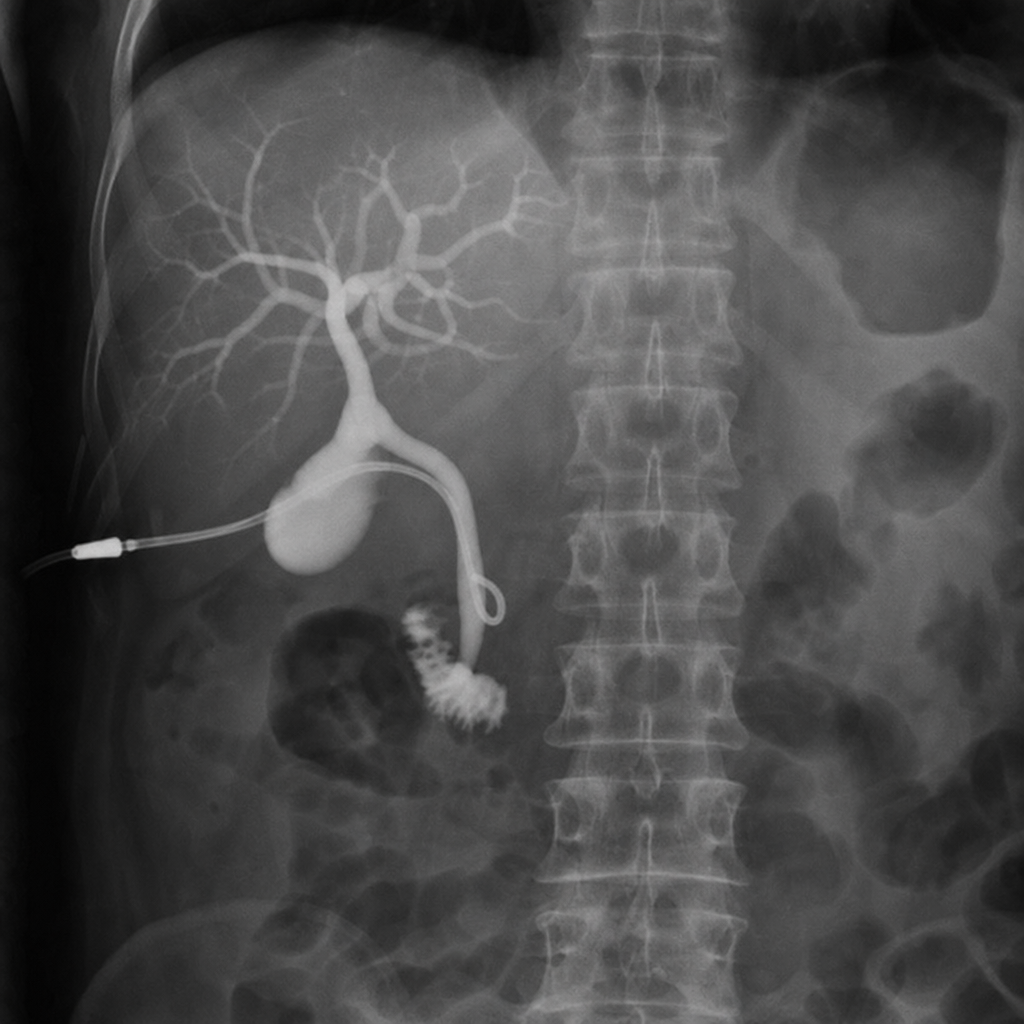
Gasless abdomen is a feature of which of the following conditions?
What is the earliest radiological finding of Crohn's disease?
Absolute contraindications for hysterosalpingography (HSG) include all except:
A patient presents with severe right upper quadrant pain associated with nausea and vomiting, exacerbation during inspiration, and tenderness on palpation. Which of the following imaging modalities is the investigation of choice for this patient?
What does the term "Phrygian cap" refer to in the context of the gallbladder?
The 'string of beads' appearance on an abdominal X-ray is typically seen in which of the following conditions?
For hiatus hernia, what is the investigation of choice?
What is the cupola sign?
The triad of pelvic lipomatosis includes all of the following except?
The double bubble sign is a radiological feature of which condition?
Explanation: **Explanation:** A **gasless abdomen** on a plain X-ray refers to a significant reduction or total absence of normal bowel gas patterns. This occurs when the bowel is either empty, fluid-filled, or displaced. **1. High Intestinal Obstruction:** In cases of proximal obstruction (e.g., pyloric stenosis or duodenal atresia), gas cannot pass into the distal small and large intestines. If the patient vomits the swallowed air, the distal bowel collapses, leading to a gasless appearance below the site of obstruction. **2. Acute Pancreatitis:** While the "sentinel loop" (localized ileus) is a common sign, severe acute pancreatitis can present with a gasless abdomen. This occurs because the intense retroperitoneal inflammation causes the bowel loops to fill with fluid (exudate) rather than air, or due to persistent vomiting. **3. Congenital Diaphragmatic Hernia (CDH):** In CDH (specifically Bochdalek), the abdominal viscera herniate into the thoracic cavity. Consequently, the abdominal cavity appears scaphoid and "gasless" because the air-filled bowel loops are located in the chest rather than the abdomen. **Clinical Pearls for NEET-PG:** * **Other causes of gasless abdomen:** Acute gastroenteritis (due to hyperperistalsis and vomiting), midgut volvulus (early stage), and mesenteric ischemia. * **Normal Bowel Gas:** In adults, gas is normally seen in the stomach and colon. Small bowel gas is minimal (<2.5 cm diameter). * **Differential Diagnosis:** If you see a gasless abdomen in a neonate with respiratory distress, immediately suspect **CDH**. If seen in an adult with severe epigastric pain, consider **Acute Pancreatitis**.
Explanation: **Explanation:** **Correct Answer: C. Aphthous lesions** In Crohn's disease, the earliest macroscopic radiological finding is the **aphthous ulcer**. These appear on a double-contrast barium enema as small, superficial, punctate collections of barium surrounded by a radiolucent halo of edema (the "target" or "bull's eye" sign). They typically occur over lymphoid follicles and represent the initial stage of mucosal inflammation before deeper ulceration occurs. **Analysis of Incorrect Options:** * **A. Cobblestone appearance:** This is a characteristic but **late** finding. It results from deep longitudinal and transverse ulcers intersecting, leaving islands of relatively normal, edematous mucosa between them. * **B. Raspberry appearance:** This is a classic radiological description for **Schistosomiasis** of the colon, not Crohn's disease. * **D. String sign of Kantor:** This refers to the severe narrowing of the terminal ileum due to transmural inflammation and spasm. While highly characteristic of Crohn's, it indicates **advanced** fibrostenotic disease rather than early changes. **NEET-PG High-Yield Pearls:** * **Distribution:** Crohn's is characterized by "skip lesions" (discontinuous involvement) and most commonly affects the terminal ileum. * **Proud Flesh:** These are inflammatory polyps (pseudopolyps) seen between areas of ulceration. * **Comb Sign:** On CT/MRI, this refers to the prominence of the vasa recta due to hypervascularity in the mesentery, indicating active inflammation. * **Creeping Fat:** The extension of mesenteric fat around the bowel wall is a pathognomonic surgical/radiological feature.
Explanation: **Explanation:** Hysterosalpingography (HSG) is a fluoroscopic procedure used primarily to evaluate tubal patency and the uterine cavity. Understanding its contraindications is crucial for NEET-PG. **Why Mullerian Anomalies is the Correct Answer:** Mullerian anomalies (such as a septate, bicornuate, or unicornuate uterus) are actually an **indication** for performing an HSG, not a contraindication. HSG is a primary diagnostic tool used to delineate the internal architecture of the uterus to identify these structural malformations. **Analysis of Incorrect Options (Absolute Contraindications):** * **Pregnancy (A):** Performing an HSG during pregnancy is strictly contraindicated as the procedure involves ionizing radiation and the injection of contrast medium, which can lead to fetal harm or miscarriage. * **Pelvic Inflammatory Disease (B):** HSG is contraindicated in the presence of acute pelvic infection. The procedure involves injecting contrast under pressure, which can cause the retrograde spread of bacteria into the peritoneal cavity, potentially leading to peritonitis or sepsis. * **Genital Tuberculosis (D):** Active genital TB is considered a contraindication because the procedure can cause a flare-up or hematogenous spread of the infection. **High-Yield Clinical Pearls for NEET-PG:** * **Timing:** HSG should be performed during the **proliferative phase** (Day 7 to Day 10 of the menstrual cycle) to ensure the endometrium is thin (better visualization) and to avoid an early undiagnosed pregnancy. * **Water-soluble vs. Oil-based contrast:** Water-soluble contrast (e.g., Iohexol) is preferred today due to faster absorption and lower risk of granuloma formation. * **Therapeutic Effect:** HSG can sometimes have a "flushing" effect, slightly increasing conception rates in the months following the procedure.
Explanation: ### Explanation The clinical presentation of severe right upper quadrant (RUQ) pain, nausea, vomiting, and tenderness exacerbated by inspiration (positive **Murphy’s sign**) is classic for **Acute Cholecystitis**. **Why Ultrasonography (USG) is the Correct Answer:** USG is the **initial investigation of choice** for suspected acute cholecystitis and biliary pathologies. It is highly sensitive (up to 95%) and specific. Key diagnostic findings on USG include: * Gallbladder wall thickening (>3 mm). * Pericholecystic fluid. * Presence of gallstones (cholelithiasis). * **Sonographic Murphy’s sign:** Maximal tenderness when the USG probe is pressed directly over the gallbladder (more specific than the physical exam sign). **Why Other Options are Incorrect:** * **B. CT Scan:** While CT is excellent for identifying complications (like perforation or gangrene) and evaluating the entire abdomen, it is less sensitive than USG for detecting gallstones and is more expensive with radiation exposure. * **C. MRI (MRCP):** Highly accurate for detecting ductal stones (choledocholithiasis) but is time-consuming, expensive, and not used as a first-line emergency tool. * **D. X-ray:** Only 10–15% of gallstones are radiopaque (calcium-containing). A plain radiograph is generally non-diagnostic for cholecystitis. **High-Yield Clinical Pearls for NEET-PG:** * **Gold Standard Investigation:** While USG is the *initial* choice, **HIDA scan (Cholescintigraphy)** is the most sensitive/gold standard for diagnosing acute cholecystitis (showing non-visualization of the gallbladder). * **Emphysematous Cholecystitis:** Look for "gas in the gallbladder wall" on X-ray or CT; this is a surgical emergency often seen in diabetic patients. * **WES Triad (Wall-Echo-Shadow):** A USG sign indicating a gallbladder packed with stones.
Explanation: **Explanation:** The **Phrygian cap** is the most common congenital anatomical variant of the gallbladder. It occurs when there is a fold or septum at the junction of the **gallbladder fundus and the body**. The name is derived from its resemblance to the "Phrygian cap" (a soft conical cap with the top pulled forward) worn by ancient inhabitants of Phrygia. **Why the correct answer is right:** * **Option A:** This is the precise anatomical definition. The fold causes the fundus to "cap" over the body. On imaging (Ultrasound or CT), it may mimic a mass or a septated gallbladder, but it is a benign finding with no pathological significance. **Why the incorrect options are wrong:** * **Option B:** Agenesis refers to the complete absence of the gallbladder due to failure of the cystic bud to develop. * **Option C:** An abnormally large gallbladder is termed "cholecystomegaly" or "hydrops," often seen in conditions like Kawasaki disease or cystic duct obstruction. * **Option D:** Duplication of the gallbladder is a rare congenital anomaly where two separate gallbladder cavities (and usually two cystic ducts) are present. **High-Yield Clinical Pearls for NEET-PG:** * **Clinical Significance:** It is a **normal variant**. It does not predispose a patient to cholelithiasis (gallstones) or cholecystitis. * **Imaging:** On Cholescintigraphy (HIDA scan), it may cause a filling delay, but it should not be mistaken for pathology. * **Differential Diagnosis:** It must be distinguished from **adenomyomatosis**, which involves thickening of the gallbladder wall and Rokitansky-Aschoff sinuses (comet-tail artifact).
Explanation: ### Explanation **1. Why Small Bowel Obstruction (SBO) is Correct:** The **'string of beads'** (or 'string of pearls') sign is a classic radiological finding on an erect abdominal X-ray in patients with **Small Bowel Obstruction**. It occurs when the bowel loops are almost entirely filled with fluid, leaving only small pockets of gas trapped between the **valvulae conniventes** (circular folds). These small gas bubbles appear as a row of radiolucent "beads" along the superior wall of the fluid-filled bowel loop. This sign is highly suggestive of a mechanical obstruction rather than a functional ileus. **2. Why the Incorrect Options are Wrong:** * **Large Bowel Obstruction:** Typically presents with peripheral bowel dilatation and the presence of **haustrations** (which do not cross the entire width of the bowel). The 'string of beads' is specific to the anatomy of the small intestine. * **Carcinoma of the Stomach:** This usually presents with a filling defect on barium studies or a soft tissue mass on CT. It does not typically produce the specific gas-fluid pattern seen in SBO. * **Gastric Outlet Obstruction:** This results in a massively dilated stomach (often seen as a large "single bubble" with a fluid level in the left upper quadrant), but it does not produce the multiple small gas pockets characteristic of the 'string of beads' sign. **3. NEET-PG High-Yield Pearls:** * **Step-ladder pattern:** Another classic sign of SBO on erect films, representing multiple air-fluid levels. * **Valvulae Conniventes (Plicae Circulares):** These cross the *entire* diameter of the small bowel, helping distinguish it from the large bowel. * **Coffee Bean Sign:** Characteristic of Sigmoid Volvulus. * **Bird’s Beak Sign:** Seen on barium swallow in Achalasia Cardia or barium enema in Sigmoid Volvulus. * **Gold Standard Investigation:** While X-ray is the initial screening tool, **Contrast-Enhanced CT (CECT)** is the investigation of choice for diagnosing the site and cause of bowel obstruction.
Explanation: **Explanation:** The investigation of choice for diagnosing a hiatus hernia is a **Barium meal upper GI study performed in the Trendelenburg position**. **Why the Trendelenburg position?** A hiatus hernia occurs when a portion of the stomach protrudes through the esophageal hiatus of the diaphragm into the mediastinum. In many patients, this herniation is "sliding" (Type I) and intermittent. Placing the patient in the **Trendelenburg position** (head-down tilt) increases intra-abdominal pressure and utilizes gravity to displace the stomach upwards. This maneuver "provokes" the herniation, making it visible on fluoroscopy and allowing the radiologist to identify the position of the gastroesophageal junction relative to the diaphragm. **Analysis of Incorrect Options:** * **Barium meal follow-through (A):** This is primarily used to evaluate the small intestine (jejunum and ileum). It is not specific for the gastroesophageal junction. * **Barium meal upper GI (B):** While this looks at the stomach and esophagus, a standard upright or supine study may miss a sliding hiatus hernia that reduces spontaneously. * **Barium meal double contrast (D):** Double contrast (using gas-producing crystals) is excellent for visualizing mucosal lesions like ulcers or tumors, but it is not the specific provocative technique required to demonstrate the mechanical displacement of a hernia. **High-Yield Clinical Pearls for NEET-PG:** * **Schatzki Ring:** A mucosal ring at the squamocolumnar junction, often associated with a sliding hiatus hernia. * **Cameron Ulcers:** Linear erosions found on the crest of mucosal folds at the level of the diaphragm in patients with large hiatus hernias; a known cause of iron deficiency anemia. * **Rolling Hernia (Paraesophageal):** The gastroesophageal junction remains in its normal position, but the fundus protrudes. This carries a high risk of **volvulus and strangulation**, unlike sliding hernias.
Explanation: ### Explanation The **Cupola Sign** is a classic radiological sign of **pneumoperitoneum** (free intraperitoneal air) seen on a **supine** abdominal radiograph. It refers to an arcuate (cup-shaped) lucency seen overlying the lower thoracic spine and the central portion of the diaphragm. **1. Why the Correct Answer is Right:** In the supine position, free air rises to the highest point of the peritoneal cavity. This air accumulates under the central tendon of the diaphragm (the "cupola"). Because the central tendon is located anteriorly and superiorly, the air outlines its undersurface, creating a curved radiolucency that crosses the midline, often appearing just above the heart's apex or over the lower vertebrae. **2. Analysis of Incorrect Options:** * **Option B:** Pneumothorax in a supine patient is typically identified by the **Deep Sulcus Sign** (an abnormally deep and lucent costophrenic angle), not the Cupola sign. * **Option C:** Air in Morison’s pouch (the posterior subhepatic space) is known as the **Doge’s Cap sign**. * **Option D:** Visualization of both the inner and outer walls of the bowel due to free air is known as **Rigler’s Sign** (also a sign of pneumoperitoneum, but distinct from the Cupola sign). **3. High-Yield Clinical Pearls for NEET-PG:** * **Gold Standard for Pneumoperitoneum:** Erect Chest X-ray (can detect as little as 1–2 ml of air). * **Other Supine Signs of Pneumoperitoneum:** * **Rigler’s Sign:** Double wall sign. * **Football Sign:** Large amount of air outlining the entire peritoneal cavity. * **Falciform Ligament Sign:** Air outlining the falciform ligament (longitudinal linear opacity in the right upper quadrant). * **Inverted V Sign:** Air outlining the lateral umbilical ligaments.
Explanation: **Explanation:** **Pelvic Lipomatosis** is a rare, benign condition characterized by the excessive deposition of non-encapsulated mature adipose tissue within the perivesical and perirectal spaces of the pelvic cavity. This fat accumulation exerts extrinsic pressure on the pelvic organs, leading to characteristic radiological findings. **Why "Thickening of the colon" is the correct answer:** In pelvic lipomatosis, the colon is not pathologically thickened. Instead, the rectosigmoid colon is **displaced, elongated, and narrowed** due to external compression by the surrounding fat. The bowel wall itself remains intact and of normal thickness. Therefore, "thickening of the colon" is not part of the classic triad or clinical presentation. **Analysis of Incorrect Options:** * **A. Pelvic radiolucency:** On a plain X-ray, the excessive deposition of fat (which has low attenuation) appears as increased radiolucency (darker areas) in the pelvic region. * **B. Elevation of an intact rectosigmoid:** The massive amount of pelvic fat pushes the rectum and sigmoid colon superiorly and straightens them. This is a hallmark feature. * **C. Pear-shaped bladder:** The bladder is compressed laterally and elongated vertically by the pelvic fat, resulting in a characteristic "pear-shaped" or "inverted teardrop" appearance on intravenous pyelogram (IVP) or CT. **NEET-PG High-Yield Pearls:** * **Classic Triad:** 1. Pear-shaped bladder, 2. Straightened/Elevated rectosigmoid, 3. Increased pelvic radiolucency. * **Demographics:** Most commonly seen in middle-aged African American males. * **Clinical Presentation:** Often asymptomatic but can present with urinary frequency, constipation, or hydronephrosis due to ureteral compression. * **Association:** Strongly associated with **cystitis glandularis** (a premalignant condition of the bladder). * **Imaging Gold Standard:** **CT scan** is the investigation of choice, showing fat attenuation (-60 to -100 Hounsfield Units) filling the pelvic space.
Explanation: ### Explanation **Correct Answer: B. Duodenal Atresia** The **Double Bubble Sign** is a classic radiological finding seen on a plain abdominal X-ray. It represents the simultaneous dilatation of the **stomach** and the **proximal duodenum**. * **Mechanism:** In duodenal atresia, there is a complete congenital obstruction of the second part of the duodenum. Air swallowed by the neonate distends the stomach (first bubble) and the proximal duodenum (second bubble). * **Key Feature:** Because the obstruction is complete, there is typically a total absence of gas in the distal bowel (distal gasless abdomen). --- ### Why the other options are incorrect: * **A. Pyloric Stenosis:** Presents with a "Single Bubble" (distended stomach) and a gasless distal abdomen. Clinically, it presents later (3–6 weeks) with non-bilious projectile vomiting and an "olive-shaped" mass. * **C. Hirschsprung’s Disease:** This is a distal colonic obstruction. X-rays show multiple dilated loops of bowel (low intestinal obstruction) and a transition zone on contrast enema, not a double bubble. * **D. Necrotizing Enterocolitis (NEC):** The hallmark radiological finding is **Pneumatosis Intestinalis** (gas within the bowel wall). You may also see portal venous gas or pneumoperitoneum if perforation occurs. --- ### High-Yield Clinical Pearls for NEET-PG: * **Association:** Approximately 30% of infants with duodenal atresia have **Down Syndrome (Trisomy 21)**. * **Antenatal Ultrasound:** May show polyhydramnios and two fluid-filled structures in the fetal abdomen. * **Vomiting:** Since the obstruction is usually distal to the ampulla of Vater, the vomiting is typically **bilious**. * **Differential for Double Bubble:** While duodenal atresia is the most common cause, a double bubble can also be seen in **Annular Pancreas**, **Malrotation with Midgut Volvulus**, or **Duodenal Web**.
Imaging of Liver
Practice Questions
Biliary Tract Imaging
Practice Questions
Pancreatic Imaging
Practice Questions
Spleen and Lymphatic System
Practice Questions
Gastrointestinal Tract Imaging
Practice Questions
Renal and Urinary Tract Imaging
Practice Questions
Adrenal Imaging
Practice Questions
Female Pelvic Imaging
Practice Questions
Male Pelvic Imaging
Practice Questions
Abdominal Trauma Imaging
Practice Questions
Acute Abdomen Imaging
Practice Questions
Imaging of Peritoneal Cavity and Retroperitoneum
Practice Questions
Get full access to all questions, explanations, and performance tracking.
Start For Free