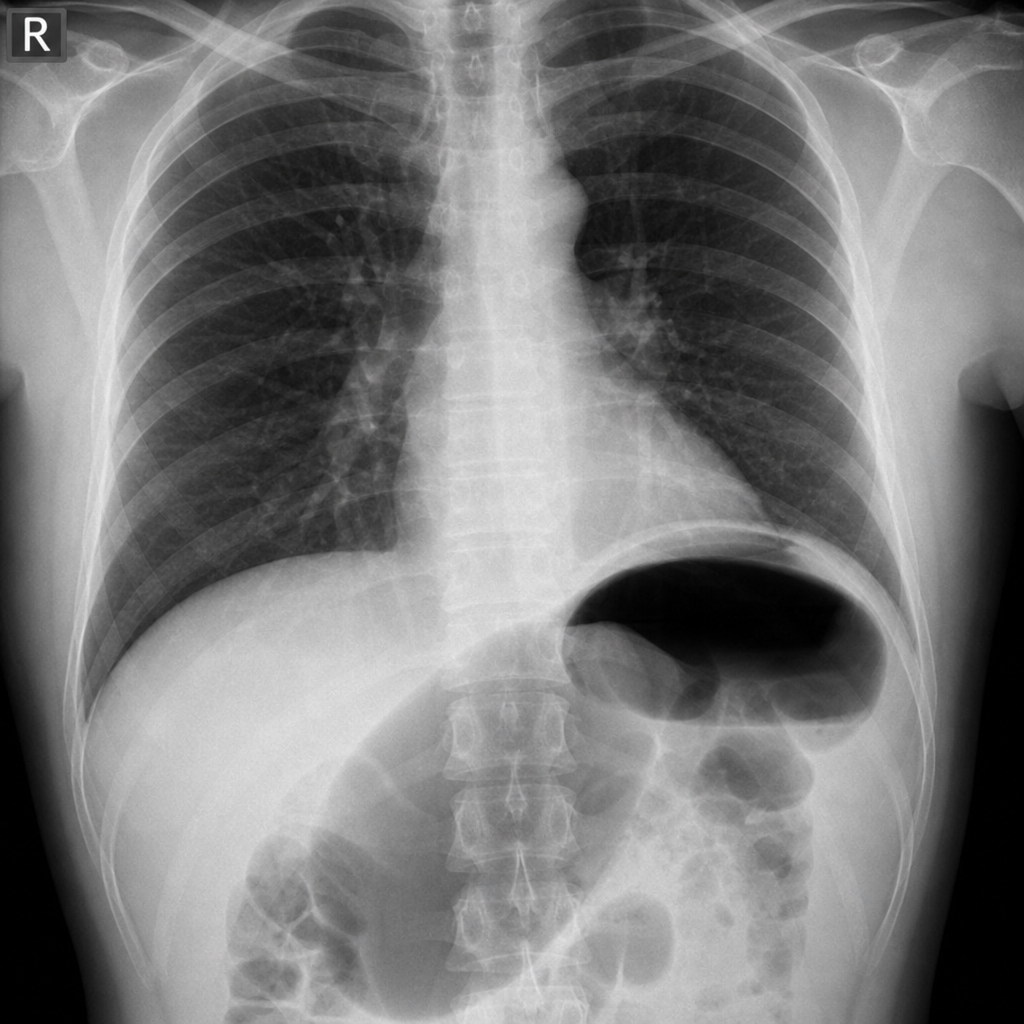
What is the investigation of choice for intermittent gastrointestinal obstruction?
What is the investigation of choice to diagnose congenital malformations?
Which abdominal organ is best visualized with CT scanning?
Which of the following is NOT an X-ray sign of acute pancreatitis?
A 'windsock' appearance on barium studies is typically seen in which of the following conditions?
What is the procedure of choice to diagnose uterus didelphys?
Which of the following is not evaluated by Ultrasound (USG) of the Kidneys, Ureters, and Bladder (KUB) in the context of carcinoma prostate?
A patient admitted with an abdominal mass underwent MRI, which revealed bilateral adrenal calcification. What is the most likely diagnosis?
Which is the commonest incidentaloma detected in the liver?
What is the most sensitive test for ureteric stones?
Explanation: **Explanation:** **1. Why Enteroclysis is the Correct Answer:** Enteroclysis (Small Bowel Enema) is considered the gold standard for evaluating **intermittent or low-grade small bowel obstruction**. Unlike conventional studies, it involves the placement of a nasojejunal tube (passed beyond the ligament of Treitz) to inject contrast and methylcellulose directly into the small bowel. This creates **controlled luminal distension**, which allows for the visualization of subtle abnormalities, such as adhesions, small tumors, or strictures, that might be missed when the bowel is collapsed or intermittently obstructed. **2. Why the Other Options are Incorrect:** * **X-ray (Option A):** While useful for acute, complete obstruction (showing dilated loops and air-fluid levels), it is often normal or non-specific in intermittent cases. * **USG (Option B):** Ultrasound is operator-dependent and limited by overlying bowel gas. It is better suited for identifying intussusception or pyloric stenosis rather than general intermittent obstruction. * **Barium Meal Follow-Through (BMFT) (Option D):** In BMFT, contrast is ingested orally. The transit is passive and depends on gastric emptying. The contrast often becomes diluted and the bowel loops overlap, making it less sensitive than enteroclysis for detecting the specific transition point in intermittent obstruction. **3. Clinical Pearls for NEET-PG:** * **IOC for Acute Intestinal Obstruction:** Contrast-Enhanced CT (CECT) of the Abdomen. * **IOC for Intermittent/Low-grade Obstruction:** Enteroclysis (CT Enteroclysis is increasingly preferred over conventional fluoroscopic enteroclysis). * **Double Contrast:** In enteroclysis, **Methylcellulose** is used as the second contrast agent to provide a "double-contrast" effect, improving mucosal detail. * **Contraindication:** Enteroclysis should **not** be performed if a complete/high-grade obstruction or bowel perforation is suspected.
Explanation: **Explanation:** The investigation of choice for diagnosing congenital uterine malformations (Müllerian duct anomalies) is **Magnetic Resonance Imaging (MRI)**. **Why MRI is the Correct Answer:** MRI provides excellent soft-tissue contrast and multiplanar imaging capabilities. It allows for the simultaneous evaluation of the **uterine contour (serosal surface)** and the **internal endometrial cavity**. This distinction is critical; for example, MRI can accurately differentiate between a septate uterus (normal convex/flat fundal contour) and a bicornuate uterus (cleft/concave fundal contour), which is essential because their surgical management differs significantly. MRI is also non-ionizing and can detect associated renal anomalies. **Why Other Options are Incorrect:** * **Hysterosalpingography (HSG):** While excellent for assessing tubal patency, HSG only visualizes the internal cavity. It cannot see the external fundal contour, making it impossible to distinguish between a septate and a bicornuate uterus. * **Ultrasound (USG):** 2D-USG is often the initial screening tool but is operator-dependent and has lower sensitivity for complex anomalies. (Note: **3D-USG** is highly accurate and comparable to MRI, but if "MRI" is an option in a general context, it remains the gold standard). * **Computed Tomography (CT):** CT involves significant ionizing radiation to the pelvis and lacks the soft-tissue resolution required to detail uterine anatomy compared to MRI. **High-Yield Clinical Pearls for NEET-PG:** * **Gold Standard:** MRI is the overall gold standard for non-invasive diagnosis. * **Screening Tool:** 2D-Ultrasound is the initial investigation. * **Associated Anomalies:** Always screen the **Renal system** (e.g., renal agenesis) in patients with Müllerian duct anomalies, as they share a common embryological origin. * **Septate Uterus:** Most common anomaly; associated with the highest rate of infertility/miscarriage. * **Bicornuate Uterus:** Results from partial failure of fusion of Müllerian ducts.
Explanation: **Explanation:** The **pancreas** is considered the abdominal organ best visualized and most accurately evaluated by CT scanning. This is because the pancreas is a retroperitoneal organ with a complex, oblique orientation that makes it difficult to visualize entirely via ultrasonography (USG) due to overlying bowel gas and patient habitus. Contrast-Enhanced Computed Tomography (CECT) provides excellent spatial resolution, allowing for the precise assessment of the pancreatic parenchyma, the pancreatic duct, and peripancreatic fat planes, which is crucial for staging pancreatitis and detecting neoplasms. **Analysis of Options:** * **Liver (A):** While CT is excellent for liver lesions, USG is often the first-line screening tool, and MRI (with gadolinium) is superior for characterizing specific focal liver lesions like hemangiomas or FNH. * **Gallbladder (B):** **Ultrasonography is the gold standard** for the gallbladder. It is highly sensitive for detecting gallstones (cholelithiasis) and gallbladder wall thickening, often outperforming CT in these areas. * **Kidneys (D):** While CT (specifically CT Urography) is excellent for stones and tumors, the kidneys are also very well visualized by USG and MRI. The pancreas remains the organ where CT provides the most significant diagnostic advantage over other modalities. **High-Yield Clinical Pearls for NEET-PG:** * **Gold Standard for Acute Pancreatitis:** CECT (performed 48–72 hours after symptom onset to assess for necrosis). * **Double Duct Sign:** Dilatation of both the common bile duct and pancreatic duct on CT, highly suggestive of pancreatic head carcinoma. * **Best Initial Investigation for Gallstones:** Ultrasonography. * **Modality of Choice for Renal Calculi:** Non-Contrast CT (NCCT) KUB.
Explanation: **Explanation:** Acute pancreatitis is primarily a clinical and biochemical diagnosis, but abdominal X-rays (AXR) are often performed to rule out other causes of acute abdomen (like perforation). The correct answer is **C. Scrambled egg sign**, as this is not a radiological feature of pancreatitis. **1. Why "Scrambled Egg Sign" is the correct answer:** The "scrambled egg sign" is a classic radiological description for **Pneumatosis Cystoides Intestinalis** (multiple gas-filled cysts in the bowel wall) or certain appearances of **ovarian teratomas/dermoid cysts** on ultrasound. It has no clinical association with the inflammatory process of the pancreas. **2. Analysis of Incorrect Options (Signs seen in Pancreatitis):** * **Colon Cut-off Sign (A):** This occurs when inflammatory exudate from the pancreas spreads to the phrenicocolic ligament, causing functional spasm/narrowing of the splenic flexure. On X-ray, there is gas in the ascending and transverse colon with an abrupt termination at the splenic flexure. * **Sentinel Loop Sign (B):** This represents a localized paralytic ileus of a loop of jejunum located near the inflamed pancreas (usually in the LUQ). It appears as a single, dilated, gas-filled small bowel loop. * **Ground Glass Appearance (D):** In severe necrotizing pancreatitis, a large amount of peritoneal fluid (ascites) or a massive pseudocyst can accumulate, leading to a hazy, "ground glass" opacification of the abdomen on AXR. **Clinical Pearls for NEET-PG:** * **Most common X-ray finding in Acute Pancreatitis:** Is actually a **normal** X-ray. * **Gas in the pancreatic bed:** Suggests an abscess or infection by gas-forming organisms (Emphysematous pancreatitis). * **Gold Standard Imaging:** Contrast-Enhanced CT (CECT) is the investigation of choice to assess necrosis and complications (ideally performed 72-96 hours after symptom onset).
Explanation: ### Explanation **Correct Answer: D. Internal duodenal diverticulum** The **'windsock' appearance** is the classic radiological sign of an **intraluminal duodenal diverticulum (IDD)**. This condition is a rare congenital anomaly where a circumferential web or diaphragm forms within the second part of the duodenum. Over time, the pressure of peristalsis and food boluses causes this web to stretch distally, creating a pouch-like sac. On a barium swallow, the contrast fills this sac, which is surrounded by a thin radiolucent line (the wall of the web) and further surrounded by contrast in the duodenal lumen, mimicking the appearance of a windsock or a "halo." **Analysis of Incorrect Options:** * **A. Duodenal perforation:** Typically presents with "pneumoperitoneum" (free air under the diaphragm) on an erect X-ray. Barium is contraindicated; Gastrografin is used if a leak is suspected. * **B. Duodenal ulcer:** Characterized by a "crater" or "niche" (persistent collection of barium) often associated with radiating mucosal folds. * **C. Brunner gland hyperplasia:** Presents as multiple small, well-defined nodular filling defects in the proximal duodenum, often described as a **"cobblestone"** or **"Swiss cheese"** appearance. **High-Yield Clinical Pearls for NEET-PG:** * **Location:** Most IDDs occur in the **second part of the duodenum**, near the Ampulla of Vater. * **Complications:** While often asymptomatic, they can cause gastric outlet obstruction, pancreatitis, or biliary stasis (Lemmel Syndrome). * **Differential Sign:** Do not confuse the "windsock sign" with the **"string sign of Kantor"** (Crohn’s disease) or the **"coiled spring appearance"** (intussusception).
Explanation: ### Explanation **Uterus didelphys** is a Class III Mullerian duct anomaly resulting from the complete failure of the Mullerian ducts to fuse. This leads to two entirely separate uterine horns, two distinct cervices, and often a longitudinal vaginal septum. **Why Hysterosalpingography (HSG) is the correct answer:** HSG is traditionally considered the gold standard for evaluating the **internal morphology** of the uterine cavity. In uterus didelphys, HSG characteristically demonstrates two widely divergent, separate fusiform uterine cavities, each communicating with its own fallopian tube. The wide angle of divergence (typically >90°) between the two horns is a hallmark finding that helps differentiate it from a bicornuate uterus. **Analysis of Incorrect Options:** * **Laparoscopy (A):** While laparoscopy can visualize the external contour of the uterus (showing two separate fundi), it is an invasive surgical procedure. It is usually reserved for cases where differentiation between a bicornuate and septate uterus is unclear, rather than as the primary diagnostic tool for didelphys. * **Intravenous Pyelogram (B):** IVP is used to evaluate the renal system. While renal anomalies (like renal agenesis) are frequently associated with Mullerian anomalies, IVP cannot diagnose the uterine structure itself. * **Ultrasonography (D):** USG is often the initial screening tool. While 3D-USG is highly accurate, routine 2D-USG lacks the sensitivity of HSG for detailed cavity mapping and may miss the dual cervical canals. **NEET-PG High-Yield Pearls:** * **Gold Standard for Uterine Anatomy:** MRI is now considered the overall non-invasive gold standard for Mullerian anomalies because it evaluates both the **internal cavity** and the **external fundal contour**. However, among the provided options, HSG remains the classic procedural choice. * **Clinical Presentation:** Patients often present with dysmenorrhea (if a vaginal septum causes obstruction) or repeated pregnancy loss. * **Associated Anomaly:** Always screen for **renal anomalies** (ipsilateral renal agenesis) in patients with Mullerian duct malformations.
Explanation: ### Explanation The correct answer is **C. Biopsy guidance**. While Ultrasound (USG) is the primary imaging modality for the prostate, a standard **USG KUB (transabdominal approach)** is insufficient for guiding a prostate biopsy. 1. **Why Biopsy Guidance is the correct answer:** Prostate biopsies require high-resolution visualization of the peripheral zone and precise needle placement. This is performed using **Transrectal Ultrasound (TRUS)**, not a transabdominal USG KUB. TRUS allows the probe to be in close proximity to the gland, enabling the standard 12-core systematic biopsy or MRI-fusion biopsy. 2. **Analysis of Incorrect Options:** * **Residual Volume (B):** USG KUB is the gold standard for measuring Post-Void Residual (PVR) volume. In prostate cancer, bladder outlet obstruction is common, and measuring PVR helps assess the degree of compensation or decompensation of the bladder. * **Hydronephrosis (D):** Advanced prostate cancer can cause ureteric orifice obstruction or bladder wall infiltration. USG KUB is the initial screening tool to detect hydroureteronephrosis, which signifies Stage T4 disease or significant local spread. * **Lymph Node Involvement (A):** While CT/MRI are superior, a thorough USG KUB can detect significant pelvic or para-aortic lymphadenopathy, aiding in the initial staging of the disease. ### Clinical Pearls for NEET-PG: * **Best Initial Investigation for Prostate:** Transrectal Ultrasound (TRUS). * **Gold Standard for Staging (Local Spread & Nodes):** Multiparametric MRI (mpMRI). * **Osteoblastic Metastases:** Prostate cancer characteristically spreads to the bone (lumbar spine), best visualized on a **Radionuclide Bone Scan** (Technetium-99m MDP). * **PSA Levels:** A value >4 ng/mL is suspicious, but >10 ng/mL significantly increases the risk of malignancy.
Explanation: **Explanation:** **Neuroblastoma** is the most common extracranial solid tumor of childhood and the most frequent cause of an abdominal mass in infants. A hallmark radiologic feature of neuroblastoma is the presence of **calcification**, which occurs in approximately 80–90% of cases. While often unilateral, neuroblastoma can present with bilateral adrenal involvement, especially in metastatic or hereditary cases. On MRI or CT, these calcifications appear as stippled or coarse densities within the mass. **Analysis of Incorrect Options:** * **Pheochromocytoma:** While these are "10% tumors" (10% bilateral, 10% extra-adrenal), calcification is rare (less than 10%). They typically present with paroxysmal hypertension and "light bulb" bright appearance on T2-weighted MRI. * **Adrenal Incidentaloma:** This is a clinical term for an unsuspected adrenal mass found on imaging. Most are non-functioning adenomas which rarely calcify. * **Medullary Thyroid Cancer (MTC):** While MTC is associated with MEN 2A and 2B (which include pheochromocytoma), MTC itself is a thyroid malignancy, not an adrenal mass. **Clinical Pearls for NEET-PG:** * **Crossing the Midline:** Unlike Wilms' tumor, Neuroblastoma frequently **crosses the midline** and encases (rather than invades) major vessels. * **VMA/HVA:** 90% of neuroblastomas produce catecholamines, leading to elevated urinary Vanillylmandelic acid (VMA) and Homovanillic acid (HVA). * **Opsoclonus-Myoclonus Syndrome:** A high-yield paraneoplastic syndrome associated with neuroblastoma ("dancing eyes, dancing feet"). * **Bilateral Adrenal Calcification (Other causes):** In neonates, consider **Adrenal Hemorrhage**; in adults, consider **Tuberculosis** or **Waterhouse-Friderichsen Syndrome**.
Explanation: **Explanation:** **Liver Hemangioma** is the most common benign tumor of the liver and the most frequently encountered **incidentaloma** (a lesion found incidentally during imaging for unrelated reasons). It is a vascular malformation composed of blood-filled cavernous spaces. Most are asymptomatic, small (<5 cm), and do not require treatment unless they become "giant" and cause mass-effect symptoms. **Analysis of Options:** * **B. Haemangioma (Correct):** It has a prevalence of up to 20% in autopsy series. On imaging, it shows a characteristic **peripheral globular enhancement** with a centripetal fill-in pattern on delayed phases (CT/MRI). * **A. Focal Nodular Hyperplasia (FNH):** The second most common benign liver tumor. It is a regenerative response to a pre-existing vascular malformation, characterized by a **central stellate scar**. * **C. Hepatocellular Adenoma:** Much rarer than hemangiomas. It is strongly associated with **oral contraceptive use** and carries a risk of rupture or malignant transformation, unlike hemangiomas. * **D. Hydatid Cyst:** An infectious etiology caused by *Echinococcus granulosus*. While common in endemic areas, it is not a "tumor" and is typically symptomatic or suspected based on history, rather than being a true incidentaloma. **High-Yield Clinical Pearls for NEET-PG:** * **Most common benign liver tumor:** Hemangioma. * **Most common primary malignant liver tumor:** Hepatocellular Carcinoma (HCC). * **Most common liver malignancy overall:** Metastasis (usually from the GI tract). * **Investigation of Choice:** **MRI** is the most sensitive and specific for diagnosing hemangiomas (shows "light bulb" appearance on T2-weighted images). * **Biopsy Contraindication:** Percutaneous biopsy of a suspected hemangioma is generally avoided due to the risk of hemorrhage.
Explanation: ### Explanation The gold standard and most sensitive investigation for the diagnosis of ureteric stones is a **Non-Contrast Computed Tomography (NCCT) of the Kidney, Ureter, and Bladder (KUB)**. **Why NCCT KUB is the Correct Answer:** NCCT has a sensitivity of **95-98%** and a specificity of **96-98%**. Its superiority lies in its ability to detect virtually all types of stones, including radiolucent ones (like uric acid stones) that are invisible on X-rays. It can precisely determine stone size, location, and density (Hounsfield units), which helps predict the success of lithotripsy. Furthermore, it can identify secondary signs of obstruction (e.g., hydroureter, "rim sign") and alternative diagnoses for acute flank pain. **Why Other Options are Incorrect:** * **Ultrasound (USG):** While safe and radiation-free, USG is operator-dependent and often misses small stones, especially in the mid-ureter, due to overlying bowel gas. It is better at detecting hydronephrosis than the stone itself. * **Intravenous Pyelogram (IVP):** Formerly the gold standard, it has been replaced by CT. It requires contrast injection (risk of anaphylaxis/nephrotoxicity) and takes longer to perform. * **X-ray KUB:** It has low sensitivity (approx. 60%) because it misses radiolucent stones, small calculi, or those overlying bony structures (sacrum). **High-Yield Clinical Pearls for NEET-PG:** 1. **Only stone not seen on NCCT:** Pure **Indinavir stones** (protease inhibitor used in HIV) are the only stones that are radiolucent even on CT. 2. **Rim Sign:** An edematous ureteric wall surrounding a stone on CT, helping differentiate a stone from a phlebolith. 3. **First-line in Pregnancy:** Ultrasound is the initial investigation of choice to avoid radiation; MRI is the second-line. 4. **Phleboliths vs. Stones:** Phleboliths often have a lucent center and are located below the level of the ischial spines, whereas stones are usually solid and follow the ureteric course.
Imaging of Liver
Practice Questions
Biliary Tract Imaging
Practice Questions
Pancreatic Imaging
Practice Questions
Spleen and Lymphatic System
Practice Questions
Gastrointestinal Tract Imaging
Practice Questions
Renal and Urinary Tract Imaging
Practice Questions
Adrenal Imaging
Practice Questions
Female Pelvic Imaging
Practice Questions
Male Pelvic Imaging
Practice Questions
Abdominal Trauma Imaging
Practice Questions
Acute Abdomen Imaging
Practice Questions
Imaging of Peritoneal Cavity and Retroperitoneum
Practice Questions
Get full access to all questions, explanations, and performance tracking.
Start For Free