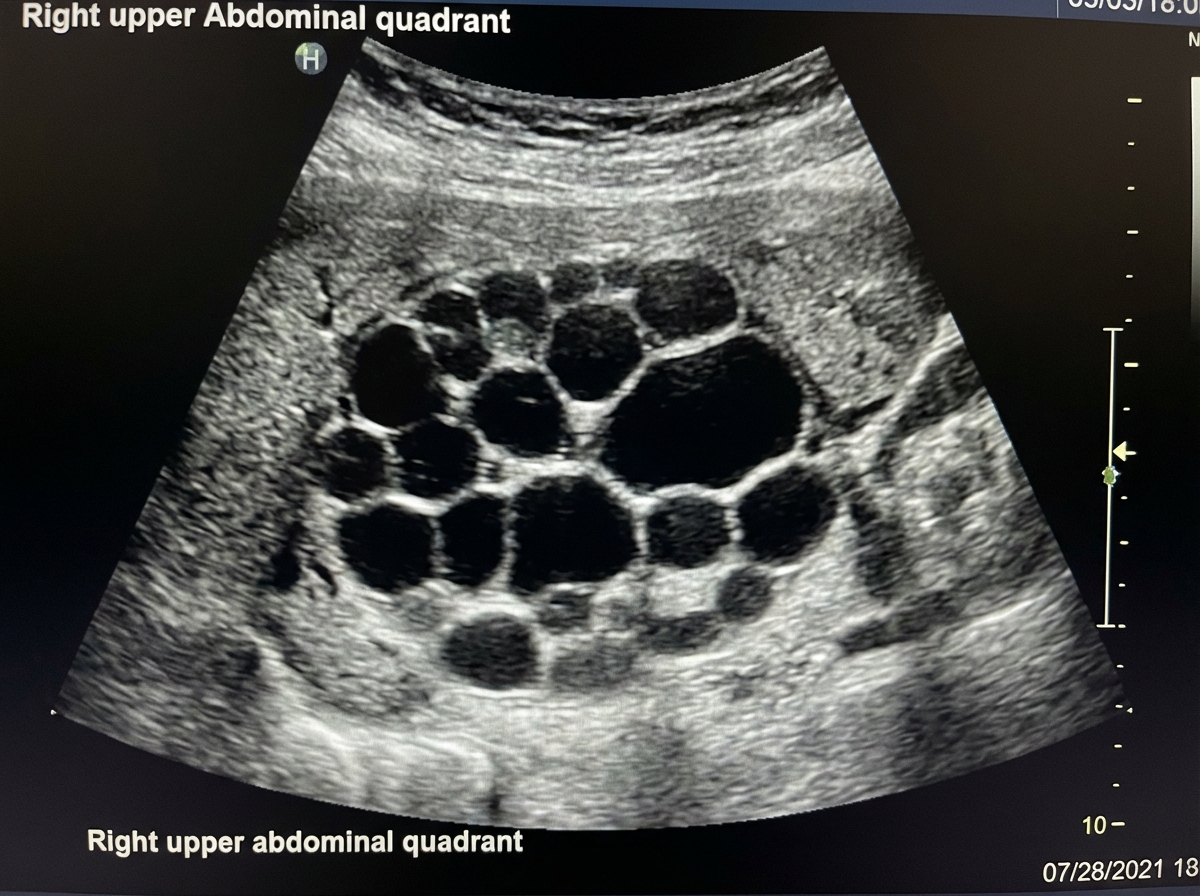
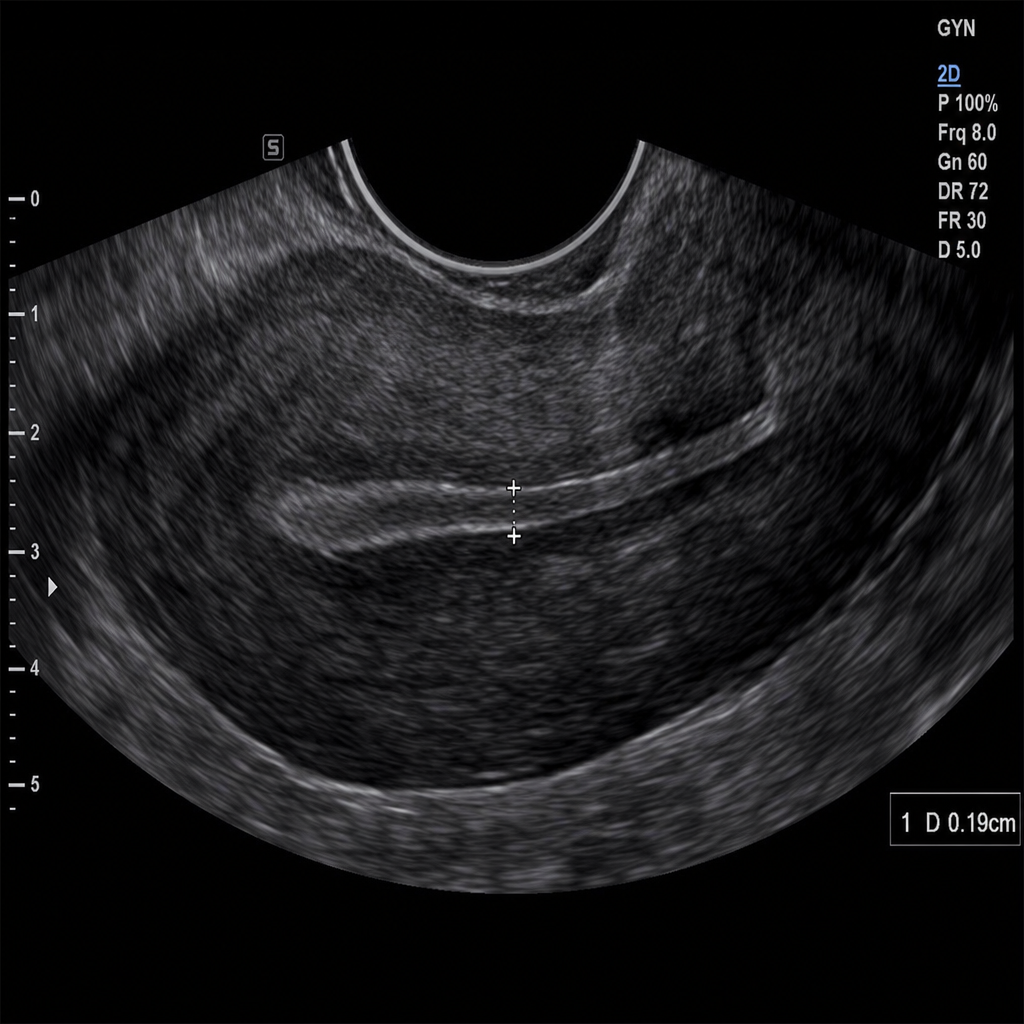
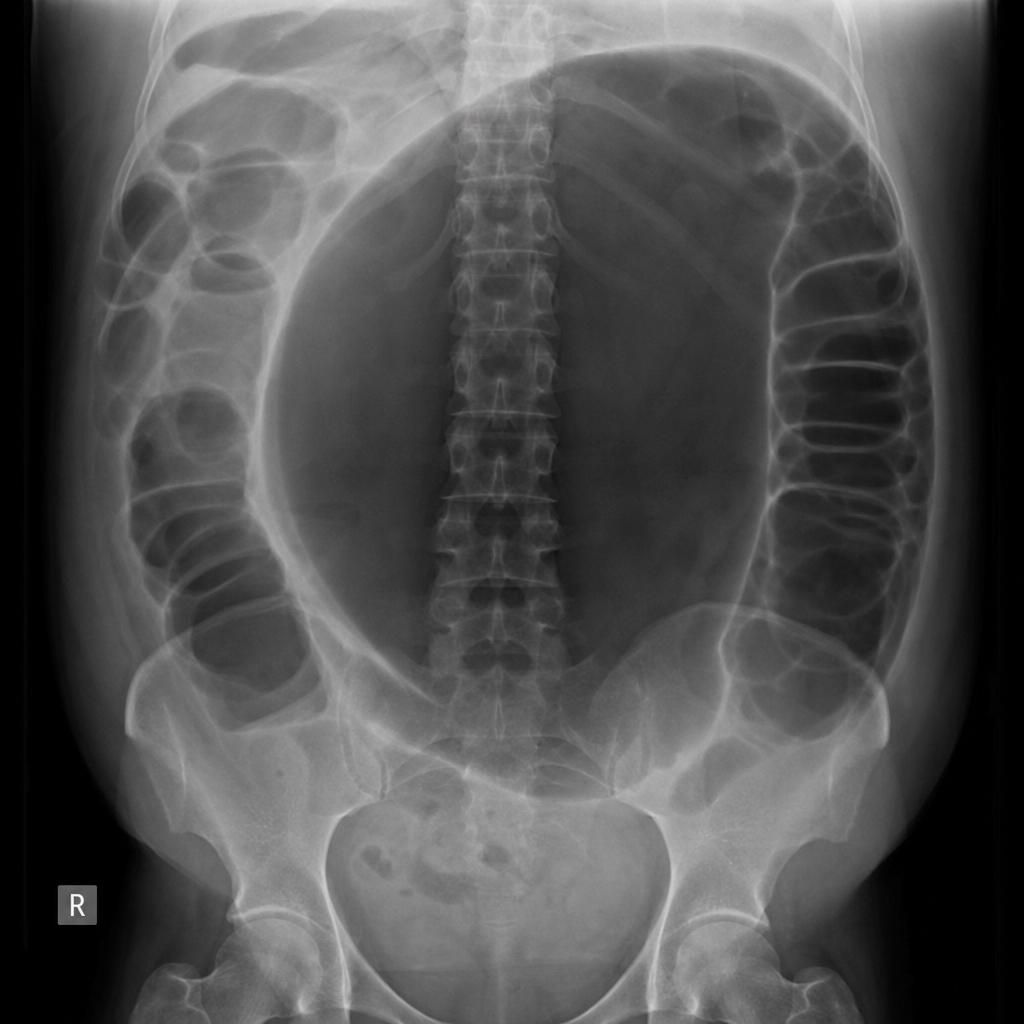
A plain abdominal X-ray in a patient with a sigmoid volvulus will show a distended bowel loop with its apex in which location?
What is the preferred imaging modality for confirming choledocholithiasis?
Which imaging study has the highest pickup for a gastrojejunocolic fistula?
What pattern is described as "paint brush-like" in intravenous urography?
What is the term for a condition where blood bypasses the liver through an abnormal connection between the portal vein and the hepatic vein?
Which radiologic feature is suggestive of achalasia cardia?
You are shown an AP view from a percutaneous trans-hepatic cholangiogram of a jaundiced patient. What is the MOST likely diagnosis?

USG abdomen of a 30-year-old SLE patient who cannot feel her baby moving for the past 7 days. What is the earliest appearance of Spalding sign?
All of the following statements regarding ileocaecal TB are TRUE, EXCEPT:
Sigmoid esophagus on barium swallow is seen in which of the following conditions?
Explanation: ### Explanation **1. Why the Correct Answer is Right:** Sigmoid volvulus occurs when the sigmoid colon twists around its mesenteric axis. Because the sigmoid colon is a mobile, redundant loop attached to a fixed base in the left iliac fossa, it distends massively when obstructed. As it expands, it follows the path of least resistance, moving **upward and toward the opposite side** of its origin. Consequently, the apex of the distended loop typically points toward the **Right Hypochondrium** (the right upper quadrant). This creates the characteristic **"Coffee Bean Sign"** or "Omega Sign" on a plain X-ray, where the two limbs of the loop are seen meeting at the site of the twist. **2. Why the Incorrect Options are Wrong:** * **Left Iliac Fossa (B):** This is the anatomical origin of the sigmoid colon. In a volvulus, the loop distends *away* from this site. * **Right Iliac Fossa (A):** This is the typical location for the apex of a **Cecal Volvulus**. In cecal volvulus, the cecum twists and displaces toward the left upper quadrant or epigastrium, whereas sigmoid volvulus moves toward the right upper quadrant. * **Left Hypochondrium (C):** The sigmoid loop rarely points here as it is already situated on the left; the massive distension forces it across the midline toward the right. **3. NEET-PG High-Yield Pearls:** * **Classic Signs:** "Coffee Bean Sign," "Omega Sign," or "Bent Inner Tube Sign." * **Barium Enema Finding:** "Bird’s Beak" or "Ace of Spades" appearance at the site of the twist. * **Demographics:** More common in elderly, institutionalized patients, or those with chronic constipation (megacolon). * **Management:** Initial treatment is often **sigmoidoscopic detorsion** (if no gangrene), followed by elective surgery to prevent recurrence.
Explanation: **Explanation:** **Choledocholithiasis** refers to the presence of gallstones within the Common Bile Duct (CBD). Selecting the "preferred" modality depends on whether the goal is initial screening, non-invasive confirmation, or therapeutic intervention. **1. Why MRCP is the Correct Answer:** MRCP is currently considered the **gold standard non-invasive investigation** for confirming choledocholithiasis. It utilizes T2-weighted MRI sequences where static fluid (bile) appears bright, and stones appear as signal voids. It boasts a sensitivity and specificity of over 90–95%. It is preferred for confirmation because it provides high-resolution anatomical detail without the risks of radiation or invasive complications like pancreatitis. **2. Analysis of Incorrect Options:** * **Ultrasound (USG):** This is the **initial investigation of choice** for biliary disease. While excellent for detecting gallstones (cholelithiasis), it has low sensitivity (~50%) for CBD stones due to overlying bowel gas. * **ERCP:** This was historically the gold standard. However, because it is invasive and carries a 5–10% risk of complications (post-ERCP pancreatitis, bleeding, perforation), it is now reserved as a **therapeutic modality** (for stone extraction) rather than a primary diagnostic tool. * **HIDA Scan:** This is the most sensitive test for **Acute Cholecystitis** (demonstrating gallbladder non-visualization). It is not the primary modality for visualizing CBD stones. **High-Yield Clinical Pearls for NEET-PG:** * **Initial/Screening Test:** USG Abdomen. * **Best Non-invasive/Confirmatory Test:** MRCP. * **Gold Standard (Invasive/Therapeutic):** ERCP. * **IOC for Acute Cholecystitis:** USG (Initial); HIDA (Most Sensitive). * **IOC for CBD Dilation (post-cholecystectomy):** MRCP.
Explanation: ### Explanation A **gastrojejunocolic fistula** is a late and serious complication of peptic ulcer surgery (typically following a Billroth II reconstruction), where a marginal ulcer erodes into the transverse colon. #### Why Barium Enema is the Correct Answer The **Barium Enema** is the gold standard and most sensitive imaging modality for diagnosing this condition. This is due to the **pressure gradient and valvular anatomy**. When contrast is introduced via the rectum, the high hydrostatic pressure easily forces the barium through the fistula from the colon into the stomach or jejunum. Conversely, antegrade studies (swallow/meal) often fail because the mucosal folds of the jejunum and the direction of peristalsis act as a "valve," preventing the contrast from entering the colon through the small fistulous tract. #### Analysis of Incorrect Options * **A & B. Barium Swallow/Meal:** These antegrade studies have a very low sensitivity (often <30%). The contrast tends to follow the path of least resistance down the efferent limb of the jejunum rather than entering the narrow fistulous communication. * **D. Barium Follow-through:** Similar to the meal, by the time the contrast reaches the site of the fistula, it is often too dilute or obscured by overlying small bowel loops to demonstrate a clear communication with the colon. #### NEET-PG High-Yield Pearls * **Clinical Presentation:** Classically presents with the triad of **diarrhea, weight loss, and fecaloid vomiting** (due to colonic contents entering the stomach). * **Pathogenesis:** Usually results from an inadequate gastrectomy or incomplete vagotomy leading to a stomal/marginal ulcer. * **Imaging Sign:** On Barium Enema, the rapid appearance of contrast in the stomach and small bowel immediately after filling the transverse colon is diagnostic. * **Alternative Modality:** While CT with oral and rectal contrast is used in modern practice, the Barium Enema remains the classic "textbook" answer for the highest pickup rate.
Explanation: **Explanation:** The **"paint brush" appearance** is a classic radiological sign seen on Intravenous Urography (IVU) in patients with **Medullary Sponge Kidney (MSK)**. **1. Why Medullary Sponge Kidney is correct:** MSK is characterized by congenital ectasia (dilatation) of the papillary collecting ducts. During an IVU, the contrast medium fills these dilated, cystic collecting ducts in the renal pyramids. This creates linear streaks of contrast radiating from the papilla into the medulla, resembling the bristles of a paintbrush or a "bouquet of flowers." **2. Why the other options are incorrect:** * **Medullary Cystic Kidney Disease (MCKD) & Nephronophthisis:** These are part of the same disease spectrum involving tubulointerstitial nephritis and cyst formation at the corticomedullary junction. Unlike MSK, these conditions typically result in **small, shrunken kidneys** with poor contrast excretion, rather than the characteristic ductal dilatation seen in MSK. * **Polycystic Kidney Disease (ADPKD):** This presents with massively enlarged kidneys and multiple large cysts throughout the cortex and medulla. On IVU, it shows the **"Spider Leg" appearance** due to the stretching and compression of the renal calyces by large cysts. **3. High-Yield Clinical Pearls for NEET-PG:** * **MSK Association:** Often associated with **Nephrocalcinosis** (calcium deposits in the pyramids) and recurrent calcium oxalate stones. * **Benign Course:** MSK is usually a benign, sporadic condition, unlike the progressive renal failure seen in MCKD or ADPKD. * **Radiological Mimic:** On plain X-ray, the clusters of stones in the dilated ducts may resemble "bunches of grapes."
Explanation: ### Explanation **Correct Answer: B. Abernethy Malformation** **Abernethy Malformation** is a rare congenital vascular anomaly where the portal venous blood bypasses the liver and drains directly into the systemic venous system (most commonly the inferior vena cava or hepatic veins). * **Type I:** There is a complete absence of the intrahepatic portal vein; the entire portal flow is diverted into the systemic circulation. This is more common in females and often associated with other congenital anomalies. * **Type II:** The intrahepatic portal vein is present, but a portion of the blood is shunted into the systemic circulation via a side-to-side communication. **Why other options are incorrect:** * **Sturge-Weber Syndrome:** A neurocutaneous disorder characterized by a facial port-wine stain (capillary malformation), leptomeningeal angiomas, and glaucoma. It does not involve porto-systemic shunts. * **Courvoisier Syndrome:** States that in the presence of a palpably enlarged gallbladder which is nontender and accompanied by mild painless jaundice, the cause is unlikely to be gallstones (usually indicates malignancy like periampullary carcinoma). * **Stockholm Syndrome:** A psychological phenomenon where hostages develop an emotional bond with their captors; it has no relevance to radiology or vascular anatomy. **High-Yield Clinical Pearls for NEET-PG:** * **Imaging Gold Standard:** CT angiography or MR angiography is used to visualize the shunt. * **Clinical Presentation:** Patients may present with hepatic encephalopathy (due to ammonia bypassing the liver), hepatopulmonary syndrome, or liver tumors (like Focal Nodular Hyperplasia) due to altered hepatic perfusion. * **Key Association:** Often associated with **polysplenia** and congenital heart disease.
Explanation: **Explanation:** Achalasia cardia is a primary esophageal motility disorder characterized by the failure of the Lower Esophageal Sphincter (LES) to relax and the absence of esophageal peristalsis. This leads to progressive proximal dilatation and stasis. **Why "All of the Above" is correct:** * **Absence of gastric air bubble:** Due to the tonically contracted LES, air cannot pass from the esophagus into the stomach. On a chest or abdominal X-ray, the normal gastric fundic bubble is often missing. * **Air-fluid level in the mediastinum:** As the esophagus dilates, it acts as a reservoir for undigested food and saliva. On an upright chest X-ray, this appears as a retrocardiac air-fluid level within the dilated esophagus (widened mediastinum). * **Sigmoid esophagus:** In long-standing, end-stage achalasia, the esophagus becomes massively dilated (mega-esophagus) and tortuous, assuming a "sigmoid" or "S-shaped" configuration. **High-Yield Clinical Pearls for NEET-PG:** * **Barium Swallow (Investigation of Choice):** Classically shows the **"Bird’s Beak"** or "Rat-tail" appearance (smooth tapering at the GE junction). * **Manometry (Gold Standard):** Confirms diagnosis by showing incomplete LES relaxation (residual pressure >10 mmHg) and aperistalsis. * **Chest X-ray findings:** Look for a widened mediastinum, double right heart border (due to the dilated esophagus), and absence of the gastric bubble. * **Complication:** Increased risk of Squamous Cell Carcinoma of the esophagus due to chronic stasis and irritation. * **Heller’s Myotomy:** The definitive surgical treatment, usually combined with a partial fundoplication.
Explanation: ***Cholangiocarcinoma*** - **Percutaneous transhepatic cholangiogram (PTC)** typically shows **irregular stricture** with **rat-tail appearance** and **proximal biliary dilatation**, especially in **Klatskin tumors** at the hepatic duct confluence. - The **abrupt cutoff** and **asymmetric stricture** pattern with upstream ductal dilatation is characteristic of **cholangiocarcinoma** on cholangiography. *Pancreatic carcinoma* - PTC would show **smooth stricture** of the **lower common bile duct (CBD)** with **double duct sign** (pancreatic and bile duct dilatation). - The stricture location is typically at the **intrapancreatic portion** of the CBD, not at the hepatic duct confluence. *Sclerosing cholangitis* - Cholangiogram demonstrates **diffuse multifocal beading** and **alternating strictures and dilations** throughout the biliary tree. - The **string-of-beads appearance** affects both **intrahepatic and extrahepatic ducts** diffusely, not a focal stricture. *Cholelithiasis* - PTC would reveal **filling defects** (stones) within the bile ducts appearing as **radiolucent areas** surrounded by contrast. - **Mobile filling defects** that change position with patient positioning, unlike fixed strictures seen in malignancies.
Explanation: ### Explanation **Correct Answer: D. 7 days** **1. Understanding the Medical Concept** The **Spalding sign** is a classic radiological indicator of **intrauterine fetal death (IUFD)**. It refers to the overlapping of the fetal skull bones (calvarium) caused by the liquefaction of the brain matter and the subsequent loss of intracranial pressure following fetal demise. While fetal death occurs immediately, the structural collapse of the skull is not instantaneous. It requires a significant decrease in intracranial volume and the softening of sutural ligaments. In clinical practice and radiology textbooks, the Spalding sign typically becomes evident on ultrasound or X-ray **no earlier than 4 to 7 days** after fetal death. For the purpose of NEET-PG, **7 days** is the standard recognized duration for this sign to manifest reliably. **2. Analysis of Incorrect Options** * **A & B (3-4 days):** These are too early. While some minor molding may begin, the definitive overlapping required to diagnose Spalding sign is rarely visible this soon. * **C (6 days):** While closer to the timeline, 7 days is the classically taught "earliest" threshold in standardized medical examinations for a definitive presentation. **3. Clinical Pearls & High-Yield Facts for NEET-PG** * **Robert’s Sign:** The appearance of gas in the fetal heart and great vessels. This is the **earliest** radiological sign of IUFD, often seen within 12–24 hours. * **Deuel’s Halo Sign:** Scalp edema leading to an "elevation" of the subcutaneous fat layer around the fetal skull, resembling a halo. * **Curvature of Spine:** Extreme angulation or collapse of the fetal spine due to loss of muscle tone. * **Clinical Context:** In this question, the patient has **SLE (Systemic Lupus Erythematosus)**, which is a high-risk factor for IUFD due to complications like Congenital Heart Block or Antiphospholipid Syndrome (APS). * **Gold Standard:** Today, the definitive diagnosis of IUFD is the **absence of fetal cardiac activity** on real-time ultrasonography, rather than relying on secondary skeletal signs.
Explanation: **Explanation:** The **Apple core sign** (or napkin-ring sign) is the classic radiological hallmark of **Colorectal Carcinoma**, particularly of the descending and sigmoid colon. It represents a short-segment, concentric, irregular luminal narrowing with overhanging edges (shouldering). While tuberculosis can cause strictures, the "Apple core" appearance is highly specific to malignancy. **Analysis of Options:** * **A. Narrowing of terminal ileum:** In ileocaecal TB, the terminal ileum often shows ulceration and narrowing. This is known as the **Kantor’s String Sign** (also seen in Crohn’s disease), where the terminal ileum appears as a thin, string-like shadow. * **B. Obliteration of ileocaecal angle:** Chronic inflammation and fibrosis in TB lead to the contraction of the caecum and terminal ileum. This results in the loss of the normal right-angled junction between the two, known as the **Fleischner Sign** (inverted-T appearance). * **C. Caecum ascends up:** Due to extensive fibrosis and longitudinal shortening of the ascending colon, the caecum becomes shrunken, conical, and pulled upward into the subhepatic position. This is referred to as a **High-placed caecum** or **Purse-string caecum**. **High-Yield Clinical Pearls for NEET-PG:** * **Stierlin Sign:** Rapid emptying of the inflamed ileocaecal segment (barium does not stay in the diseased area). * **Goose-neck deformity:** Fixed patency of the ileocaecal valve with a narrowed terminal ileum. * **Most common site:** The ileocaecal region is the most common site for intestinal TB due to the abundance of lymphoid tissue (Peyer's patches) and physiological stasis. * **Differential Diagnosis:** Crohn’s disease is the closest mimic; however, TB typically involves the ileocaecal valve, whereas Crohn’s often spares it.
Explanation: **Explanation:** **1. Why Achalasia Cardia is Correct:** Achalasia cardia is a primary esophageal motility disorder characterized by the failure of the Lower Esophageal Sphincter (LES) to relax and the absence of peristalsis. In long-standing, untreated cases, the chronic obstruction at the LES leads to massive proximal dilatation and elongation of the esophagus. The esophagus becomes tortuous and redundant, taking on an "S-shaped" appearance on a Barium swallow, known as the **Sigmoid Esophagus**. This represents the end-stage of the disease. **2. Why Other Options are Incorrect:** * **Scleroderma:** Characterized by "Patulous" or wide-open LES due to fibrosis, leading to severe reflux. The esophagus is dilated but typically straight, not sigmoid. * **Diffuse Esophageal Spasm (DES):** Presents with uncoordinated tertiary contractions. On Barium swallow, this appears as a **"Corkscrew esophagus"** or "Rosary bead esophagus." * **Carcinoma Esophagus:** Typically shows an irregular, eccentric luminal narrowing with mucosal destruction, often described as a **"Rat-tail appearance"** or "Apple-core lesion" (if circumferential). **3. High-Yield Clinical Pearls for NEET-PG:** * **Classic Sign:** The early/standard Barium swallow finding in Achalasia is the **"Bird’s Beak"** or "Rat-tail" appearance (smooth tapering). * **Gold Standard Investigation:** Esophageal **Manometry** (shows incomplete LES relaxation and aperistalsis). * **Heller’s Myotomy:** The surgical treatment of choice. * **Chagas Disease:** A common secondary cause of Achalasia-like symptoms globally. * **Important Distinction:** In Achalasia, the narrowing is smooth; in Carcinoma, the narrowing is irregular/shouldered.
Imaging of Liver
Practice Questions
Biliary Tract Imaging
Practice Questions
Pancreatic Imaging
Practice Questions
Spleen and Lymphatic System
Practice Questions
Gastrointestinal Tract Imaging
Practice Questions
Renal and Urinary Tract Imaging
Practice Questions
Adrenal Imaging
Practice Questions
Female Pelvic Imaging
Practice Questions
Male Pelvic Imaging
Practice Questions
Abdominal Trauma Imaging
Practice Questions
Acute Abdomen Imaging
Practice Questions
Imaging of Peritoneal Cavity and Retroperitoneum
Practice Questions
Get full access to all questions, explanations, and performance tracking.
Start For Free