The 'pencil tip' deformity is typically observed in which of the following conditions?
What is the most likely diagnosis?

Which of the following is NOT a feature of chronic pancreatitis associated with pancreatic cancer?
Multiphasic hepatic imaging includes all except?
What is a potential limitation of Contrast-Enhanced Computed Tomography (CECT) in the evaluation of acute pancreatitis?
A middle-aged female presents with chronic right-sided abdominal pain and intermittent fever. Clinical examination reveals mild hepatomegaly. A contrast-enhanced CT abdomen was performed. Based on the imaging characteristics of the focal lesion, what is the most likely diagnosis?

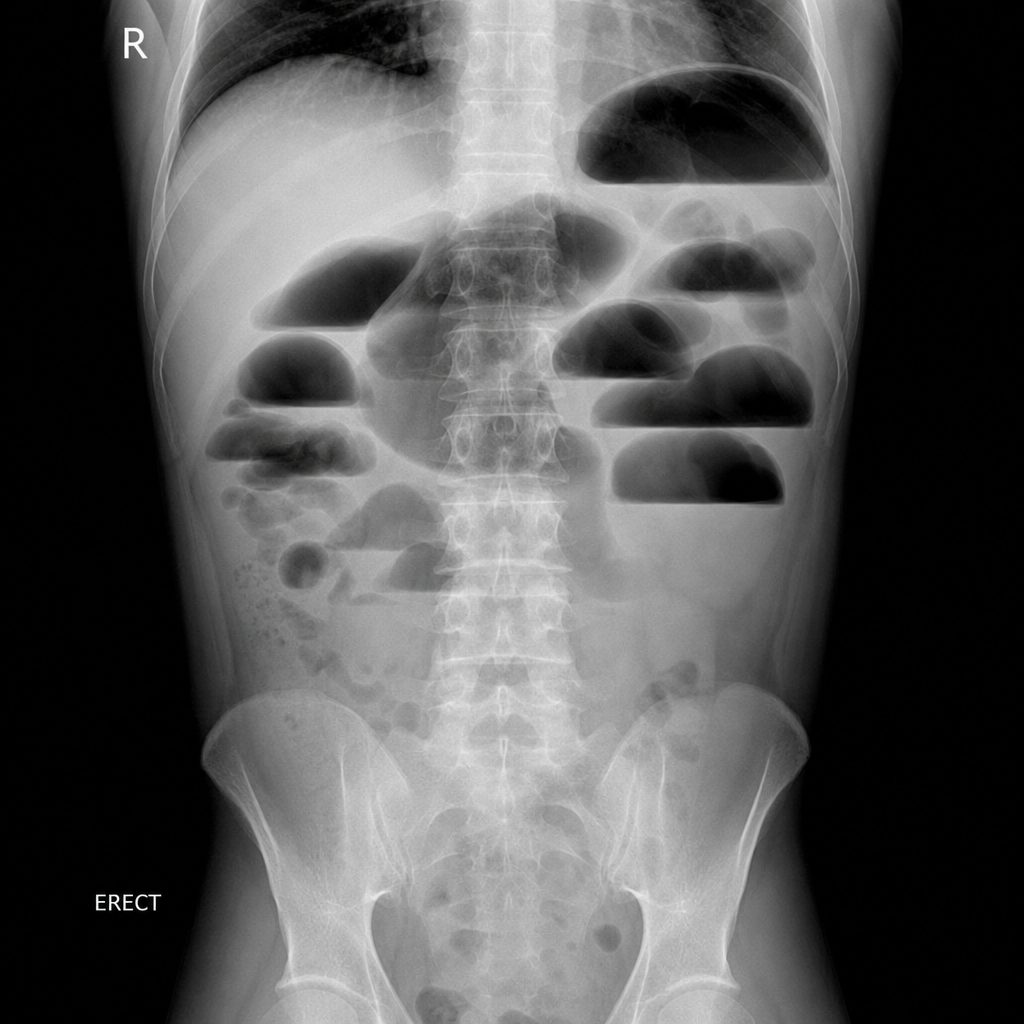
The X-ray demonstrates which of the following conditions?

What is the best diagnostic method for pancreatic cancer?
Carman's meniscus sign is seen in?
A 72-year-old man is found on examination to have a prostatic nodule. What is the best investigation to evaluate this finding?
Explanation: **Explanation:** **Achalasia Cardia** is a primary esophageal motility disorder characterized by the failure of the Lower Esophageal Sphincter (LES) to relax and the absence of peristalsis in the distal esophagus. On a **Barium Swallow**, this results in a classic appearance where the distal esophagus shows smooth, symmetrical, conical narrowing at the level of the gastroesophageal junction. This appearance is famously described as the **'Pencil tip'**, **'Bird’s beak'**, or **'Rat-tail'** deformity. The proximal esophagus often shows compensatory dilatation (megaesophagus). **Analysis of Options:** * **Carcinoma of the Esophagus:** Typically presents with an **'Irregular, eccentric narrowing'** or a **'Shouldering effect'** (Apple-core appearance) due to the malignant mass. The narrowing is usually abrupt and irregular, unlike the smooth tapering seen in Achalasia. * **Barrett's Esophagus:** This is a premalignant condition (metaplasia). Radiologically, it may show signs of gastroesophageal reflux, such as ulcerations or a mid-esophageal stricture, but it does not produce the characteristic pencil-tip tapering. **High-Yield Clinical Pearls for NEET-PG:** * **Gold Standard Investigation:** Esophageal Manometry (shows incomplete LES relaxation and aperistalsis). * **Heller’s Myotomy:** The surgical treatment of choice. * **Chagas Disease:** A secondary cause of Achalasia (caused by *Trypanosoma cruzi*). * **Chest X-ray:** May show an absent gastric air bubble and a widened mediastinum with an air-fluid level.
Explanation: ***Perforation peritonitis*** - **Free air under the diaphragm** (pneumoperitoneum) on erect chest X-ray is the pathognomonic sign of gastrointestinal perforation. - Results from rupture of a hollow viscus allowing air to escape into the peritoneal cavity, causing **acute peritonitis**. *Intestinal obstruction* - Characterized by **air-fluid levels** in dilated bowel loops on X-ray, not free air under diaphragm. - Presents with **colicky abdominal pain** and vomiting, but lacks signs of perforation like pneumoperitoneum. *Paralytic ileus* - Shows **diffuse bowel dilation** with gas throughout small and large bowel without air-fluid levels. - Absence of **peristalsis** leads to gaseous distension, but no free intraperitoneal air is present. *Chilaiditi's syndrome* - **Colonic interposition** between liver and diaphragm can mimic free air but shows **bowel wall markings**. - Usually **asymptomatic** and represents a normal anatomical variant, not an acute pathological condition.
Explanation: This question tests the ability to differentiate between **Chronic Pancreatitis (CP)** and **Pancreatic Adenocarcinoma**, a common diagnostic challenge in radiology. ### **Explanation of the Correct Answer** **Option C (Duct/gland width ratio <0.5)** is the correct answer because a ratio **>0.5** is actually suggestive of chronic pancreatitis. * **The Concept:** In chronic pancreatitis, the pancreatic duct dilates while the surrounding parenchyma undergoes atrophy (thinning). This results in a high duct-to-gland ratio. * In contrast, in **Pancreatic Cancer**, the gland often appears enlarged or "full" due to the presence of a mass, leading to a **lower ratio (<0.5)**. Therefore, a ratio <0.5 is a feature of cancer, not the underlying chronic pancreatitis itself. ### **Analysis of Incorrect Options** * **A. Calcification:** This is the hallmark of chronic pancreatitis. While cancer can occasionally develop in a calcified gland, the presence of diffuse parenchymal calcification strongly points toward a benign chronic inflammatory process. * **B. Duct penetrating sign:** This is a classic radiologic sign of **Chronic Pancreatitis**. It refers to the visualization of a non-obstructed main pancreatic duct passing through a mass-like inflammatory head. In pancreatic cancer, the duct is typically completely obliterated or "cutoff" by the tumor. * **D. Dilation of bile and pancreatic duct:** Known as the **"Double Duct Sign,"** this occurs when a lesion in the head of the pancreas obstructs both the Common Bile Duct (CBD) and the Main Pancreatic Duct. While highly suspicious for cancer, it is also a recognized feature of chronic pancreatitis due to inflammatory strictures. ### **High-Yield Clinical Pearls for NEET-PG** * **Double Duct Sign:** Most commonly associated with Pancreatic Head Carcinoma, but can be seen in Ampullary Carcinoma and Chronic Pancreatitis. * **Chain of Lakes Appearance:** Refers to the irregular, beaded dilatation of the pancreatic duct in chronic pancreatitis. * **Trousseau Sign:** Migratory thrombophlebitis associated with pancreatic malignancy. * **Courvoisier’s Law:** A palpable, non-tender gallbladder in a jaundiced patient suggests malignant obstruction (e.g., pancreatic cancer) rather than gallstones.
Explanation: **Explanation:** Multiphasic CT/MRI of the liver is the gold standard for evaluating hypervascular lesions like Hepatocellular Carcinoma (HCC). It relies on the dual blood supply of the liver: the **portal vein (75%)** and the **hepatic artery (25%)**. **Why "Capillary Phase" is the correct answer:** In hepatic imaging, there is no distinct "capillary phase" used for diagnostic protocols. While capillary exchange occurs physiologically, it is not a defined temporal window in multiphasic imaging. Instead, the transition between arterial and venous phases is captured through specific parenchymal enhancements. **Analysis of Incorrect Options:** * **Early Arterial Phase (15–25 sec):** Used primarily for CT angiography. It visualizes arterial anatomy and identifies active bleeding or pseudoaneurysms. * **Hepatic Parenchymal Phase (Late Arterial Phase, 35–45 sec):** This is the **most critical phase** for detecting hypervascular tumors (e.g., HCC, FNH, Adenoma). These lesions derive their blood supply from the hepatic artery and "light up" (enhance) against the yet-to-enhance liver parenchyma. * **Portal Venous Inflow Phase (60–80 sec):** The liver parenchyma reaches maximal enhancement as blood returns via the portal vein. This phase is best for detecting hypovascular metastases (e.g., from colon cancer) which appear dark against the bright liver. **High-Yield Clinical Pearls for NEET-PG:** * **HCC Classic Pattern:** Arterial phase enhancement (wash-in) followed by portal venous/delayed phase "wash-out" and a pseudocapsule. * **Hemangioma Pattern:** Peripheral globular enhancement with centripetal fill-in (progressive filling toward the center). * **Delayed Phase (3–5 mins):** Useful for identifying "wash-out" in HCC and "pooling" in hemangiomas.
Explanation: **Explanation:** **Why Option C is Correct:** While CECT is the gold standard for assessing the complications and severity of acute pancreatitis, it has a significant limitation in identifying the etiology, specifically **gallstones**. Most gallstones are **isodense** to bile on CT, making them difficult to visualize within the gallbladder or common bile duct. Therefore, **Transabdominal Ultrasonography (USG)** remains the initial investigation of choice for diagnosing gallstone-induced pancreatitis, as it has a much higher sensitivity for detecting cholelithiasis. **Analysis of Incorrect Options:** * **Option A & B:** CECT is excellent for assessing both severity and prognosis. Using the **Modified CT Severity Index (MCTSI)** or Balthazar score, radiologists can quantify pancreatic necrosis and inflammation, which directly correlates with patient outcomes and organ failure risk. * **Option D:** CECT is highly sensitive in detecting and characterizing **peripancreatic fluid collections (APFC)**, as well as distinguishing them from walled-off necrosis (WON) or pseudocysts in later stages. **High-Yield Clinical Pearls for NEET-PG:** * **Timing:** CECT should ideally be performed **72–96 hours** after the onset of symptoms. Scanning too early may underestimate the extent of pancreatic necrosis. * **Gold Standard:** CECT is the investigation of choice for diagnosing **pancreatic necrosis**. * **MRCP:** This is the most sensitive non-invasive modality for detecting **choledocholithiasis** (stones in the CBD) if USG is inconclusive. * **Sentinel Loop Sign:** A high-yield X-ray finding in acute pancreatitis representing localized ileus of a jejunal loop.
Explanation: ***Hydatid cyst*** - CT shows characteristic **daughter cysts** within the main cyst and **water lily sign** (floating membrane), pathognomonic of **Echinococcus granulosus** infection. - Often presents with **peripheral calcification** in chronic cases and occurs in endemic regions with sheep-rearing activities. *Liver abscess* - CT typically shows **rim enhancement** with central hypodense collection and **gas bubbles** in bacterial abscesses. - Lacks the characteristic **daughter cysts** and **water lily sign** seen in hydatid disease. *Pseudocyst of pancreas* - Usually located in the **pancreatic bed** or **lesser sac**, not within the liver parenchyma. - Associated with **acute pancreatitis** history and lacks the **multilayered cystic appearance** of hydatid cysts. *Hepatocellular carcinoma* - Shows **arterial enhancement** with **washout** in portal venous phase on contrast CT. - Appears as a **solid mass** rather than a cystic lesion with **septations** and **daughter cysts**.
Explanation: ***Small bowel obstruction*** - Classic X-ray findings include **dilated central loops** with **valvulae conniventes** (complete mucosal folds crossing the bowel) and a **step-ladder pattern**. - Typically shows **absent or minimal large bowel gas** distal to the obstruction point. *Sigmoid volvulus* - Characterized by the pathognomonic **coffee-bean sign** - a massively dilated sigmoid loop resembling a coffee bean shape. - Shows **loss of haustral markings** in the twisted sigmoid segment with a characteristic bent appearance. *Large bowel obstruction* - Demonstrates **dilated peripheral loops** with **haustral markings** (incomplete mucosal folds that don't cross the entire bowel width). - Shows **distended colon** with haustra creating a scalloped appearance, typically sparing the small bowel. *Perforation* - Key finding is **free air under the diaphragm** (pneumoperitoneum) on upright chest X-ray or **Rigler's sign** on supine films. - May show **air outlining both sides** of the bowel wall or air in abnormal locations like the liver edge.
Explanation: **Explanation:** **Contrast-Enhanced Computed Tomography (CECT)** is the gold standard and the best initial diagnostic method for pancreatic cancer. The preferred protocol is a **multidetector CT (MDCT)** using a dedicated pancreatic protocol (dual-phase: arterial and venous). Pancreatic adenocarcinoma is typically **hypovascular**, appearing as a hypoattenuating (darker) mass compared to the brightly enhancing normal pancreatic parenchyma during the late arterial phase. CT is superior because it not only detects the primary tumor but also accurately assesses vascular invasion (resectability) and distant metastasis. **Why other options are incorrect:** * **Ultrasound (A):** Often the first-line screening tool for jaundice, but it is limited by overlying bowel gas and has low sensitivity for small tumors (<2 cm). * **ERCP (B):** Primarily a therapeutic tool (for stenting) rather than diagnostic. While it can show the "Double Duct Sign," it is invasive and cannot assess tumor staging or extra-pancreatic spread. * **Angiography (D):** Historically used to assess vascular involvement, it has been entirely replaced by non-invasive CT angiography. **High-Yield Clinical Pearls for NEET-PG:** * **Double Duct Sign:** Simultaneous dilatation of the Common Bile Duct (CBD) and the Pancreatic Duct, classically seen in tumors of the head of the pancreas. * **Tumor Marker:** **CA 19-9** is the most specific marker for monitoring treatment and recurrence (not for primary screening). * **Courvoisier’s Law:** In a patient with painless obstructive jaundice, a palpable gallbladder is likely due to malignancy (e.g., pancreatic head) rather than gallstones.
Explanation: **Explanation:** **Carman’s Meniscus Sign** is a classic radiological sign observed during a barium meal study, specifically indicating a **large, malignant gastric ulcer**, most commonly a gastric adenocarcinoma. **Why it occurs:** In a malignant ulcer, the crater is surrounded by a heaped-up, irregular, and firm tumor margin (the "rim"). When manual compression is applied during a barium study, the barium is trapped within the large, lenticular-shaped ulcer crater. The displaced barium takes on a **crescent or meniscus shape**, with the concavity facing the gastric lumen. This occurs because the malignant mass is so rigid that it does not flatten under pressure, unlike the soft edges of a benign ulcer. **Analysis of Options:** * **Option A (Benign Gastric Ulcer):** Benign ulcers typically show the **Hampton’s Line** (a thin lucent line at the neck) or **Ulcer Pointing** (radiating mucosal folds reaching the very edge of the crater). They project *outside* the predicted lumen of the stomach, whereas malignant ulcers (Carman's) are located *within* the original contour of the stomach. * **Option D (Intestinal Obstruction):** This is characterized by dilated bowel loops and multiple air-fluid levels on an erect X-ray, unrelated to the meniscus sign. **High-Yield Clinical Pearls for NEET-PG:** * **Kirklin Complex:** This refers to the translucent zone (representing the elevated neoplastic rim) surrounding the meniscus in Carman’s sign. * **Location:** Carman’s sign is most frequently seen in ulcers located on the **lesser curvature** of the stomach. * **Benign vs. Malignant:** Remember, "Benign projects Beyond" (the gastric wall), while "Malignant is Medial" (within the lumen).
Explanation: **Explanation:** The primary goal in evaluating a palpable prostatic nodule in an elderly patient is to differentiate between benign conditions and prostate cancer. **Transrectal ultrasound (TRUS)** is the investigation of choice because it provides high-resolution imaging of the prostate's zonal anatomy, particularly the peripheral zone where most cancers originate. More importantly, TRUS is the standard modality used to **guide needle biopsies**, which are essential for a definitive histopathological diagnosis. **Analysis of Options:** * **CT scan pelvis (A):** CT has poor soft-tissue contrast for intra-prostatic architecture. It cannot reliably distinguish between benign prostatic hyperplasia (BPH) and malignancy; its role is primarily for staging (detecting lymphadenopathy) once cancer is confirmed. * **Intravenous pyelogram (B):** IVP is an outdated modality for this indication. It visualizes the collecting system and bladder but provides no information regarding the internal structure of the prostate. * **Prostatic massage (C):** This is used to obtain "expressed prostatic secretions" (EPS) for diagnosing chronic prostatitis. It is contraindicated if malignancy is suspected as it provides no diagnostic value for cancer and could theoretically promote seeding. **Clinical Pearls for NEET-PG:** * **Multiparametric MRI (mpMRI):** While TRUS is the standard for biopsy guidance, mpMRI is currently the "Gold Standard" for **localizing** suspicious lesions and staging (T-staging) before biopsy. * **PSA + DRE:** The combination of Digital Rectal Examination (DRE) and Prostate-Specific Antigen (PSA) levels remains the initial screening protocol. * **TRUS Findings:** Malignant nodules typically appear **hypoechoic** and are located in the **peripheral zone**.
Imaging of Liver
Practice Questions
Biliary Tract Imaging
Practice Questions
Pancreatic Imaging
Practice Questions
Spleen and Lymphatic System
Practice Questions
Gastrointestinal Tract Imaging
Practice Questions
Renal and Urinary Tract Imaging
Practice Questions
Adrenal Imaging
Practice Questions
Female Pelvic Imaging
Practice Questions
Male Pelvic Imaging
Practice Questions
Abdominal Trauma Imaging
Practice Questions
Acute Abdomen Imaging
Practice Questions
Imaging of Peritoneal Cavity and Retroperitoneum
Practice Questions
Get full access to all questions, explanations, and performance tracking.
Start For Free